A bike helmet is too big if it moves on your head when you shake it, if you can fit a finger between the shell and your forehead or temples, or if the fit dial is already at its tightest and the helmet still feels loose. A correct size moves with your head, not around it — any independent movement is the sign to size down or try a different shape.
Too-big helmets are easy to miss because they feel comfortable. Comfort is not the test; stability is. Here are the checks, in the order to run them.
What Is the Shake Test, and What Should Happen?
Put the helmet on level, leave the chin strap unbuckled, and do not touch the fit dial yet. Shake your head side to side, then nod up and down. A correctly sized helmet stays planted and moves only because your head moves. A too-big helmet lags, slides, or thumps against your forehead and the back of your skull.
Next, tighten the fit dial fully and repeat the shake. If the helmet still shifts, the shell itself is too large — the dial has done all it can, and no strap adjustment will fix a shell problem.
Finish with the roll test: buckle up, place both hands at the back of the helmet, and try to roll it forward off your head. A good fit resists strongly. A helmet that rolls forward toward your eyes is dangerously oversized.
Where Do Gaps Show Up on an Oversized Helmet?
Run a finger around the inside edge. Small, even contact is right; a finger-width gap at the forehead or temples is not. Side gaps with forehead pressure usually mean the shape is wrong (oval helmet on a round head); uniform looseness all around means the size is wrong.
Check the height too. A too-big helmet often sits oddly — either sunk so low it crowds your eyebrows and ears, or perched high with the cradle barely gripping. Either way, the protective EPS foam is not where it should be relative to your skull.
Another tell: you can rotate the helmet left and right with one hand while it is strapped. Straps hold a helmet down; they cannot stop rotation. If it twists, it is too big. Even advanced features such as the rotational layer described in what MIPS is for helmets assume the helmet stays positioned on the head — sizing comes before technology.

Why Is a Too-Big Helmet Dangerous?
In a crash, the helmet must stay between your head and the impact. An oversized helmet can shift or rotate on contact, exposing the area it was meant to cover and letting your head strike the shell’s edge or the ground directly. The EPS foam only helps where it actually sits.
Day to day it causes smaller harms: it slides over your eyes on bumpy descents, lifts and rattles at speed, and its vents and visor end up in the wrong place. Riders respond by pushing it back constantly or — worse — by leaving it at home.
For children the stakes are higher. A loose helmet on a small head can rotate forward and cover the eyes while riding, turning the safety device into the hazard.
There is also a subtler failure: coverage loss. A helmet that sits too big rides higher or shifts backward, leaving the forehead and temples — among the most commonly struck areas — outside the foam. Check in a mirror that the front edge still sits about two finger-widths above your eyebrows after the shake test. If the shake moved it, the coverage you bought is not the coverage you are wearing.
Watch for speed-dependent signs too. A helmet that is quiet and stable at neighborhood pace but lifts, buzzes, or needs pushing back at 20 mph is telling you the fit system is not gripping — wind is finding the gaps your fingers found earlier.
How Can You Fix a Helmet That Is Slightly Too Big?
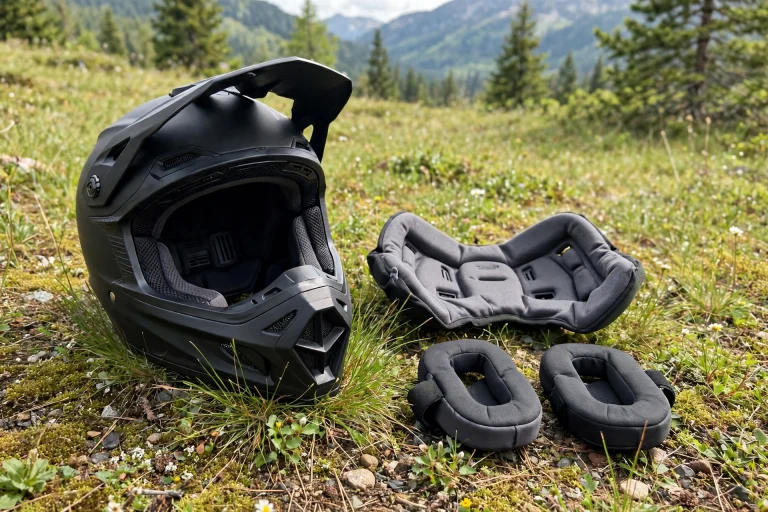
If the looseness is small, use the tools the maker provides: tighten the fit dial, and swap to the thicker pad set if the helmet shipped with two pad thicknesses. Position the straps into a snug V under the ears and set the chin strap to one or two fingers — this completes the fit, though it cannot shrink the shell.
If the dial is maxed out, the thicker pads are in, and the shake test still fails, the honest fix is a smaller size. If the smaller size then creates a hard forehead hot spot while the sides stay loose, the shape is the problem: try a rounder or more oval model instead.
Do not improvise with hats, beanies, or aftermarket foam inserts to fill a big helmet. Extra layers change how the helmet sits and slides, and none of them are part of the certified design.
Also beware the opposite trap: a helmet that was right two seasons ago can become too big as its pads compress with use. If a trusted helmet starts failing the shake test with the dial fully tightened, the pads are spent. Replace the pads if the maker offers them, or replace the helmet — do not simply live with the movement.
Can a Child Grow Into a Bigger Helmet?
No — this is a persistent myth worth retiring. A helmet protects at the size the head is now, not the size it will be next year. Buying big means months or years of riding with a helmet that fails the shake test.
Buy the size that fits the child’s current measurement, use the included thicker pads while they are at the small end of the range, and replace the helmet when the measurement outgrows it or the dial is at its limit.
Kids typically get a season or two from a size. A well-fitting affordable helmet replaced on time is far safer than an expensive oversized one kept for years.
Frequently Asked Questions
Should a bike helmet move at all on your head?
No. With the chin strap unbuckled and the dial set, it should move only with your head. Any slide, lag, or rotation in the shake test means the size or shape is off.
Can thicker pads fix a helmet that is too big?
They can take up a small amount of slack if the maker supplies them. If the helmet still moves with the dial fully tightened and thicker pads fitted, you need a smaller size.
Is a comfortable helmet a well-fitting helmet?
Not necessarily. Oversized helmets feel very comfortable because nothing presses anywhere. Judge fit by stability and even contact, not by the absence of pressure alone.

Olivia
Writer at Helmet Today, covering helmet reviews, fit and riding safety.