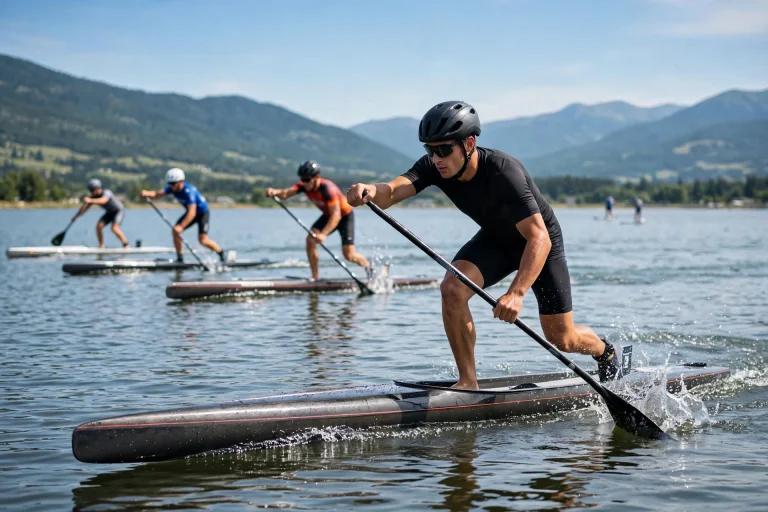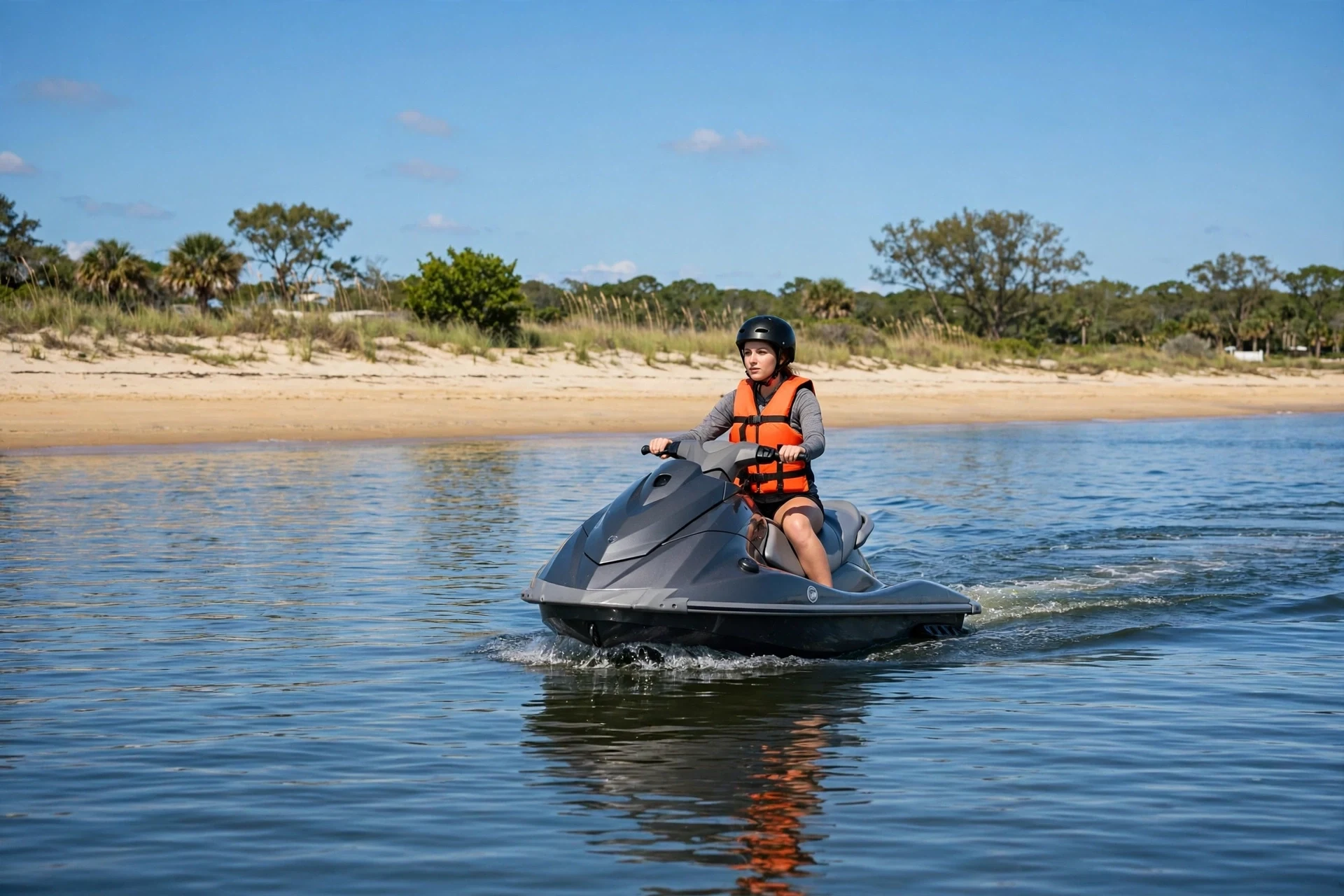
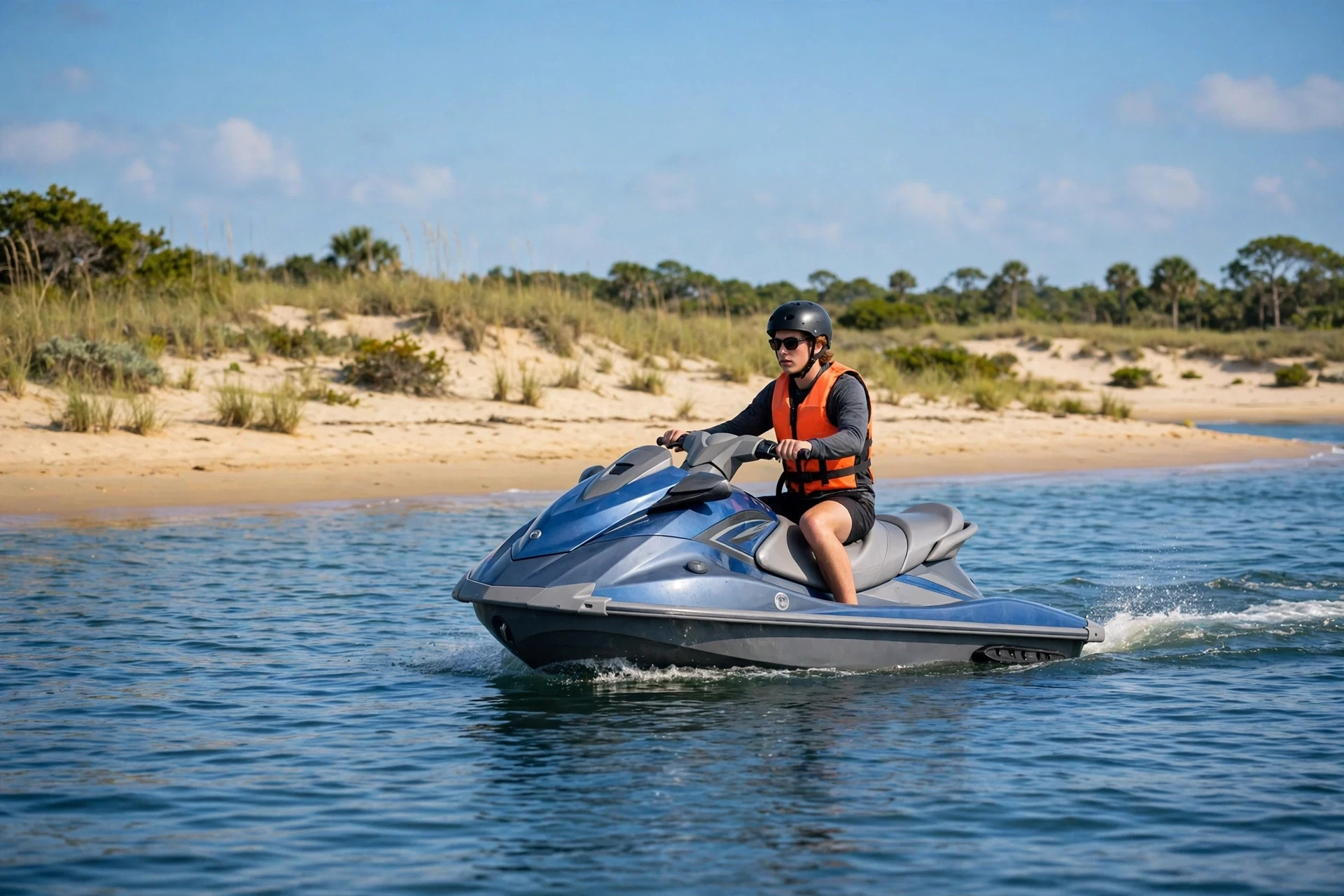
A jet ski helmet for beginners is a water sports helmet worn by a new jet ski rider to protect the head from falls, collisions, and hard impacts with the water at speed. It gives a beginner extra safety while they are still learning to steer, balance, and control a powerful personal watercraft. Jet skis are fast and lively, and a beginner can easily be thrown off by a wave, a sharp turn, or a sudden stop. A helmet is therefore a sensible choice for a first-time rider, and in general terms it is a common sight at jet ski schools and rental centres.
What Is a Jet Ski?
A jet ski is a small personal watercraft that the rider sits or stands on, steering with handlebars and controlling speed with a throttle. It is powered by a jet of water pushed out of the back, which makes it quick to accelerate and able to turn sharply. Jet skis are used for fun on the sea, on lakes, and on rivers, and they are popular for short rides, tours, and water sports.
For a beginner, a jet ski can feel unfamiliar at first. The steering works differently from a car or a bike, because the craft only steers well when the throttle is open, and it can feel unstable at low speed or in choppy water. Most beginners start with a short safety briefing and a gentle ride in calm water, building up speed as they get used to the controls. The learning stage is when a helmet matters most, because mistakes are more likely.
How Is a Jet Ski Helmet Different From Other Helmets?
A jet ski helmet is a water sports helmet, and it is built to cope with water, impacts, and repeated wetting rather than with the kinds of crashes seen on the road. It usually has a hard outer shell that can take a knock from the handlebars or another craft, with a liner inside that absorbs some of the force of an impact. The shell often covers the sides and back of the head well, because a rider who falls off can be hit from many directions.
Many water helmets also have drainage holes or vents that let water flow out rather than pooling inside, and straps that stay secure when wet. Some jet ski helmets have a visor or a face shield, which helps keep spray and wind out of the eyes at speed, while others are open-face so the rider can see and hear clearly. A light, close-fitting helmet is best, since a heavy helmet can feel tiring on a long ride. If you want to understand one of the safety technologies used in modern helmets, reading about what MIPS is for helmets is a good place to start, though not every water helmet uses that system.
Why Do Beginners Need a Helmet on a Jet Ski?
Beginners need a helmet on a jet ski because a fall at speed can bring the head into contact with the water, the handlebars, or another craft. Water feels soft at low speed, but at the speeds a jet ski reaches, hitting the surface can feel hard, and a rider who is thrown off in a sharp turn can land awkwardly. A collision with another jet ski or a boat is also a risk in busy water, and a helmet gives the head some protection in that case.
A helmet also helps when a beginner is thrown forwards onto the handlebars by a sudden stop or a wave, a common knock for a new rider. A helmet does not make jet skiing safe in every situation, and it cannot protect against every kind of impact, but it does reduce the force that reaches the head in the kinds of knocks beginners are most likely to have while learning.
What Should a Jet Ski Helmet Fit Like?
A jet ski helmet should fit snugly all round the head, without pressure points and without wobbling when the rider shakes their head. The helmet should sit level, covering the forehead without slipping down over the eyes, and the back should sit low enough to protect the back of the head. If the helmet can be rocked forwards or backwards easily, it is probably too loose, and it may shift in the water or in the wind at the worst moment.
The chin strap should be fastened snugly before setting off, because a loose strap can let the helmet come off in a fall into the water. It is worth testing the fit with wet hair, since wet hair can change how the helmet sits. If the helmet has a visor, it should be checked for a clear view ahead and to the sides. In general terms, comfort matters too: a helmet that pinches or presses will distract a beginner who is already concentrating hard on the controls.
When Should a Jet Ski Helmet Be Replaced?
A jet ski helmet should be replaced after a hard impact, even if it looks fine from the outside. The liner inside a helmet can compress or crack in a heavy knock, and that damage may not be visible under the shell. A helmet that has already absorbed a hard blow may not protect as well the next time, so it is generally sensible to retire it after a serious impact and use a new one.
Age and wear matter as well. Repeated soaking in salt water, sun, and knocks can wear down the straps, the liner, and the shell over time, and a helmet that has been used hard for several seasons may no longer fit or protect as it once did. Rinsing the helmet in fresh water after a session in the sea helps it last longer. Checking the helmet before each ride is a good habit: look for cracks, loose straps, worn padding, or a shell that feels brittle, and replace it if anything seems wrong.
What Other Kit Goes With a Jet Ski Helmet?
A jet ski helmet is usually worn with a life jacket, the most important piece of kit for a beginner. A life jacket keeps the rider afloat if they fall into the water, which matters most when a beginner is far from shore or in choppy conditions. Many schools and rental centres provide one as standard, and in many places wearing one is required by law or by the operator’s rules.
Beginners also often wear a wetsuit or a rash guard for warmth and sun protection, gloves for grip on wet handlebars, and water shoes for walking on slipways and rocky shores. Sunglasses with a strap can help with glare on the water. The helmet works as part of this whole set: it protects the head, while the life jacket and other kit protect the body and keep the rider afloat. No single item does the whole job on its own.
Do beginners need a helmet on a jet ski?
In general terms, yes, a helmet is strongly recommended for a beginner on a jet ski. Many schools and rental centres provide one, and it gives extra protection while the rider is still learning the controls.
Can I use a bike helmet on a jet ski?
No, a bike helmet is not a good choice for a jet ski. Bike helmets are not designed to cope with water, repeated soaking, or impacts on the water, and a water sports helmet is the right tool for the job.
Do I need a life jacket as well as a helmet on a jet ski?
Yes. A helmet protects the head, while a life jacket keeps you afloat if you fall in. The two work together, and a life jacket is usually required on a jet ski.

Olivia
Writer at Helmet Today, covering helmet reviews, fit and riding safety.