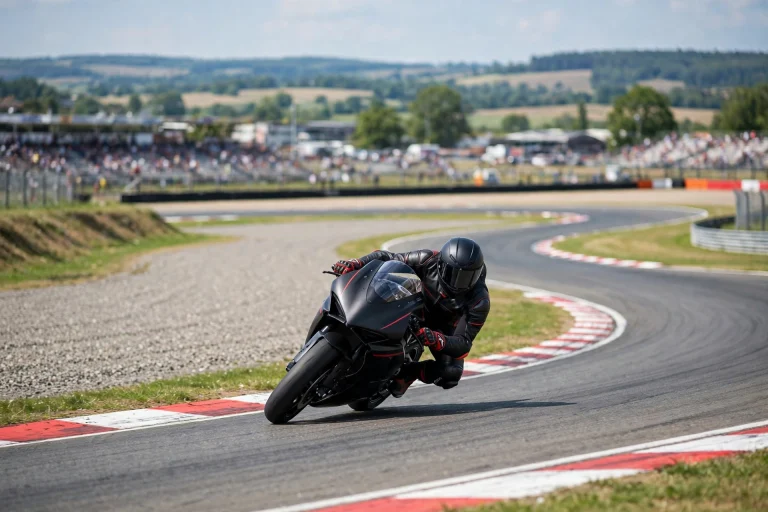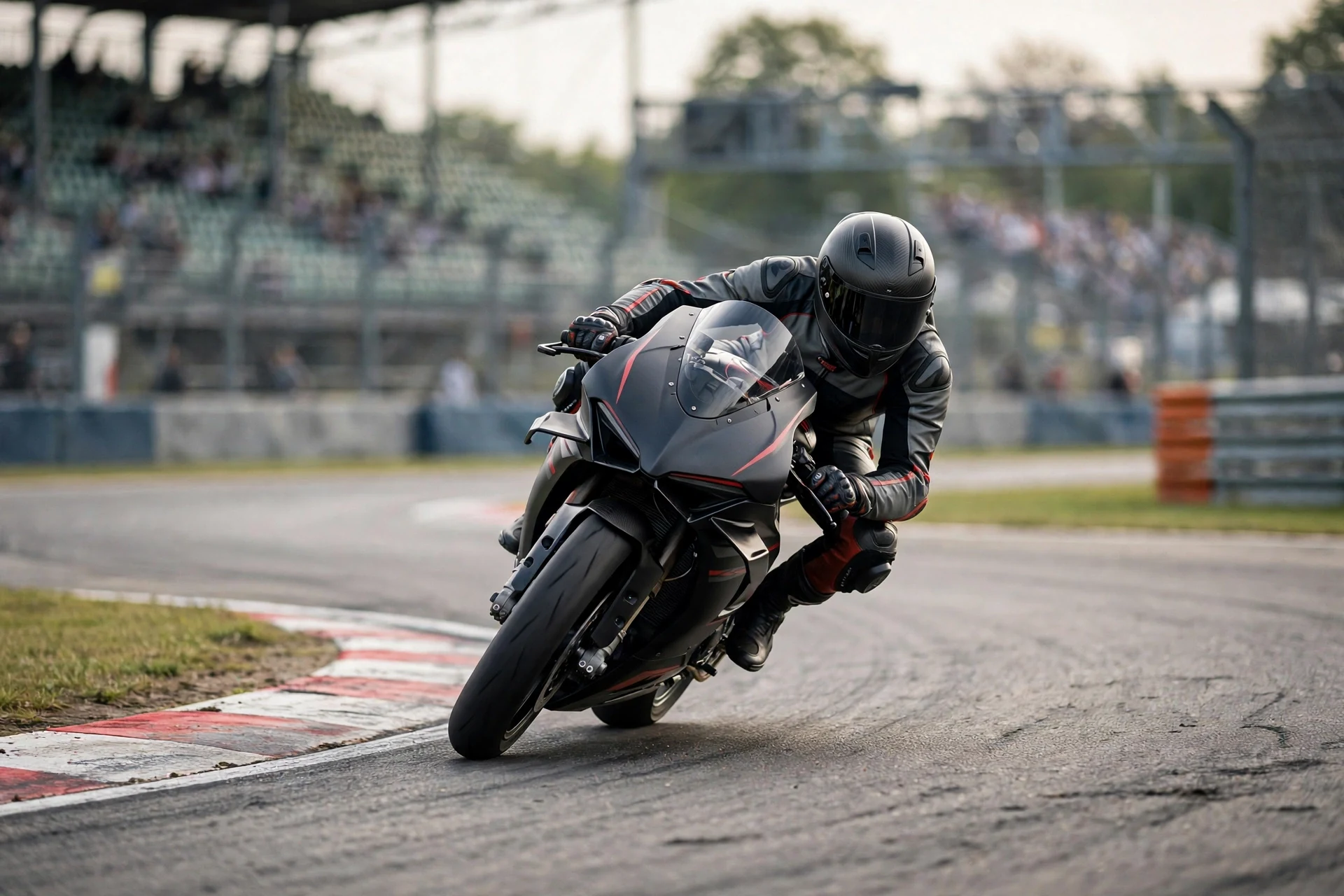
A Moto2 helmet is a full-face racing helmet worn by riders in the Moto2 class, built for high-speed circuit racing with strong impact protection, a wide field of vision, a secure fit, and good ventilation at racing speeds. Moto2 is a class of motorcycle road racing run as part of the Grand Prix world championship, sitting between the lighter Moto3 class and the premier MotoGP class. Riders race prototype-style motorcycles on closed circuits, at speeds and lean angles far beyond normal road riding, so their helmets are made for that world.
In general terms, a Moto2 helmet is a top-level racing helmet, not a road helmet with a racing look. It is designed with the help of riders, tested in wind tunnels and in crashes, and built to meet the strict safety standards that apply to Grand Prix racing. That makes it an interesting example of what a racing helmet can be, even for riders who will never race at that level.
What is Moto2?
Moto2 is a class within Grand Prix motorcycle road racing, run alongside MotoGP and Moto3 at the same race weekends. The class is a stepping stone for riders aiming for the premier class, and it is known for close racing, with large fields of riders competing on similar machinery. Races are held on closed circuits around the world, over a set number of laps.
Riders in Moto2 race on motorcycles that are built for the class, with a focus on handling and rider skill rather than on outright power alone. The bikes are fast, the racing is close, and riders often fight for position in large groups, overtaking and being overtaken many times in a single race. That close racing means crashes can happen, and rider protection is taken very seriously.
What makes a Moto2 helmet different from a road helmet?
A Moto2 helmet is a full-face racing helmet, made to be light, strong, and stable at very high speed. The shell is shaped to cut through the air cleanly when the rider is tucked behind the fairing, and to stay stable when the rider sits up to brake or moves around on the bike. A road helmet, by contrast, is made for a wider range of speeds, weather, and riding positions.
Racing helmets usually have a wider eye port than road helmets, so the rider can see more when tucked low and looking through a corner. The visor is made to be changed quickly, and it is often fitted with tear-off strips that the rider can pull away during a race to clear rain, insects, or dirt from the visor without stopping.
How is a Moto2 helmet fitted to the rider?
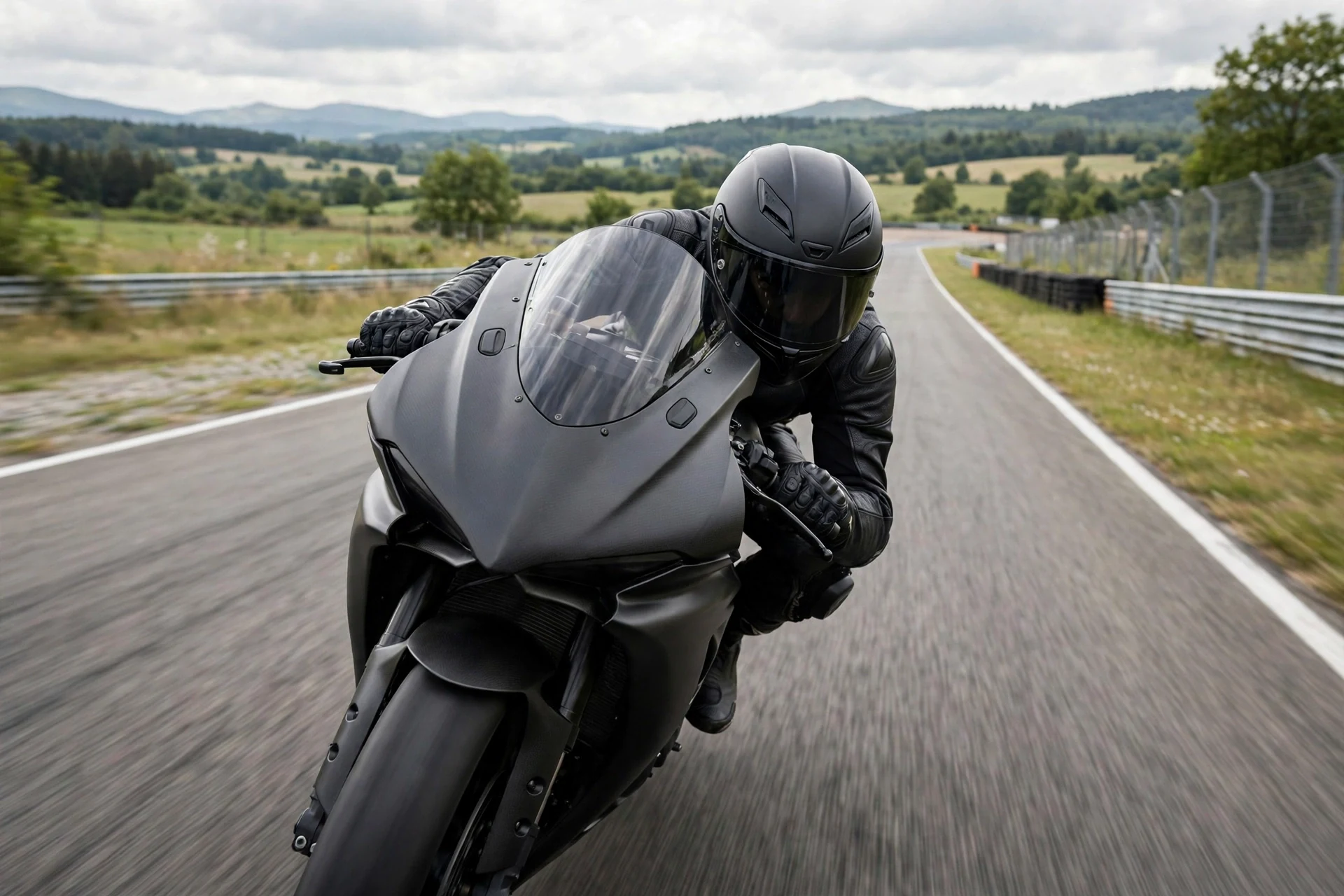
Fitting is a careful process for a racing rider. The helmet must be snug all round, with no pressure points that would distract the rider over a race distance, and it must stay put under hard braking, acceleration, and cornering. Riders often try several sizes and pad combinations before settling on a fit, and the fit is checked again in the racing position on the bike.
The cheek pads, crown pads, and liner can often be swapped for different thicknesses, so the fit can be tuned to the rider’s head shape. That matters because a helmet that fits one rider perfectly may press on another rider’s forehead or temples. A good fit is not just about comfort: a helmet that moves in a crash protects less well than one that stays in place.
How does a Moto2 helmet protect the rider?
A Moto2 helmet protects the rider with a strong outer shell, an energy-absorbing liner inside, and a secure retention system. The shell spreads the force of an impact, the liner absorbs energy by compressing, and the chin strap keeps the helmet on the rider’s head. Together, they reduce the force that reaches the head in a crash.
Many racing helmets also include a system designed to reduce rotational forces in a crash, such as a slip liner that lets the helmet move a little relative to the head. In general terms, these systems aim to reduce the twisting forces that can occur when a helmet hits the ground at an angle. If you want to read more about one such system, see our guide to MIPS and how it works in helmets.
What about visors, ventilation, and aerodynamics?
The visor on a Moto2 helmet is a key part of the design. It must give a clear, wide view, resist fogging, and stay firmly in place at speed. Riders use different visor tints for different light conditions, and they may change visors between sessions if the weather changes. Tear-off strips let them clear the visor during a race without taking their hands off the bars for long.
Ventilation is tuned for racing speeds, with vents at the front that force air in and exhausts at the back that pull hot air out. At racing speed, that airflow keeps the rider cool and the visor clear. At slow speeds, the same vents do less, which is one reason a racing helmet can feel hot and stuffy when worn on the road.
Can a road rider use a Moto2-style helmet?
A road rider can buy a helmet based on a Moto2 racing design, and many helmet makers sell road versions of their racing helmets. Those road versions are usually very good helmets: light, well ventilated at road speeds, with a wide field of vision and a secure fit. But they are still racing helmets at heart, and they may be noisier, less comfortable on long rides, and more expensive than a good touring helmet.
For most road riders, a helmet made for the road is a better choice than a pure racing helmet. A road helmet is designed for a wider range of speeds, for use with glasses and communication systems, and for comfort over hours rather than over a race distance. A racing helmet is a specialist tool, and it works best in the world it was made for.
If you do choose a racing-style helmet for the road, make sure it meets the safety standard required where you ride, and that it fits well in your normal riding position. Check that you can see clearly, hear traffic, and wear it comfortably for the length of your usual rides. A helmet that is perfect on a circuit may not be the best choice for a daily commute or a long tour.
Is a Moto2 helmet the same as a MotoGP helmet?
In general terms, Moto2 and MotoGP riders wear similar top-level full-face racing helmets, made to the same strict safety standards. The designs may differ in detail, but both are built for high-speed circuit racing with strong protection and a wide field of vision.
Do Moto2 riders use tear-offs on their visors?
Yes, in general terms many racing riders use tear-off strips on their visors, so they can pull away a dirty layer during a race and see clearly again. Tear-offs are a racing feature, and they are not usually needed on the road.
Should I buy a Moto2-style helmet for road riding?
You can, but a helmet made for the road is usually more comfortable and practical for everyday riding. A racing-style helmet is light and protective, but it may be noisier and less comfortable over long rides than a good road or touring helmet.

Olivia
Writer at Helmet Today, covering helmet reviews, fit and riding safety.