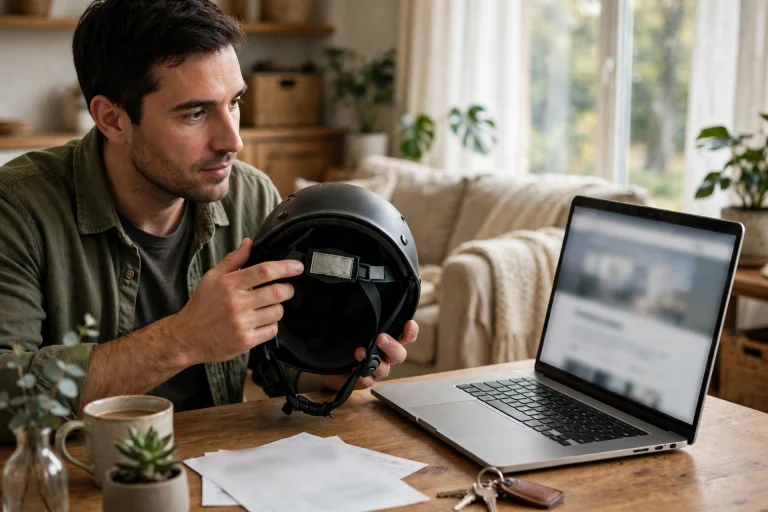
SANS 1026 is the South African national standard for motorcycle helmets, setting out what a helmet must do to protect a rider’s head. It is published by the South African Bureau of Standards, and it covers helmets worn by motorcycle riders and their passengers. A helmet that meets SANS 1026 has been tested for impact protection, head coverage, and the strength of its retention system, and it is the standard that South African riders and sellers look for when judging whether a helmet is fit for the road.
South Africa has a large and varied riding community, from city commuters on scooters to long-distance tourers and off-road riders. A national standard gives all of them a common way to tell a properly tested helmet from a cheap imitation, and it gives sellers a clear benchmark to meet.
What Is the SANS 1026 Standard?
SANS 1026 is a South African national standard, written by the South African Bureau of Standards, that applies to helmets for motorcycle riders and their passengers. The letters SANS stand for South African National Standard, and the number 1026 identifies this particular standard among all the others. Like other national helmet standards, it sets out the performance a helmet must reach, rather than dictating exactly how the helmet must be built, so makers can use different shells, linings, and designs as long as the finished helmet passes the tests.
The standard applies to the kinds of helmets people actually wear on South African roads: full-face helmets, open-face helmets, and modular helmets that combine both. It sets out how much of the head the helmet must cover, how the helmet must behave when it is struck, and how securely it must stay on the head. It also covers details such as the field of vision the helmet must allow, since a helmet that blocks your view of the road is a danger in itself.
What Does SANS 1026 Testing Cover?
In general terms, testing under SANS 1026 involves striking the helmet in several places and measuring the forces that reach the inside. The helmet is fitted onto a head-shaped form and dropped onto a hard surface, with sensors recording how much force is transmitted through the shell and lining. The helmet is struck on the top, the sides, and the front and back, because a crash can hit any part of the head. The helmet passes only if the forces stay within the limits the standard sets.
The retention system is tested as well. The chin strap is pulled with a set force and the helmet is checked for how far it moves, because a helmet that comes off in a crash cannot protect the rider. The buckle and the strap attachments are also checked for strength. This matters because the strap is the one part of the helmet that holds everything in place, and a strap that breaks or slips undoes all the protection the shell and lining provide.
How Can You Tell a Helmet Meets SANS 1026?
The simplest way is to look for the certification mark on the helmet. In South Africa, helmets that meet the standard carry a mark showing they have been certified, and this is usually a label on the outside of the shell or on a tag inside the helmet. The mark should be clear and permanent, not a sticker that peels off easily. If a helmet sold in South Africa has no certification mark at all, that is a reason to be cautious, since legitimate helmets from reputable makers will carry one.
It is also worth checking the helmet’s own documentation. The manual or the packaging should state that the helmet meets SANS 1026, and it should give the maker’s name and the model. A reputable seller will be able to tell you which standard the helmet meets and show you the marking. If a seller cannot answer that question, or the price seems far below what a tested helmet normally costs, the helmet may not have been through the proper testing at all.
Fake helmets are a real problem in many markets, and they often look convincing from the outside. One way to check is to feel the weight and the lining: a real helmet has a firm, thick lining that feels solid when you press it, while a fake often feels light and hollow. If you are learning about the extra technologies that can be built into a helmet, reading about what MIPS is for helmets can help you understand one of the features that may appear on the helmets you compare.
How Does SANS 1026 Compare with International Standards?
SANS 1026 sits alongside the other major national helmet standards, such as the European ECE 22.06 standard and the American DOT standard. All of these standards aim at the same thing: a helmet that absorbs impact energy, stays on the head, and covers the parts of the head that need protection. The differences are in the details of how the tests are run, such as the height from which the helmet is dropped, the shape of the surface it is dropped onto, and the limits placed on the forces measured.
For a rider, the practical point is that a helmet meeting any recognised national standard has been properly tested. A helmet that meets SANS 1026 has passed a serious set of tests, just as a helmet that meets ECE 22.06 has. Some helmets sold internationally carry more than one standard marking, which means they have been tested to each of those standards separately. That is a good sign, but a single genuine marking from a recognised standard is enough to show the helmet is a real, tested product.
What Should Riders in South Africa Look for When Buying?
Start with the certification mark and the SANS 1026 statement on the helmet and its packaging. Buy from a reputable shop or a known brand’s own store rather than from an unknown seller, and keep the receipt so you can return the helmet if something is wrong. A shop that sells genuine helmets will be happy to explain the marking and let you try the helmet on before you buy.
Fit is just as important as the standard. A helmet should sit level on your head, low on your forehead, with the chin strap snug enough that you can only fit one or two fingers between the strap and your chin. It should feel snug all around without pressing painfully in one spot, and it should not wobble when you shake your head. Try on more than one size and more than one model, because helmet shapes vary and the right fit depends on your head.
Frequently Asked Questions
Q: What is the SANS 1026 helmet standard?
A: SANS 1026 is South Africa’s national standard for motorcycle helmets, published by the South African Bureau of Standards. It sets out requirements for impact protection, head coverage, and chin strap strength for helmets worn by riders and passengers.
Q: How do I know if a helmet meets SANS 1026?
A: Look for the certification mark on the helmet or its packaging, and check that the manual states the helmet meets SANS 1026. Buy from a reputable seller, and be cautious of helmets with no marking or an unusually low price.
Q: Is a SANS 1026 helmet safe to use outside South Africa?
A: In general terms, a genuine SANS 1026 helmet has passed serious testing and is a properly tested helmet. However, local rules vary, so check which standards are recognised where you ride before relying on a helmet bought elsewhere.

Olivia
Writer at Helmet Today, covering helmet reviews, fit and riding safety.