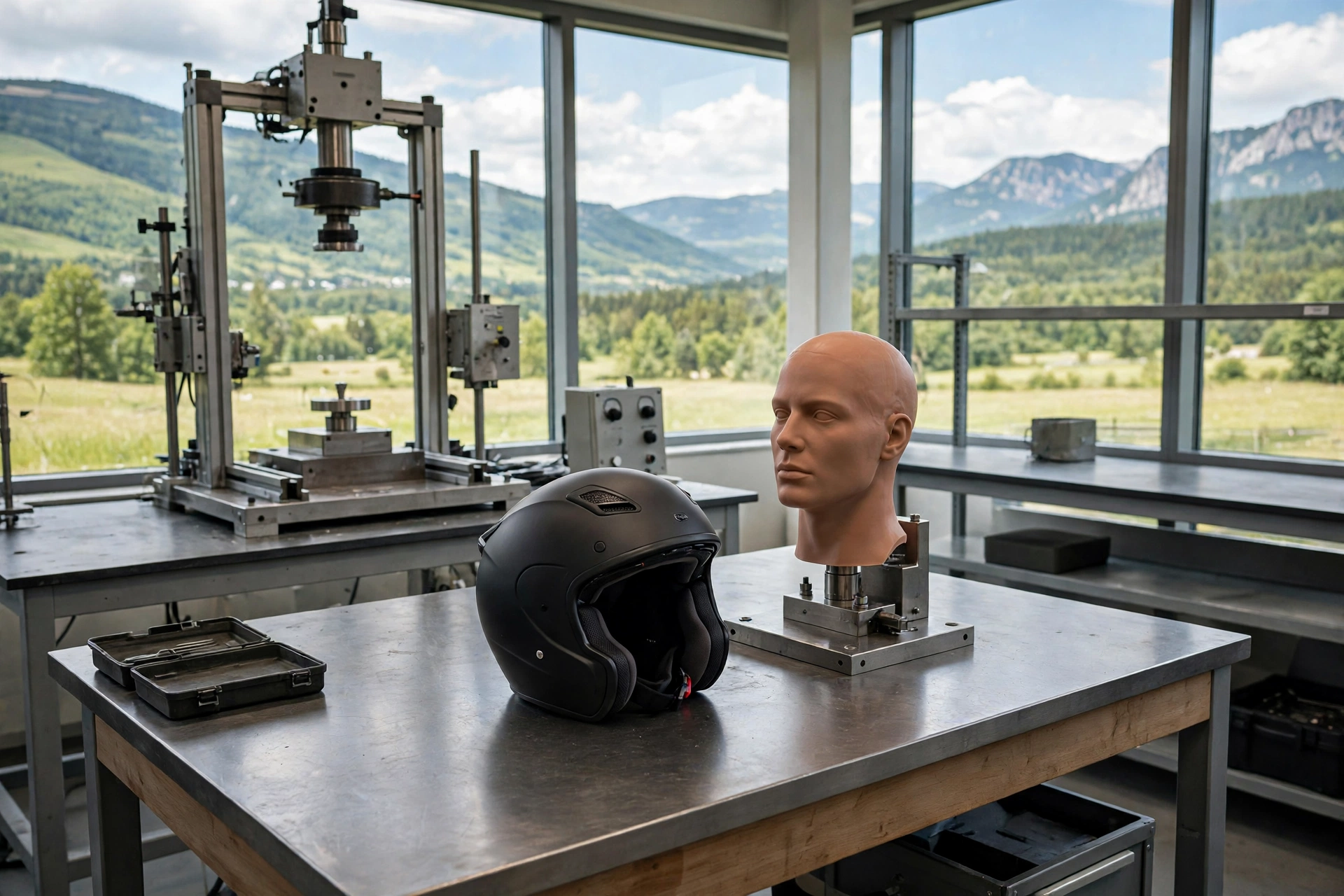
SHARP helmet ratings are star scores, from one to five, published by the UK government to show how well motorcycle helmets performed in a standardized program of laboratory impact tests. SHARP stands for the Safety Helmet Assessment and Rating Programme. Unlike the legal approval standards, which are pass or fail, SHARP buys helmets anonymously from retailers, tests them, and publishes comparative results so riders can see which models managed impact energy best under the same test conditions.
That matters because every helmet on sale has already cleared a minimum legal bar. Once two helmets are both legal, the approval sticker alone tells you nothing about which one performed better in testing. SHARP exists to answer that question in general terms, using repeatable lab work instead of marketing claims, so riders can make a more informed choice when comparing models.
What Is the SHARP Helmet Testing Program?
SHARP is a consumer information scheme run by the UK Department for Transport. Its job is not to approve or ban helmets — that is handled by the legal standards a helmet must meet before sale — but to test helmets that are already on the market and publish how they performed. The results are free for anyone to look up, whether or not they ride in the UK.
To keep the testing honest, SHARP buys its test helmets from shops rather than accepting samples supplied by manufacturers. That way, the helmet on the test rig is the same helmet a customer would take home, in the same sizes and from the same production runs. Several helmets of each model are tested, because a single sample can behave differently from the next one off the line.
The scheme focuses on popular full-face and modular motorcycle helmets sold in the UK market, and it has built up a large library of results over the years. If you are shopping in the US, you will not find every American model listed, but many helmets are sold on both sides of the Atlantic under the same or similar names, which makes the database useful well beyond Britain.
How Does SHARP Test Helmets?
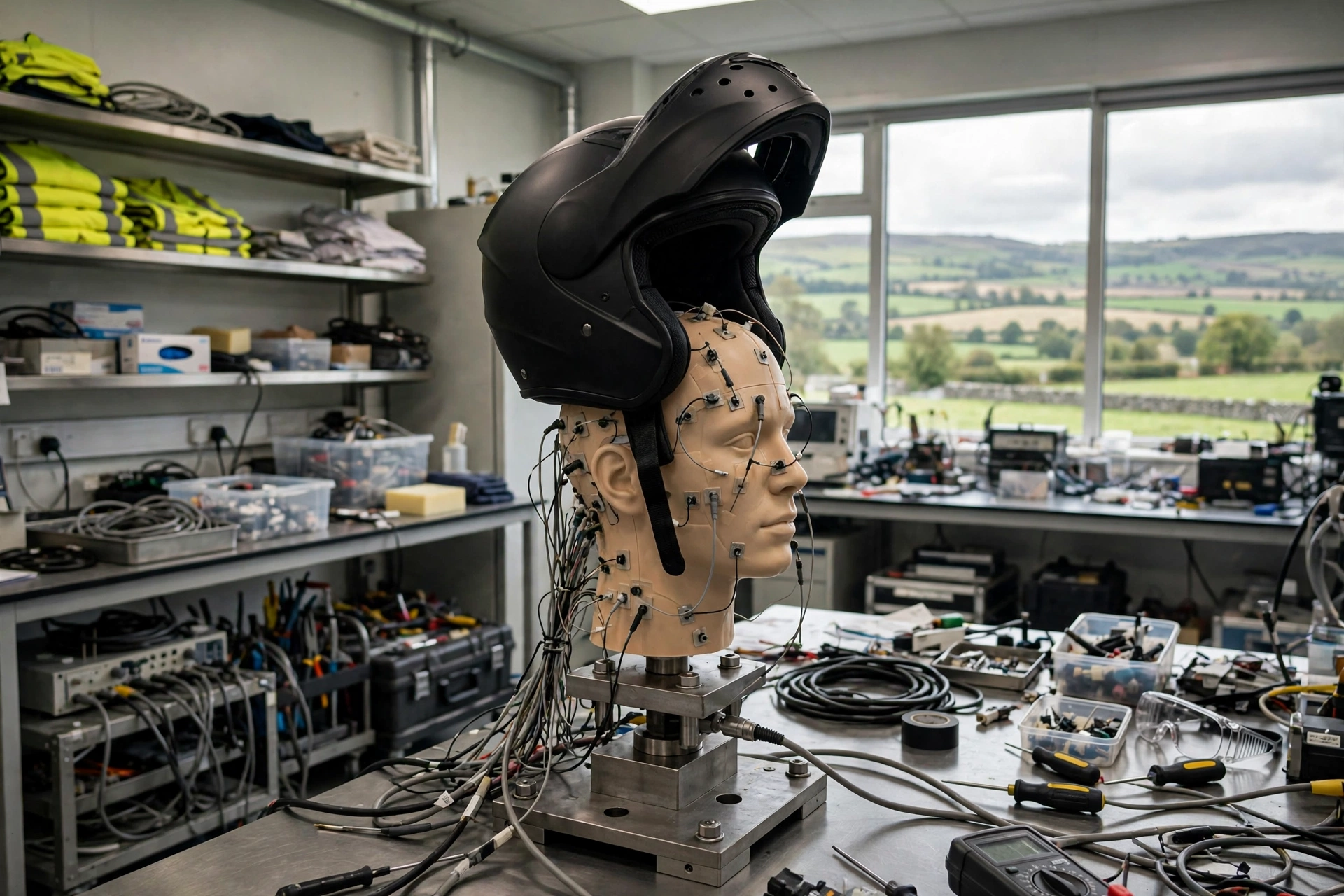
In general terms, SHARP testing follows the same basic principle as other helmet crash testing: a helmet is fitted to an instrumented headform, dropped onto anvils, and the sensors inside the headform record how much force gets through. SHARP uses impacts at different speeds and at several points around the shell, because real crashes rarely land neatly on the crown of the head.
The program tests the front, sides, rear, and top of each helmet, and combines the results so that areas more commonly struck in real accidents carry appropriate weight in the final score. It also added oblique impact testing, where the helmet strikes a moving, angled surface, to look at the rotational motion that can be passed to the head in a sliding crash.
Each model’s results are then converted into the published star rating. SHARP also publishes more detailed color-coded information about how a helmet performed at individual impact points, so a rider can see whether a model was consistently strong or excellent in one area and weaker in another. That extra detail is one of the most useful parts of the scheme, because real-world protection is only as good as the weakest area you happen to land on.
What Do the Star Ratings Actually Mean?
A five-star helmet is one that performed best overall in SHARP’s tests, and a one-star helmet performed the least well among those tested — while still having passed the legal minimum needed to be sold. That last point is important: a low star rating does not mean a helmet is illegal or fake. It means that, in this particular test program, other helmets managed the test impacts better.
The ratings are comparative, not absolute guarantees. A five-star score does not promise a specific outcome in a real crash, because real crashes vary enormously in speed, surface, angle, and luck. What the stars offer is a fair, like-for-like comparison of helmets tested the same way, which is something no approval sticker can give you.
It is also worth remembering that results apply to the exact model and version tested. Manufacturers update models over time, and a newer version sharing an old name may not perform identically. Checking the current listing for the specific helmet you are considering, rather than relying on a rating you remember from years ago, is the sensible way to use the database.
How Should Riders Use SHARP Ratings When Buying?
The most practical approach is to use the ratings as a shortlisting tool. Start with helmets that fit your head shape, your budget, and your riding needs, then check how those models scored. If two helmets fit you equally well and one carries a notably stronger SHARP result, that is a reasonable tiebreaker.
Fit should always come first, though. A five-star helmet that is loose, lifts at the back, or creates painful pressure points will not protect you as designed, because a helmet can only work properly when it stays in the right position on your head. Try helmets on, wear them around the shop for a while, and check for even pressure without pain before you worry about star counts.
It also helps to understand what is going on inside a modern helmet. Energy-absorbing foam does most of the work in a straight impact, while some helmets add a low-friction liner intended to reduce rotational motion in an angled fall. If you want the background on that technology, our explainer on what MIPS is and how it works walks through it in plain language. SHARP’s oblique tests are relevant here, because they look at exactly that kind of sliding, rotational impact.
What Are the Limitations of SHARP Ratings?
First, coverage: SHARP tests helmets sold on the UK market, so some US-only models, many open-face helmets, and most off-road helmets will not appear. The absence of a rating does not mean a helmet is poor — it may simply never have been tested by the scheme.
Second, lab tests are simulations. They are carefully designed to represent common crash types, but no rig can reproduce every real accident. A helmet’s score reflects its performance in a specific set of impacts, not a prediction of injury in any particular crash. Riders should treat the stars as one input among several, alongside fit, build quality, comfort, and how well the helmet suits their riding.
Finally, ratings only describe the helmet as tested when new. A helmet that has been dropped hard, crashed, or left to age in a hot garage will not perform like the fresh sample on the rig. Whatever rating your helmet earned, it still needs to be replaced after a significant impact and when age and wear catch up with it.
Frequently Asked Questions
Q: Is a one-star SHARP helmet unsafe to wear?
A: Not in the legal sense. Every helmet SHARP tests had to pass the applicable approval standard before it could be sold. A one-star score means it performed least well in SHARP’s comparative tests, so many riders would prefer a higher-rated model, but it does not mean the helmet failed a legal requirement.
Q: Can I use SHARP ratings if I live in the United States?
A: Yes, as a comparison tool. Many helmets are sold in both markets, sometimes under slightly different names. US helmets are sold under American rules, but SHARP’s test results still give a useful indication of how a shared model performed in independent impact testing.
Q: Should I only ever buy a five-star helmet?
A: Not necessarily. Fit, comfort, and suitability for your riding matter just as much, and a slightly lower-rated helmet that fits perfectly is a better choice than a five-star helmet that does not. Use the ratings to choose between helmets that already fit you well.

Olivia
Writer at Helmet Today, covering helmet reviews, fit and riding safety.