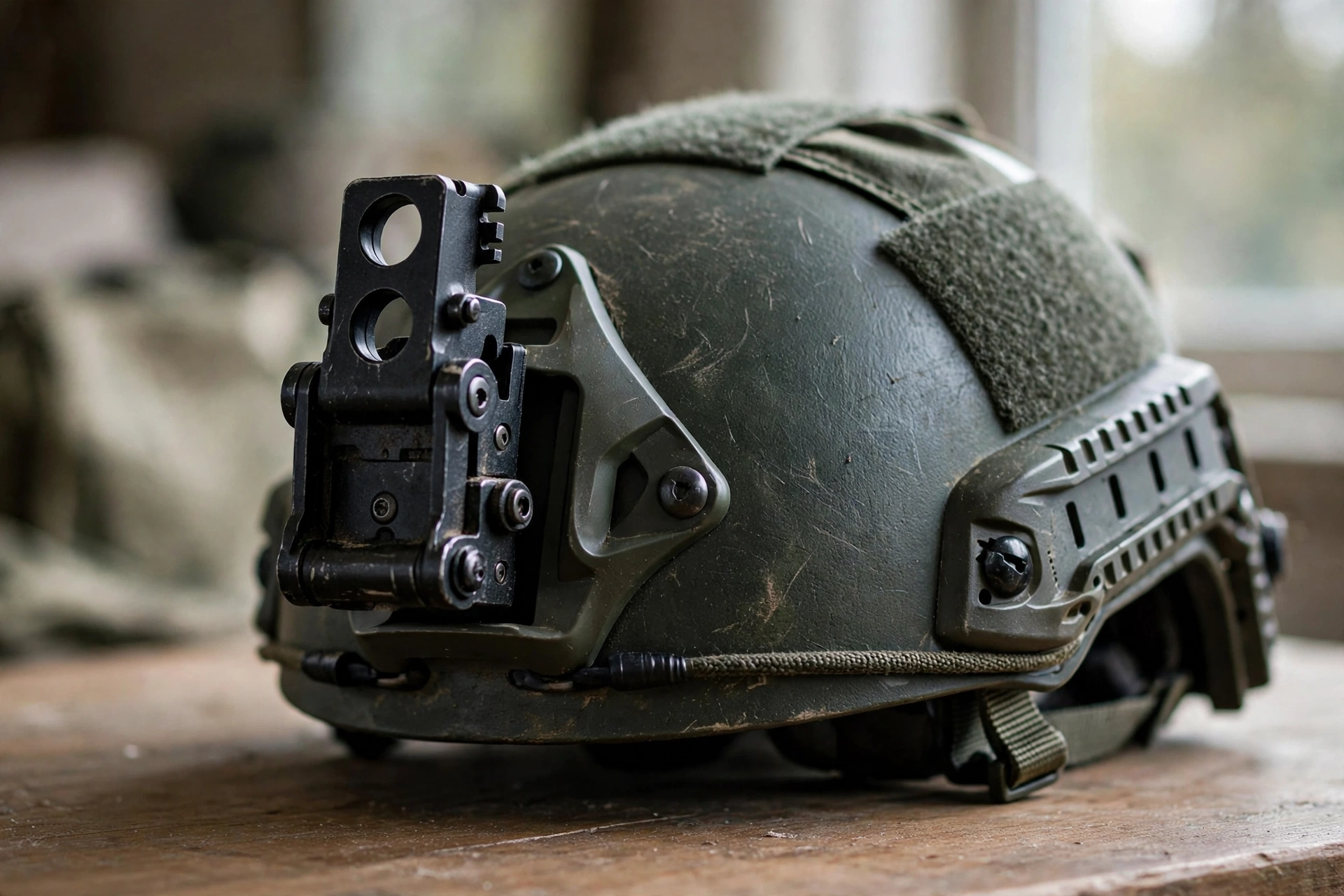
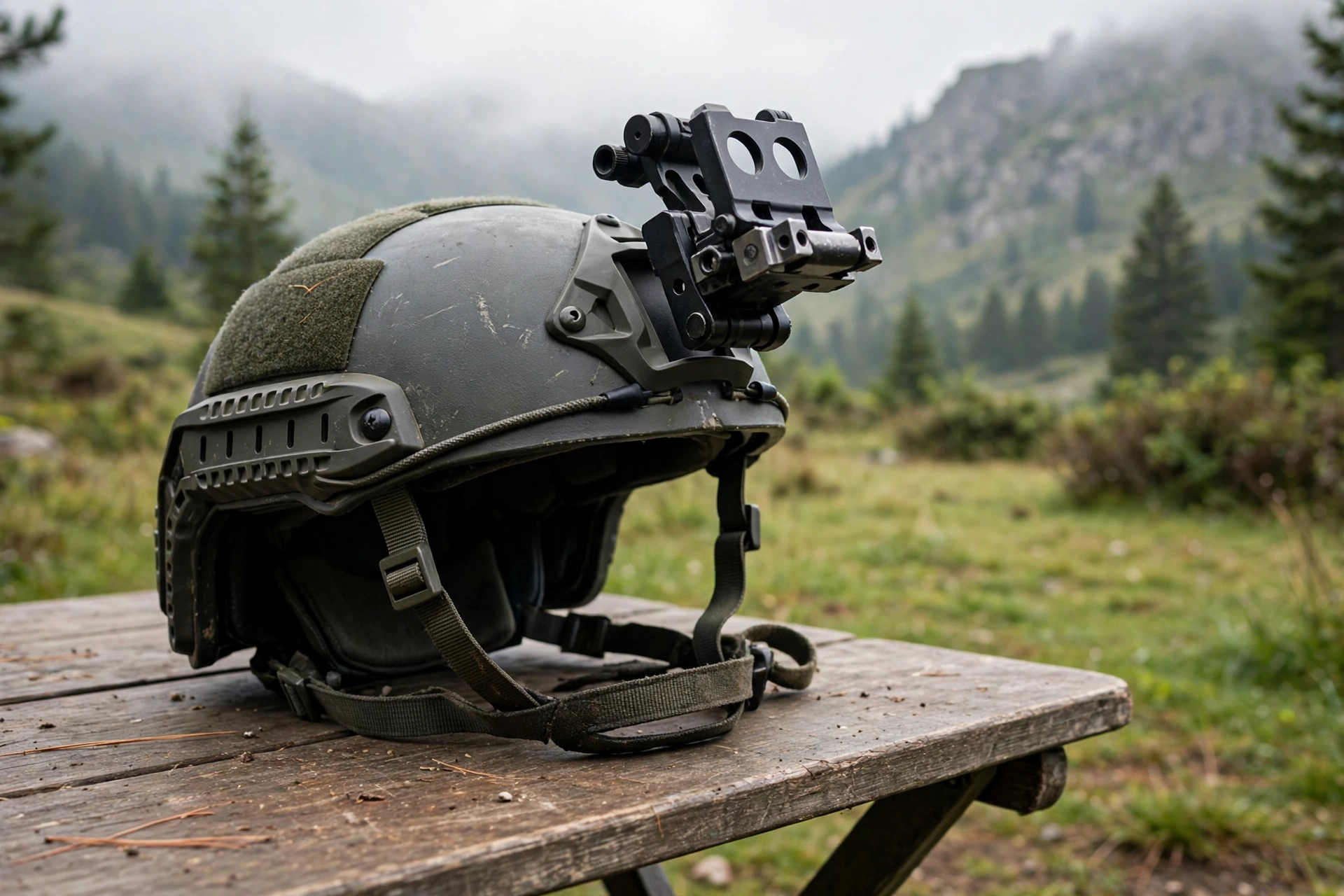
In general terms, a night vision mount on a tactical helmet is a bracket fixed to the front of the shell that holds a night vision device in front of the wearer’s eyes and lets it flip up out of the way or swing aside when it is not needed. The mount itself does not create the night vision image; it simply positions the device steadily, at the right height and distance, so the wearer can look through it hands-free while keeping the helmet balanced and secure. Without a good mount, even a capable device is hard to use for long.
Tactical helmets usually carry a front shroud, a flat or slightly curved plate bonded or bolted to the shell, and the mount attaches to that shroud. Different mounts suit different devices and budgets, and the choice affects weight, balance, and how quickly the device can be stowed. This guide explains, in general terms, how night vision mounts work, what the main types are, and how to fit and adjust one properly.
What Does a Night Vision Mount Actually Do?
A night vision mount has three jobs: hold, position, and stow. It holds the device firmly so it does not bounce or drift while the wearer moves, it positions the eyepieces at the correct height and eye relief, and it lets the device be stowed quickly — usually by flipping it up against the helmet — when the wearer needs unaided vision. A mount that wobbles, sags, or sits too high or low will cause eye strain and a poor image, no matter how good the device is.
Most mounts also include a breakaway feature, in general terms a point designed to release under a sharp snag so the helmet is not yanked violently if the device catches on something. This is a safety feature, not a flaw: a device that cannot break away can turn a minor snag into a neck injury. Cheaper mounts may lack a reliable breakaway or a solid lock, which is one reason mount quality matters as much as the device it carries.
What Are the Main Types of Night Vision Mount?
The simplest mounts are fixed brackets that hold a single device in place with limited adjustment. They are light and affordable, but they offer little height or tilt adjustment, so fit depends heavily on the helmet and the wearer. At the other end are articulating mounts with arms that swing the device up, down, and sideways, and allow fine adjustment of height, tilt, and eye relief. These cost more and weigh more, but they adapt to more users and devices.
Between those extremes sit flip-up mounts, the most common general design, which lock the device in the down position for use and flip it up against the helmet for stowage. Some mounts hold a single monocular, while dual mounts or bridge mounts carry two tubes for binocular vision. In general terms, a monocular mount suits users who want to keep one eye adapted to darkness, while a dual setup gives depth perception at the cost of weight. The mount must match the device’s attachment style, so check compatibility before buying.
How Do You Fit a Night Vision Mount to a Helmet?
Fitting usually starts with the shroud. Many tactical helmets come with a shroud already fitted; if yours does not, a shroud is bolted or bonded to the front of the shell following the maker’s instructions, taking care not to drill or modify a ballistic shell in ways the maker does not approve. Once the shroud is secure, the mount slides or clips into it and locks with a latch, screw, or lever.
After fitting, check the mount by hand: it should lock positively, with no rocking or rattling, and it should release cleanly when the release is operated. Fit the device itself and check that it sits level in front of the eyes, not tilted to one side. If the mount uses screws, check them for tightness, but do not overtighten, since stripped threads or cracked brackets are a common fitting mistake. A short indoor test before any real use will reveal most fitting problems.
How Do You Adjust a Night Vision Mount for Comfort?
Adjustment is about eye relief, height, and tilt. Eye relief is the distance between the eyepiece and the eye: too close and the eyepiece presses uncomfortably, too far and the image shrinks or darkens at the edges. Height adjustment lines the eyepiece up with the pupil, and tilt adjustment keeps the image level rather than angled. Most articulating mounts allow all three, while simpler mounts may offer only one or two.
Adjust the mount while wearing the helmet exactly as it will be worn, with the pads and straps set, and with any face covering in place. Small changes make a big difference, so adjust in stages and test by looking through the device for a minute or two. Balance matters too: a device mounted at the front shifts weight forward, so many users add a counterweight pouch at the rear of the helmet. A balanced helmet is far more comfortable over a long session than a front-heavy one.
What Should You Check Before Using a Mounted Device?
Before use, run through a short checklist. Confirm the mount locks and releases properly, the device is secure, the flip-up action works smoothly, and the breakaway (if fitted) has not been jammed or glued shut. Check that the helmet still fits and sits level with the device attached, and that the chin strap is snug, since a loose helmet will let the device bounce.
Also consider the rest of the helmet system. A heavy device changes how the helmet feels and can strain the neck over time, so build up wearing time gradually. Keep the mount clean and dry, and check screws and latches from time to time, especially after rough handling or transport. If the mount is damaged, cracked, or will not lock, do not improvise a fix with tape or glue: replace it. The mount is a small part, but it carries an expensive device in front of your eyes, so it deserves the same care as the helmet itself. For background on how helmets manage impact energy, this explanation of modern helmet liner systems is a useful read.
Frequently Asked Questions
Q: Do all tactical helmets accept a night vision mount?
A: In general terms, most modern tactical helmets have or accept a front shroud, but older or basic shells may not. Check your helmet model and the mount’s compatibility before buying.
Q: Can I fit a night vision mount myself?
A: Yes, in general terms, if the helmet already has a shroud and the mount is made for it. Fitting a new shroud to a ballistic shell should follow the maker’s guidance, since unauthorised modification can affect the shell.
Q: Why does my night vision device feel front-heavy?
A: The device adds weight ahead of the helmet’s balance point. A rear counterweight pouch often restores balance, and correct height and tilt adjustment also reduce neck strain.

Olivia
Writer at Helmet Today, covering helmet reviews, fit and riding safety.