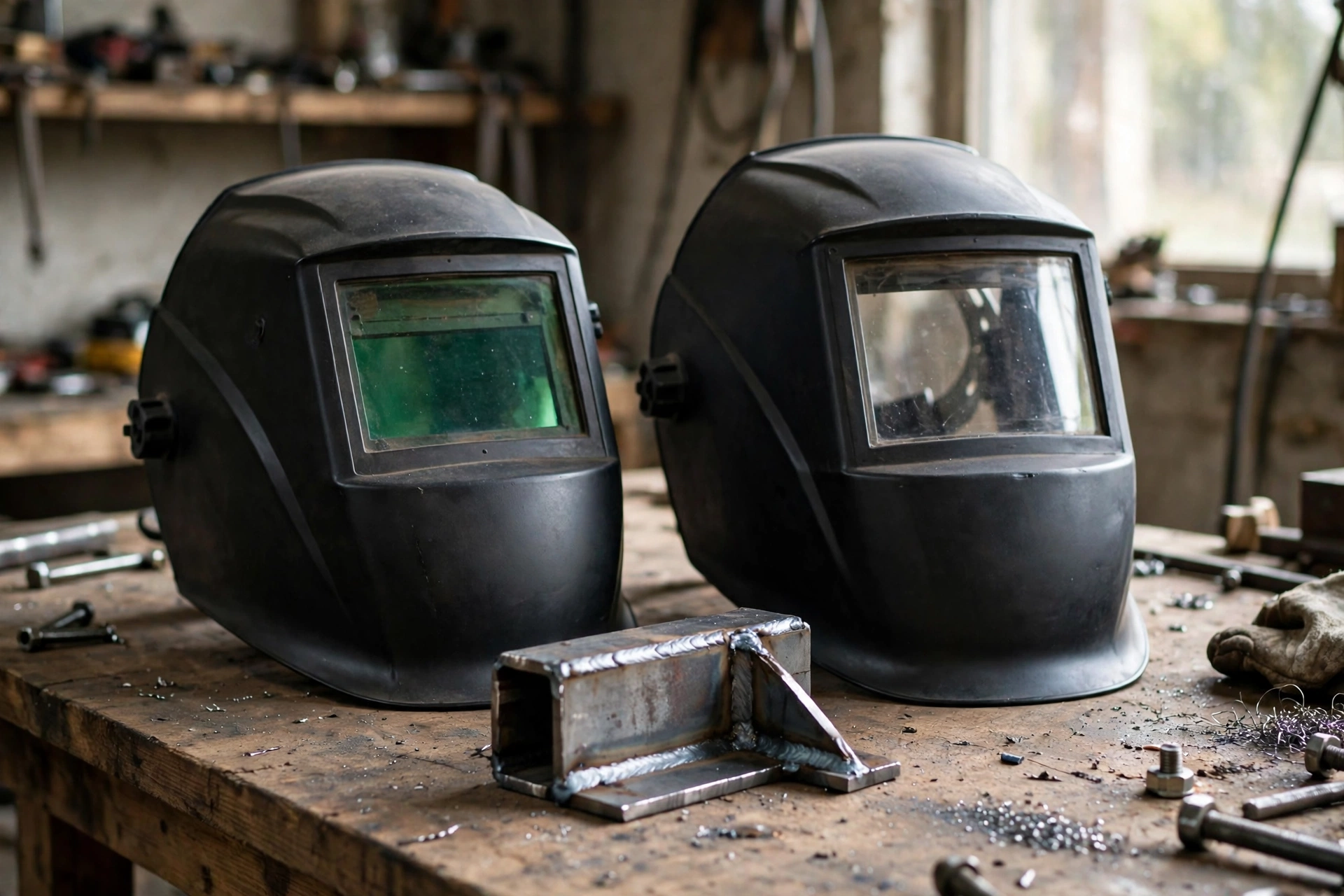
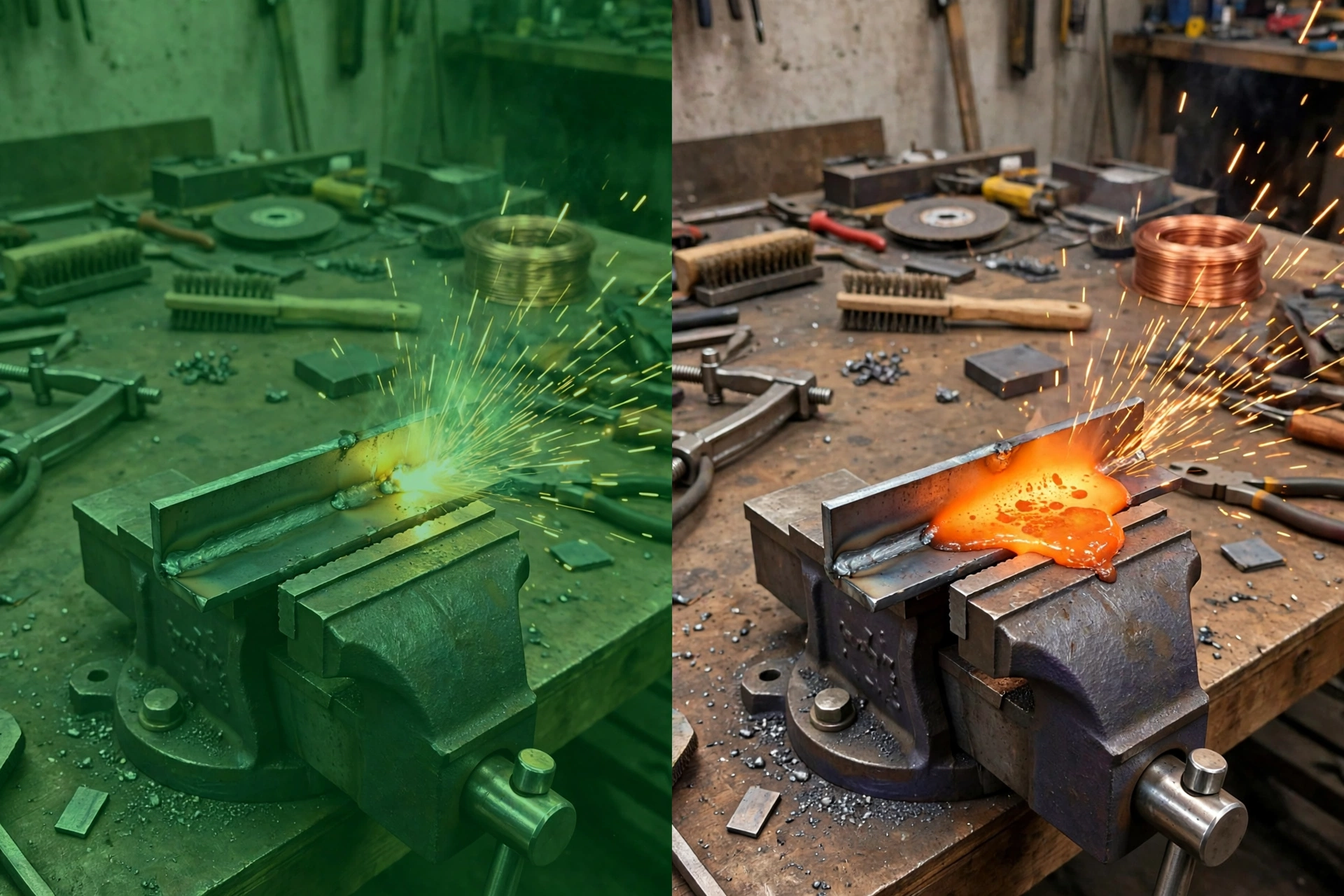
The difference is what you see: a regular auto-darkening lens tints your view green or amber, while a “true color” lens uses improved filtering so the weld puddle and your work appear in much more natural colors. Both protect your eyes the same way; true color is about clarity and comfort — and it usually costs more.
If you learned to weld looking through a green world, a true color lens can feel startling the first time: the puddle shows orange and white instead of lime, the joint line is easier to read, and colors around the shop look almost normal. Is that worth paying for? It depends on the work you do and how long your welding days are. Here is how the two compare.
Why Do Regular Welding Lenses Look Green?
Traditional auto-darkening filters block the arc’s brightness using a combination of interference filters and liquid crystal layers. The filtering that results has historically let green and amber wavelengths dominate what reaches your eye, so everything through the lens takes on that familiar green cast. Welders adapted to it for decades — you learn what a good puddle “looks like” in green, the way you learn a second language.
The tint does not mean the lens is failing. A quality regular lens still filters ultraviolet and infrared radiation and darkens to its rated shade; the green view is a by-product of the filter design, not a safety gap. The cost of the tint is purely visual: subtle color cues — the difference between a puddle that is wetting in nicely and one that is about to burn through, or the exact edge of the joint — are harder to read in monochrome green than in natural color.
What Does a True Color Lens Do Differently?
True color lenses use a broader, more balanced filtering approach that passes a wider band of the visible spectrum while still blocking the harmful rays and darkening to the set shade. The result is a view that looks much closer to what you would see with the helmet up: the arc and puddle show their real oranges, yellows, and whites, metal keeps its actual color, and the surrounding work area stays recognizable instead of going green.
Practically, welders report three benefits. First, puddle reading improves — heat color, puddle edges, and slag behavior stand out more clearly, which matters most on thin material, TIG work, and anything cosmetic. Second, eye strain drops over a long day, because your eyes work less to interpret an unnatural image. Third, switching between helmet-up and helmet-down views is less jarring, since the two views resemble each other.
Is True Color Safer Than a Regular Lens?
Not in the headline sense — and that is the right way to think about it. Both lens types, from reputable makers, meet the same eye-protection requirements: UV and IR filtering is present in light and dark states, and the shade darkening works the same way. True color changes the visible image, not the level of rated protection.
Where it can help safety indirectly is through visibility. A welder who can see the puddle and the joint clearly makes fewer mistakes, repositions less, and is less tempted to lift the helmet mid-task to “check how it looks.” Clearer vision also means noticing problems — a drifting arc, an inclusion forming — sooner. But none of that substitutes for correct shade selection and a properly certified helmet. Buy true color for the view, not for extra protection.
What Is the Optical Clarity Rating You See on Lens Specs?
Auto-darkening lenses are often described with a four-number optical rating, written in a style like 1/1/1/1. In general terms, the numbers grade the lens on optical accuracy (how undistorted the view is), light diffusion, consistency of the shade across the lens, and how well it performs when you view through it at an angle. A 1 in each position is the best grade in that system; higher numbers mean more distortion or inconsistency.
This rating is worth checking whatever lens type you buy, because it affects your day as much as the color does. A regular lens with a top optical rating can be crisper than a cheap “true color” lens with mediocre ratings. Read both specs together: color technology tells you the palette; the optical rating tells you the sharpness and consistency.
Who Benefits Most From True Color — and Who Can Skip It?
True color earns its premium for welders who live by their eyes: TIG welders working thin or cosmetic material, fabricators doing long production runs, instructors teaching students what a correct puddle really looks like, and anyone whose eyes fatigue quickly. If you weld all day, the reduced strain alone can justify the upgrade.
Occasional welders can reasonably skip it. If your welding is an hour of MIG repairs on a Saturday, a quality regular lens gives you full protection and a perfectly workable view, and the money saved is better spent on fit, a good shade range, or other protective gear. What you should not do is buy a no-name lens of either type with no verifiable ratings — the label claims are the product, and unknown lenses have unknown filtering.
Whichever way you go, the fundamentals are the same as with any certified head protection: buy from a reputable maker, confirm the ratings, and make sure the helmet fits and stays comfortable — the same certification-and-fit basics that apply to riding helmets, as our explainer on how helmet safety features and fit work outlines. A lens you trust is a lens you will keep down while the arc is lit.
Frequently Asked Questions
Q: Can I upgrade my existing helmet to a true color lens?
A: Often yes. Many helmets accept replacement auto-darkening cartridges or lenses, and true color versions exist for common sizes. Check your helmet’s lens dimensions and mounting style, and buy the replacement from a reputable maker so the ratings are genuine.
Q: Is true color worth it for a beginner?
A: It can be, because beginners are still learning what a good puddle looks like, and seeing it in natural color shortens that learning curve. But a solid regular lens with a good optical rating is also a fine start — fit, shade range, and certification come first.
Q: Do true color lenses work for all welding processes?
A: Yes, in general terms — true color refers to the viewing filter, not the process. As with any auto-darkening helmet, confirm the shade range and sensitivity settings suit your process, especially for low-amperage TIG, and follow the maker’s guidance.

Olivia
Writer at Helmet Today, covering helmet reviews, fit and riding safety.