
Vintage-style scooter helmets vary in safety because “vintage style” describes how a helmet looks, not how it is built. Some retro-looking helmets are fully modern helmets in period-correct shells, tested and certified to current standards. Others are thin novelty shells made to look old, with little or no energy-absorbing foam inside. The styling tells you nothing — the certification label tells you almost everything.
If you love the classic open-face look, that is no problem at all. Plenty of manufacturers now sell retro helmets with thick EPS liners, proper retention systems, and genuine DOT or ECE certification. The danger zone is the unregulated end of the market, where a helmet can be shaped like a 1960s classic but protect like a plastic cereal bowl. This guide explains how to tell the two apart before you buy.
Why Do Two Helmets That Look Identical Differ So Much in Safety?
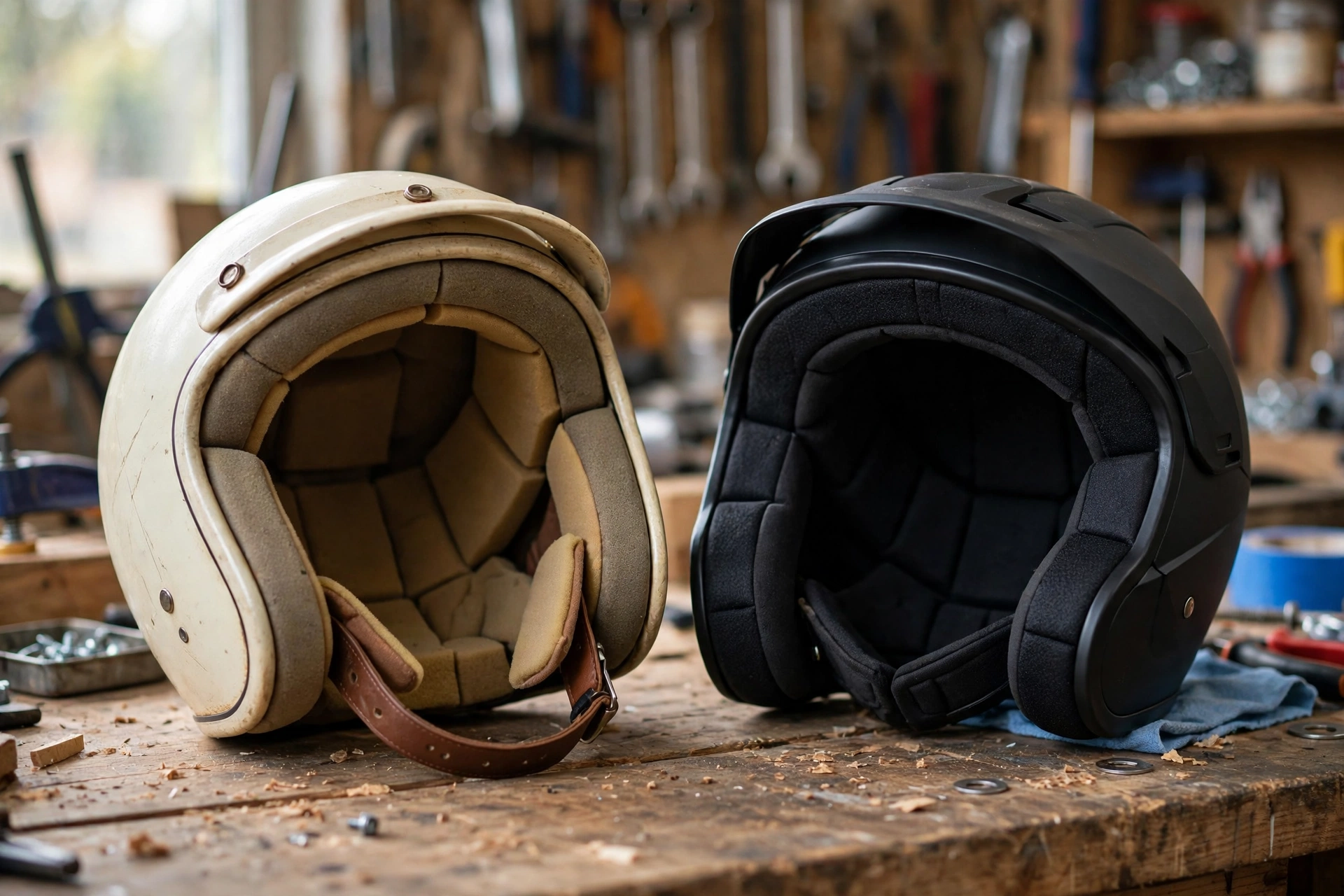
The outside of a helmet is only a shell. What actually protects your head in a crash is the crushable foam liner inside it — usually expanded polystyrene (EPS) — which absorbs impact energy by permanently deforming. In a genuine modern helmet, that liner is a substantial layer, typically an inch or more thick in key areas, and the whole design has been drop-tested against a standard.
A novelty helmet skips most of that. The shell may be thin fiberglass or plastic, the “liner” may be little more than comfort padding, and the strap may be there for decoration. From three feet away, both helmets look the same. In a fall, they perform completely differently. Weight is often the giveaway: a novelty shell usually feels suspiciously light in the hand, because the protective material simply is not there.
Price is another clue, though not a guarantee. A certified retro helmet from an established brand costs real money because testing, materials, and quality control cost money. A very cheap “vintage” helmet sold with no brand, no standard markings, and no paperwork is almost certainly a novelty item, whatever the listing claims.
How Can You Tell a Certified Retro Helmet From a Novelty Shell?
Start with the labels. A legitimate helmet carries a certification label — in the US, that means it meets the DOT standard (FMVSS 218), and in Europe it should carry an ECE 22.05 or 22.06 approval label sewn or fixed to the strap or liner. Be aware that fake DOT stickers exist and are sold separately, so the sticker alone is not proof. Look for the full package: a permanent label inside the helmet with the manufacturer name, model, size, and date of manufacture, plus documentation in the box.
Next, inspect the liner. Press the inside of the helmet: you should feel a firm, thick layer of EPS foam between the shell and the comfort padding, not a thin skin of fabric over a hollow shell. Check that the chin strap is wide, securely anchored, and fitted with a proper buckle or double D-ring — not a flimsy snap.
Finally, buy from a reputable dealer and check the model on the manufacturer’s own website. If the brand does not list the helmet, or the “brand” has no website at all, walk away. In general terms, if a seller describes a helmet as “novelty,” “costume,” “not for highway use,” or sells it in a gift shop setting, treat it as exactly that — a novelty, not protective equipment.
Are Certified Retro Helmets as Safe as Modern-Style Helmets?
Within the same certification standard, yes, broadly speaking. A retro open-face helmet that genuinely meets DOT or ECE requirements has passed the same impact tests as a modern-styled open-face helmet. Certified designs also increasingly include modern features under the classic skin, such as rotational impact liners — you can read more about how those work in our explainer on what MIPS is and how it works.
The honest caveat is about coverage, not certification. Most vintage-style helmets are open-face or three-quarter designs, which leave the chin and jaw exposed. A modern full-face helmet certified to the same standard protects more of your head. That is a trade-off scooter riders have always made: open-face helmets feel free, airy, and social, and for lower-speed city riding many riders accept the compromise knowingly. What you should never accept unknowingly is a helmet that looks protective but is not certified at all.
What About Actually Old Helmets — Are Real Vintage Helmets Safe?
No. A genuine antique helmet — one actually made in the 1960s or 70s — should be treated as a display piece, however good it looks. Helmet foam and shell materials degrade with age, heat, sunlight, and sweat. A decades-old liner may have hardened or crumbled, and the helmet was built to the standards of its era, if any, which were far less demanding than today’s.
The same logic applies to any used helmet with an unknown history. A helmet that has already taken one impact may look perfect while its liner is crushed in one spot, and it will not protect properly a second time. If you love vintage style, buy a new retro-styled helmet and enjoy the look with modern protection underneath.
What Should You Check Before Buying a Vintage-Style Helmet?
- Certification: a genuine DOT label (US) or ECE label (Europe), backed by a named manufacturer and model you can verify.
- Liner: a thick, firm EPS layer inside the shell — press and look before you buy.
- Weight and feel: a real helmet has substance; a suspiciously featherweight shell is a red flag.
- Strap and hardware: a wide, well-anchored strap with a solid buckle or D-rings.
- Fit: snug all over with no pressure points, sitting level on your head — fit matters as much as certification, because a loose helmet can shift or come off in a crash.
- Age and history: buy new, from a dealer, and replace after any crash or drop onto a hard surface.
Treat the check like a two-minute investment. Riders who run through it end up with a helmet that looks the part and genuinely does the job.
Frequently Asked Questions
Q: Is a vintage-style helmet legal to wear where helmets are required?
A: Only if it is actually certified. In places with helmet laws, the requirement in general terms is a helmet meeting the applicable standard (such as DOT in the US). An uncertified novelty shell usually does not satisfy the law, even if it has a sticker on it.
Q: Can I add a DOT sticker to my novelty helmet to make it legal?
A: No. The sticker does not change what the helmet is. Certification applies to the tested design, not the label, and using a fake sticker can leave you both unprotected and on the wrong side of a helmet law.
Q: Are retro helmets okay for highway-speed riding?
A: A certified retro helmet meets the standard it was tested to, but most retro designs are open-face, so your chin and face are unprotected. For regular faster riding, many riders choose a certified full-face helmet instead; for city scooter speeds, a certified open-face is a reasonable, informed choice.

Olivia
Writer at Helmet Today, covering helmet reviews, fit and riding safety.