

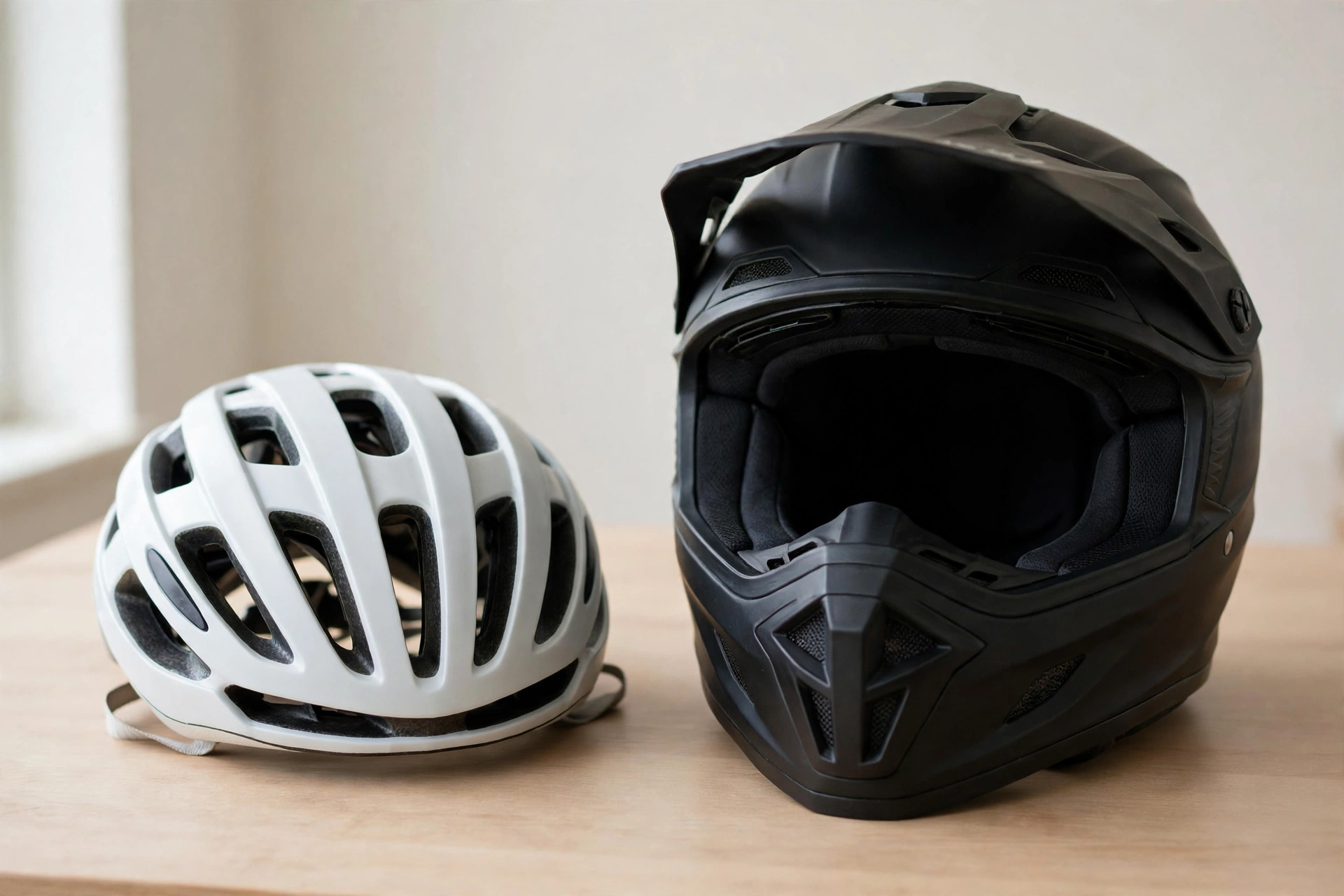
A bike helmet and a motorcycle helmet are built for completely different crashes, and you must never substitute one for the other. A bicycle helmet is light, heavily vented, and certified to the CPSC bicycle standard for cycling speeds and falls. A motorcycle helmet is much heavier, covers more of your head and face, and is certified to standards such as DOT for impacts at road speeds involving vehicles. Wearing a bike helmet on a motorcycle leaves you badly under-protected, and a motorcycle helmet is the wrong, cumbersome tool for cycling.
Both contain foam and fasten with a chin strap, but almost everything else differs, because the problem each one solves is different.
Designed for Very Different Speeds and Impacts
Most cycling falls happen at relatively low speeds, often a fall from saddle height onto the road or trail, a slide, or a collision that begins at cycling pace. A bicycle helmet is designed to absorb that kind of impact once, protect the top, sides, front, and back of your skull, and then be replaced. Its open design also deals with a cyclist’s big problem, heat, because your own effort is the engine.
A motorcyclist faces a different energy problem. Road speeds are far higher, other vehicles are involved, and a rider can strike the road, a car, or roadside objects with much greater force and then slide a long distance. A motorcycle helmet therefore needs a tough outer shell that resists penetration and abrasion, a thick energy-absorbing liner, and a strong retention system that keeps the helmet on through more than one contact.
A bicycle helmet looks like ventilated headgear; a motorcycle helmet looks like protective equipment for a serious crash. They are meant to.
Bike Helmet vs Motorcycle Helmet: Side by Side
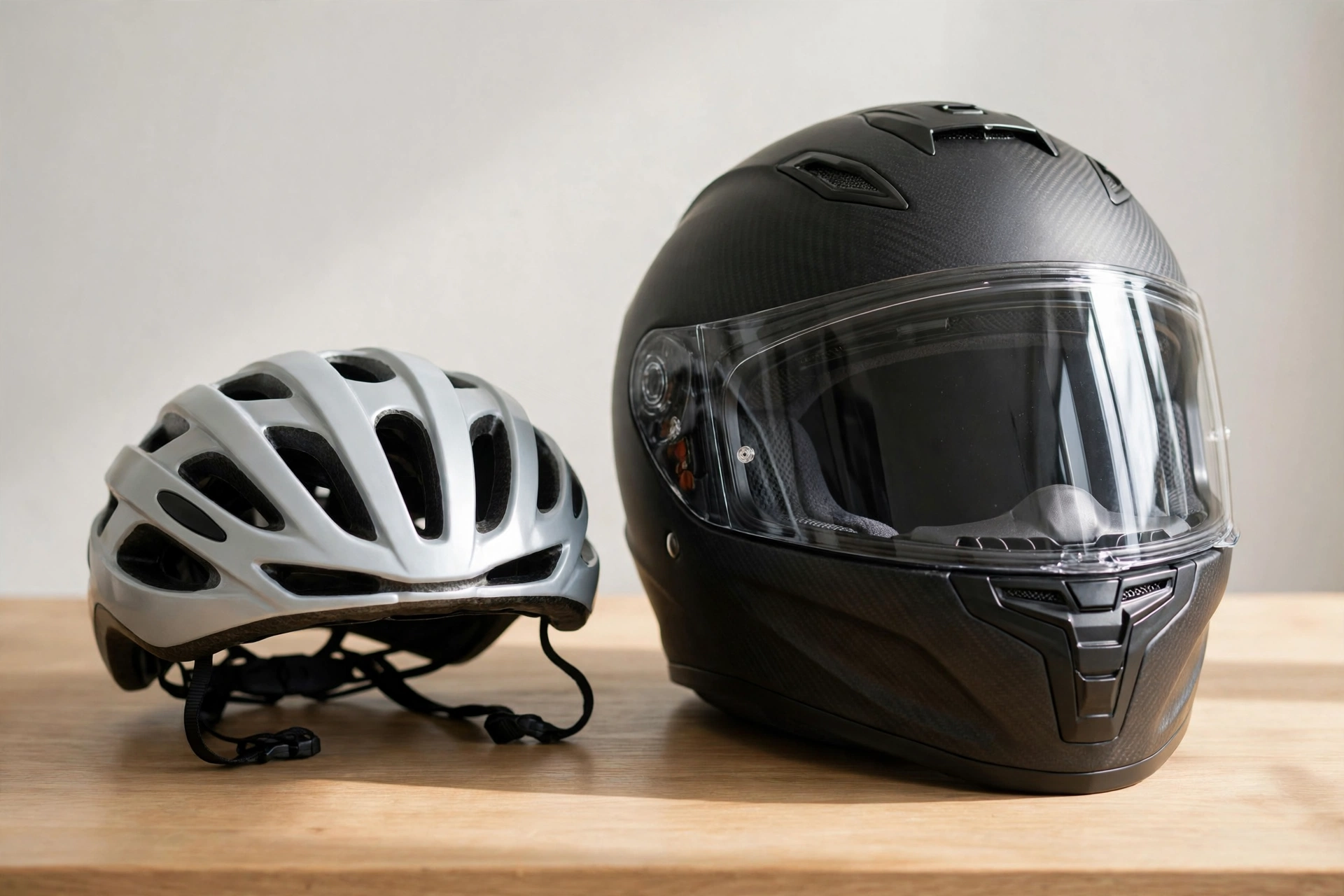
| Point | Bike Helmet | Motorcycle Helmet |
|---|---|---|
| Typical weight | Light, designed to be forgotten on long rides | Much heavier, with a substantial shell and liner |
| Coverage | Top, sides, front, and back of the skull; face is open | Full head coverage; full-face models also protect chin and face |
| Shell | Thin shell bonded to foam, mainly to hold it together and slide | Thick, hard shell in polycarbonate, fiberglass, or composite |
| Energy liner | Expanded polystyrene foam, crushes in a fall | Thicker multi-part foam liner for higher-energy impacts |
| Ventilation | Large open vents for cooling while pedalling | Smaller closable vents, balanced against noise and weather |
| Certification | CPSC bicycle helmet standard in the US | DOT in the US, and often ECE 22.06 internationally |
| Extras | Visor on some trail models, light mounts | Face shield, drop-down sun visor, speaker pockets |
| Use it for | Bicycles and, only if stated, similar low-speed activities | Motorcycles, scooters, and mopeds as local law requires |
The table also explains comfort. On a summer climb, a motorcycle helmet would trap heat and strain your neck with weight you do not need at cycling speeds. On a highway, a bicycle helmet’s open foam, thin shell, and vents offer nowhere near the coverage or impact capacity the situation demands.
Materials and Construction
Bicycle helmets are usually made by bonding a thin polycarbonate microshell directly to an expanded polystyrene foam body. This in-mold construction keeps weight low and lets designers carve the large vents cyclists need. Many models add internal reinforcement and some add a rotational impact system; our guide to what MIPS is for helmets explains how those systems work. Even the toughest-looking trail helmet, though, is still a bicycle helmet underneath.
Motorcycle helmets start with a much stronger outer shell of polycarbonate, fiberglass, or a composite, shaped to spread impact force and resist penetration. Under it sits a thick foam liner, often with sections of different density, then comfort padding, cheek pads, and a face shield on a pivot. Full-face models include a chin bar, which matters because the chin and face are exposed on open-face designs. The strap hardware is also heavier, commonly a double D-ring or a micrometric buckle made to stay fastened under load.
Care follows from the materials: rinse and air-dry a bicycle helmet, inspect a motorcycle helmet’s shell, shield, and straps regularly, and replace either after any crash impact.
Certification Is Not Interchangeable
In the United States, bicycle helmets must meet the Consumer Product Safety Commission standard for bicycle helmets, usually identified by a CPSC label inside the helmet. Motorcycle helmets must meet the Department of Transportation standard, FMVSS 218, shown by the DOT symbol on the back, and many also carry ECE 22.06 approval for use in Europe and other markets.
These are not grades on one shared scale, where DOT simply sits above CPSC. They are separate legal and technical frameworks for separate activities, with tests built around the impacts, coverage, and retention each activity demands. A helmet cannot be approved as a motorcycle helmet by passing a bicycle test, and a motorcycle helmet is not a certified bicycle helmet either, even though it feels sturdier. Purpose and standard travel together.
Children’s products make this point especially clear. A child on a bicycle needs a correctly sized bicycle helmet that meets the CPSC standard. The same child riding as a motorcycle passenger needs a properly fitting motorcycle helmet and must follow local rules, which are part of the wider picture explained in our summary of helmet laws by state. Never move a child between vehicles in the same helmet and assume they are covered.
Fit and Comfort for Each Activity
A bicycle helmet should sit level, low on the forehead, snug without pain, with side straps forming a neat V under each ear and no more than about two fingers of space under the chin strap. Because you generate heat and move your head constantly, a light helmet with a good adjustment dial is a safety feature in itself: you will wear it willingly on every ride.
A motorcycle helmet should feel snug all around, including the cheeks on a full-face model, without a painful hotspot. It should not lift or shift when you move your head, because wind at speed finds any looseness. Try one on for several minutes, and check you can operate the strap with gloves.
Both helmets share one rule: buy your own size, buy new from a reputable seller, and replace the helmet after a crash or significant impact. A borrowed, unknown-history helmet may look fine while hiding damage in the foam that does the real work.
Frequently Asked Questions
Can I wear a bicycle helmet on a motorcycle if I ride slowly?
No. A bicycle helmet is not certified for motorcycle use and does not provide the coverage, shell strength, or retention needed on the road at any speed. It may also be illegal where a DOT-compliant helmet is required.
Can I wear a motorcycle helmet for cycling?
It is a bad idea and not a certified bicycle helmet. It is heavy, hot, poorly ventilated for pedalling, and can strain your neck. Use a correctly fitted CPSC bicycle helmet for cycling.
Is a more expensive helmet from the other category safer?
No. Price does not change the category. A premium bicycle helmet is still a bicycle helmet, and a budget motorcycle helmet that truly meets DOT requirements is still the correct type for motorcycling. Buy the right category first, then compare features.

Olivia
Writer at Helmet Today, covering helmet reviews, fit and riding safety.

Pingback: How to Choose a Mountain Bike Helmet