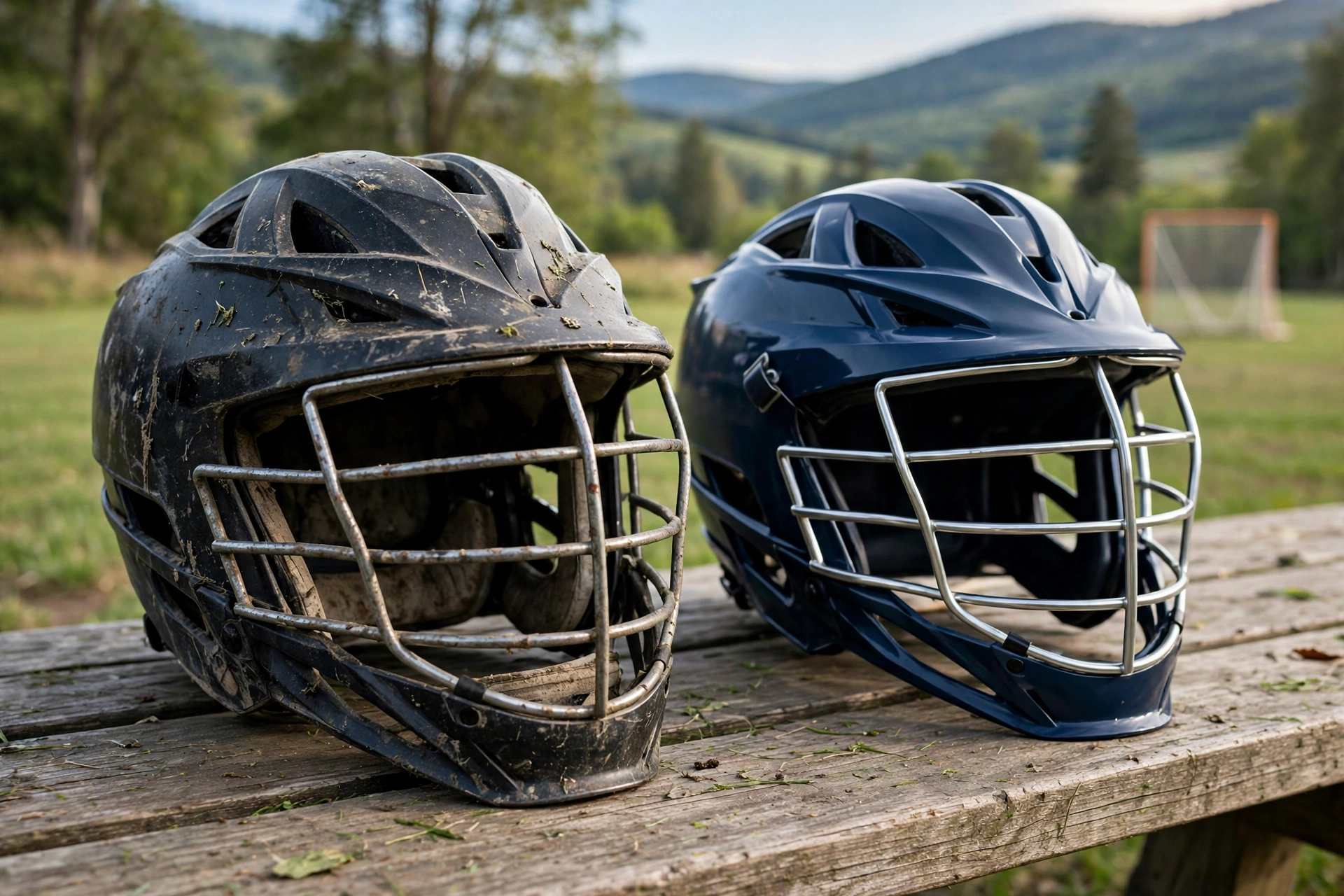
Replace a lacrosse helmet immediately after any major impact, and as soon as you find a cracked shell or mask, loose or deteriorated padding, damaged chin strap hardware, or an expired certification. Even a helmet that looks fine has a limited service life, so age and heavy use are reasons to replace it too — when in doubt, retire it, because a helmet’s protection cannot be judged from its appearance alone.
Unlike a jersey or a stick, a helmet is a single-purpose safety device whose most important materials are hidden inside the shell. The foam that absorbs impact energy degrades with hits, sweat, heat, and time, and none of that shows on the outside. The guide below covers each replacement trigger in turn, plus the two most common ways players accidentally shorten a helmet’s life: modifying and repainting it.
Should You Replace a Helmet After a Big Hit?
Yes — after a major impact, retire the helmet or send it for manufacturer inspection before using it again. Lacrosse helmet foams are designed to manage energy by deforming, and once the foam in an area has been compressed by a hard check, a fall onto the head, or a point-blank shot, it cannot absorb a second impact in the same spot as effectively. This damage is often completely invisible: the shell springs back while the foam underneath stays crushed.
Not every contact counts as a major impact. Routine bumps, stick taps, and the minor knocks of normal play are what helmets are built for. The events that matter are the ones you remember clearly — a collision that rattled you, a fall where your head struck the ground, any impact that left you with symptoms, however brief. If you are asking yourself whether a hit was “big enough,” treat it as big enough, and at minimum have the helmet checked under the manufacturer’s reconditioning or inspection program before it goes back on your head.
Any helmet involved in an incident where the player showed concussion symptoms should be removed from play entirely until professionally evaluated. Understanding how helmets address different impact types helps here — our explainer on what MIPS does in a helmet covers how modern designs manage rotational forces as well as direct hits.
What Physical Damage Means Replacement?
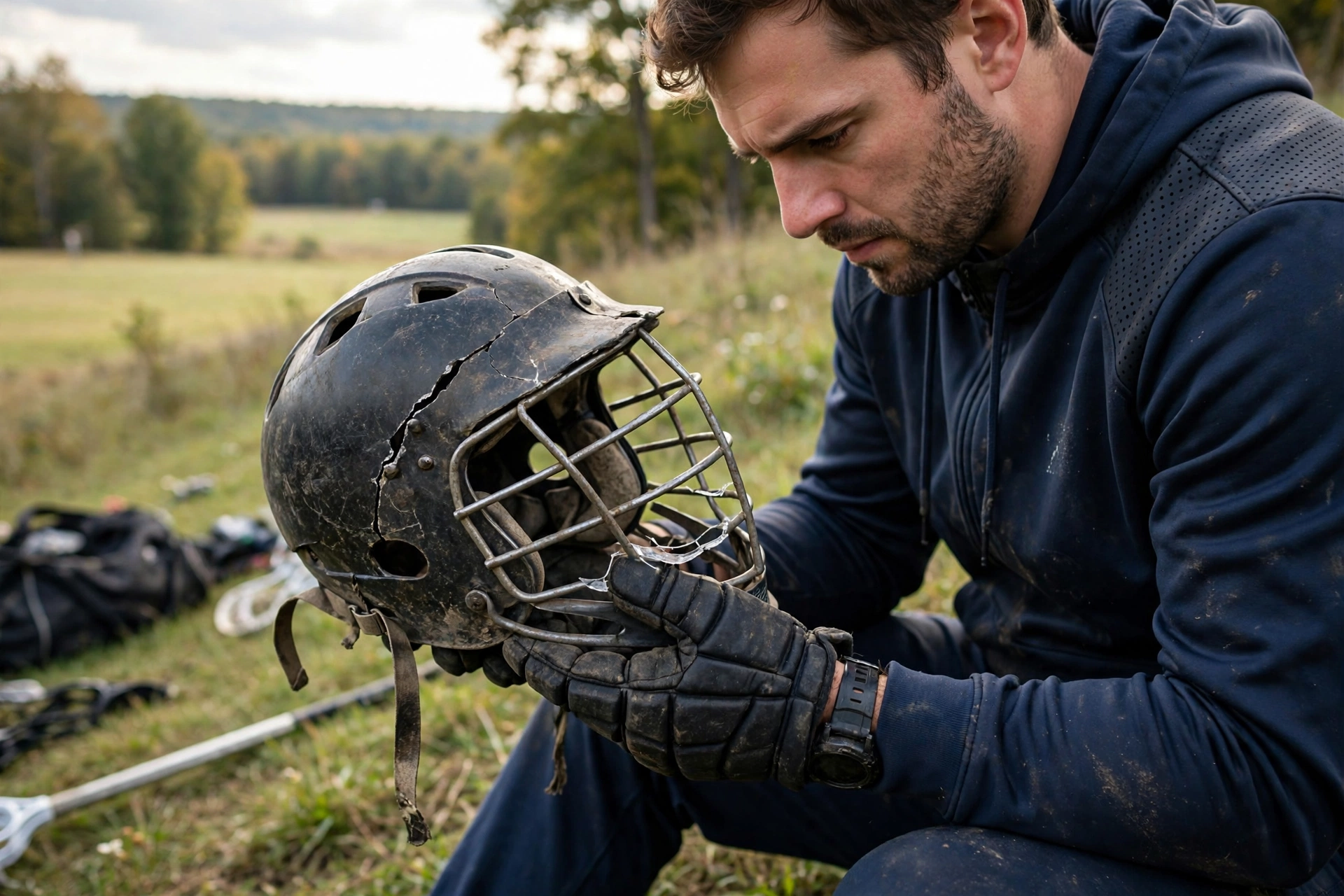
Inspect the shell regularly for cracks, deep gouges, soft or flexing spots, and stress whitening in the plastic — any of these ends the helmet’s service life. Pay special attention around the mask mounts, the chin strap attachment points, and the edges of the ear openings, where stress concentrates. A shell that flexes noticeably more than it did when new has lost structural integrity even without a visible crack.
Inspect the mask the same way. Bent bars, cracked welds or joints, rust breaking through the coating, and loose mask hardware all mean the cage can no longer be trusted. Never straighten a bent mask and keep playing: the metal has already yielded once, and its strength is reduced exactly where it bent. Loose screws can be tightened once; a mask that keeps working loose has damaged mounting points and needs professional assessment.
Inside, check the padding and liner. Foam that is cracked, crumbling, permanently compressed (noticeably thinner in one area), peeling away from the shell, or so sweat-degraded it stays stiff and smelly after cleaning cannot do its job. If the fit system no longer holds its adjustment, or the chin strap or its hardware is worn, frayed, or cracked, those are replacement triggers too — for the strap alone if a compatible part exists, and for the helmet if the shell-side mounts are damaged.
How Long Does a Lacrosse Helmet Last?
Lacrosse helmets must meet the NOCSAE standard, and that certification is not permanent. Manufacturers state a service life for each model — check the documentation and the labels inside your helmet — and heavy use, frequent impacts, heat exposure in car trunks, and hard seasons all shorten real-world life below the maximum. A helmet used several times a week by a competitive player ages far faster than one worn for a casual season a year.
Certification labels matter beyond age. If the NOCSAE label or the manufacturer’s labels are missing, illegible, or were removed, many leagues will not allow the helmet on the field at all, and officials do check. Keep the labels intact, and keep a note of when you bought the helmet and roughly how much it has been used, so the replacement decision is based on facts rather than guesswork.
Youth players add another factor: growth. A helmet that no longer fits — too small, or adjusted to its limit — must be replaced regardless of condition, because a poorly fitting helmet cannot protect as certified.
What Does Reconditioning Cover, and Should You Use It?
Many manufacturers offer reconditioning programs in which the helmet is professionally inspected, the padding and worn components are replaced, the hardware is checked, and the helmet is recertified if it passes. This is the legitimate way to extend a helmet’s life: the maker examines exactly the hidden damage a home inspection cannot see and either restores the helmet to certified condition or rejects it.
Follow the manufacturer’s stated reconditioning intervals for your model, and use only their program or an authorized service. A helmet that fails reconditioning is finished — there is no second opinion that makes it safe again. Reconditioning is also the only safe answer after a questionable impact when you want the helmet evaluated rather than replaced outright. Keep the paperwork; leagues and schools often require proof of current certification or reconditioning for helmets beyond a certain age.
What reconditioning cannot fix: cracked shells, bent masks, and helmets that have been modified. Those are retired permanently, whatever their age.
Can You Repaint or Modify a Lacrosse Helmet?
Do not repaint, refinish, or modify a lacrosse helmet in any way the manufacturer has not approved. Solvents in paints and adhesives can attack the shell material and the impact foam, weakening both invisibly, and manufacturers state clearly that unauthorized painting or modification voids the certification and any warranty. The same applies to drilling holes, removing padding, swapping in parts from other models, or applying heavy aftermarket accessories.
Stickers deserve a mention of their own: team decals supplied or approved for helmet use are generally fine, but avoid covering the certification labels, and remove old stickers carefully rather than with solvents. If you want a custom look, the safe route is a manufacturer-approved finish program or a new helmet in the color you want. A helmet’s certification is a promise about the whole tested system — shell, foam, mask, strap, and finish together — and changing any part of that system breaks the promise.
Frequently Asked Questions
Can I keep using a helmet after one hard hit if it looks fine?
No. Impact foam can be crushed beneath an undamaged-looking shell, leaving that area unable to absorb a second hit properly. Retire the helmet or have it professionally inspected under the manufacturer’s program first.
How do I know if my helmet’s certification is still valid?
Check the NOCSAE and manufacturer labels inside the helmet and the service-life and reconditioning guidance for your model. Missing or illegible labels, or a missed required reconditioning, can make the helmet ineligible for league play.
Is it okay to buy a used lacrosse helmet?
It is risky and generally not recommended. You cannot know its impact history or how it was stored or modified, and hidden foam damage is undetectable at home. A new or manufacturer-recertified helmet is the safe choice.

Olivia
Writer at Helmet Today, covering helmet reviews, fit and riding safety.