

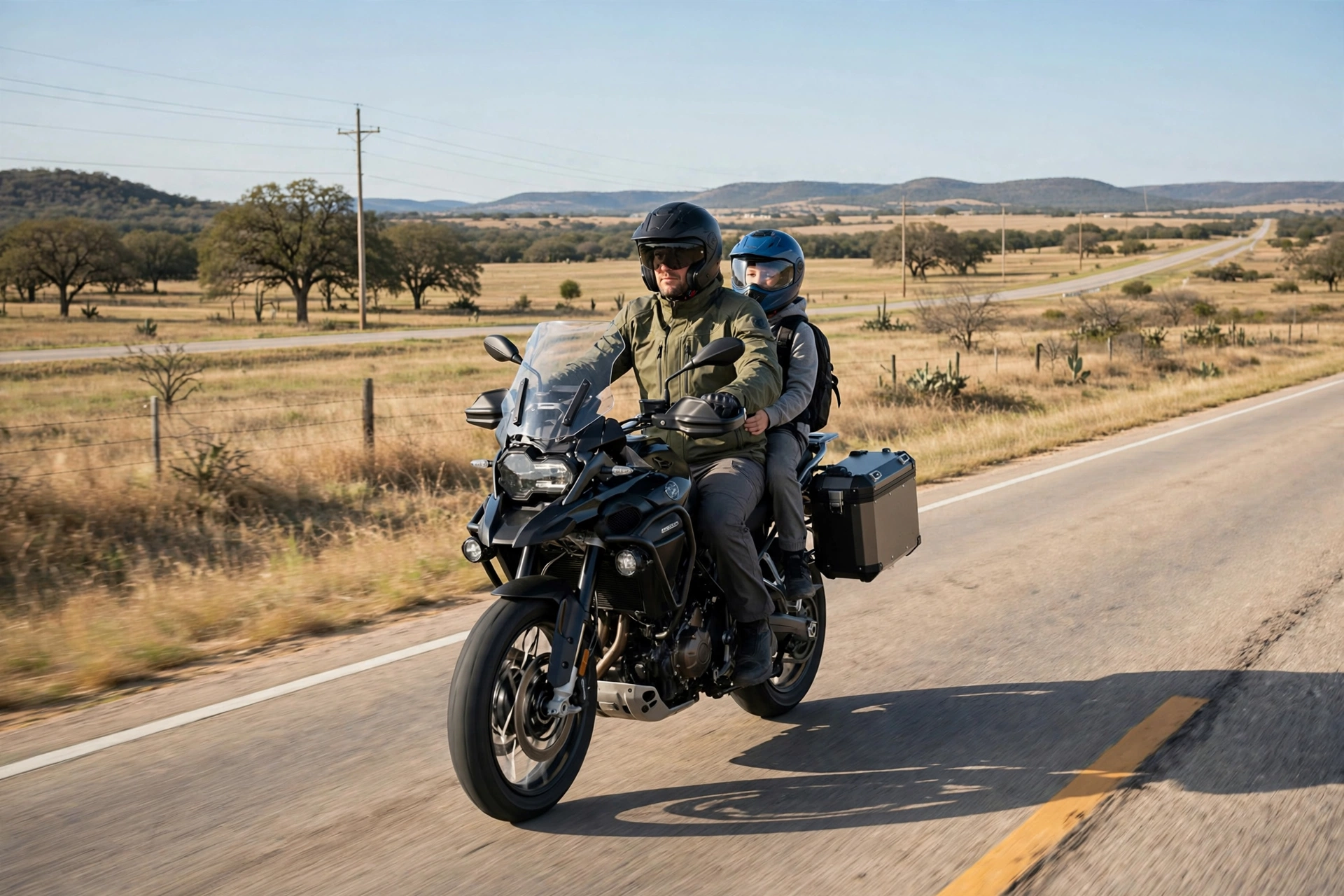
Texas has no minimum age for motorcycle passengers. State law does not set a youngest age at which a child may ride on the back of a motorcycle. Instead, Texas regulates the equipment — the motorcycle must have a seat and footrests designed for a passenger — and its helmet law still applies, so a passenger under 21 must wear a helmet.
Because there is no age number in the law, parents in Texas have to make the readiness call themselves. This article sets out what Texas law actually requires, how the helmet rule affects young passengers, and the practical checks that tell you whether a particular child is ready to ride safely.
Is There a Minimum Age for Motorcycle Passengers in Texas?
No. Unlike a small number of states that ban passengers below a set age, Texas law is silent on passenger age. There is no statute saying a passenger must be five, eight, or any other age. A child who is legally carried is carried under the general passenger equipment and helmet rules, not under an age rule.
That surprises many parents, because Texas does have age-based rules elsewhere in its motorcycle laws — most notably the helmet requirement for younger riders. But for the passenger seat specifically, the legislature left the decision with the adult operator. That means the legal responsibility sits with you: if a child cannot ride safely, the fact that no age law exists does not protect you from the consequences of a crash or from other general duties of care.
It also means you should be wary of confident claims online, both ways. Websites that state a firm Texas minimum age are usually confusing Texas with another state, and riders who say “anything goes” are ignoring the equipment and helmet rules that genuinely do apply.
What Does Texas Law Require for Passengers?
The main Texas requirements concern the motorcycle itself. To carry a passenger legally, the motorcycle must be designed and equipped for one: a proper passenger seat and footrests (pegs) intended for the passenger. Riding with a child perched on the tank, sitting on a luggage rack, or dangling their feet because they cannot reach proper pegs is not what the law contemplates, and it is plainly unsafe.
The passenger also has to be able to ride as a passenger — seated properly, feet on the footrests, holding on. An operator who carries someone who cannot do those things is asking for trouble on the road and potentially in court if something goes wrong. Operators remain fully responsible for riding sober, licensed, and insured as Texas requires of any motorcyclist.
For the full picture of how Texas fits into the national patchwork of rules, see our overview of helmet laws by state, which covers the helmet side of the rules state by state.
Do Child Passengers Still Need a Helmet in Texas?
Yes. Texas requires helmets for motorcycle riders and passengers under 21, unless an exemption applies — and the exemptions are written for adults. The well-known Texas exemption lets a rider who is 21 or older skip the helmet if they meet conditions such as completing an approved safety course or carrying qualifying health insurance coverage. None of that applies to a child passenger: under 21 means a helmet, properly fitted and fastened.
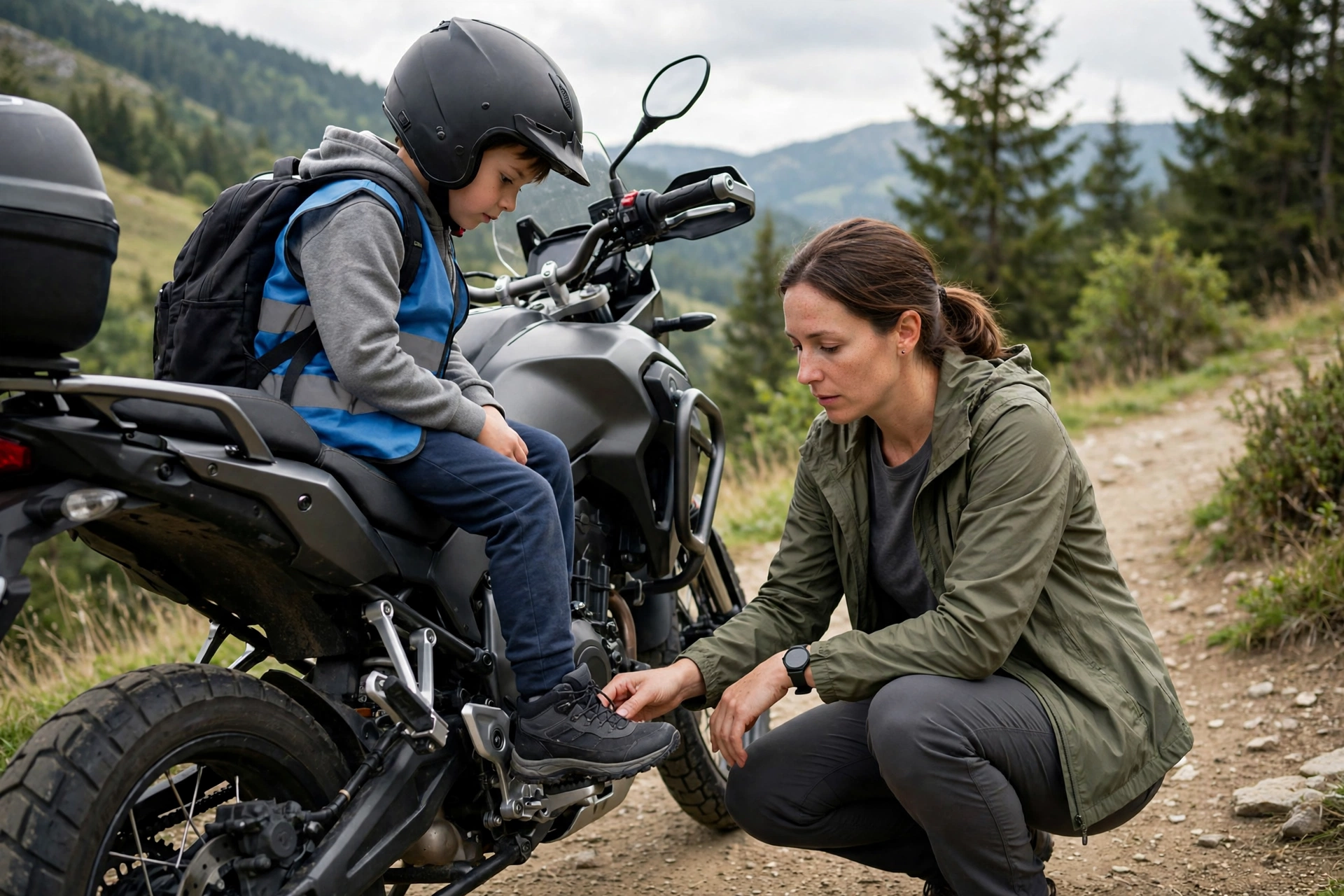
Fitting matters as much as the rule. A child’s helmet should be a real motorcycle helmet that meets the federal DOT standard, sized to the child’s head — not a loose adult helmet “they will grow into.” It should sit level, feel snug all over without pain, and stay in place during a head shake. A helmet that slides around cannot do its job in a fall.
Given Texas heat, look for a helmet with decent ventilation and consider light colours. A child who is comfortable is a child who will keep the helmet on and sit still, and that cooperation is part of safe riding.
How Do You Know If a Child Is Ready to Ride?
Since the law gives no age, use readiness tests instead. First, the physical test: sitting on the stationary bike, can the child place both feet flat on the passenger footrests and keep them there? If their legs dangle short of the pegs, they are not ready — feet that cannot reach cannot brace, and legs near hot exhausts and moving parts are a hazard.
Second, the strength and attention test: can the child hold on to you or the grab points securely for the whole ride, and follow simple instructions like “hold tight,” “lean with me,” and “don’t let go at stops”? Young children tire, get distracted, and can even fall asleep on a smooth highway cruise — a real risk that rules out longer rides for many kids.
Third, the communication test: agree on simple signals, practise them in the driveway, and start with short, slow rides on quiet streets. Add protective clothing — long trousers, a sturdy jacket, gloves, and closed footwear — scaled to the child. If any of the tests fail, wait. Children grow quickly, and the bike will still be there next season.
Can You Use a Child Seat on a Motorcycle?
No. There is no approved child safety seat for a motorcycle, and nothing equivalent to a car seat can be strapped to one. Products occasionally marketed as child harnesses or belts that tie a child to the rider are not certified safety devices and do not change the physics of a crash. The only approved way for a child to ride is as a proper passenger: on the passenger seat, feet on the pegs, holding on, wearing a correctly fitted helmet.
This is one more reason the readiness tests matter so much in Texas. In a car, the seat bridges the gap until a child is big enough. On a motorcycle there is no bridge — if the child cannot ride as a real passenger yet, the answer is to wait, not to improvise equipment.
Frequently Asked Questions
What is the minimum age for a motorcycle passenger in Texas?
Texas law sets no minimum age. The legal requirements are about the motorcycle (a passenger seat and footrests designed for a passenger) and about helmets: passengers under 21 must wear one.
Does a child passenger in Texas have to wear a helmet?
Yes. Texas requires helmets for riders and passengers under 21. The adult exemptions based on safety courses or insurance coverage apply only to riders aged 21 and over.
Can a child ride in front of the operator in Texas?
That is not proper passenger riding and is unsafe. A passenger belongs on the passenger seat with feet on the footrests and a secure hold. There is also no child seat made or approved for motorcycles.

Olivia
Writer at Helmet Today, covering helmet reviews, fit and riding safety.


