

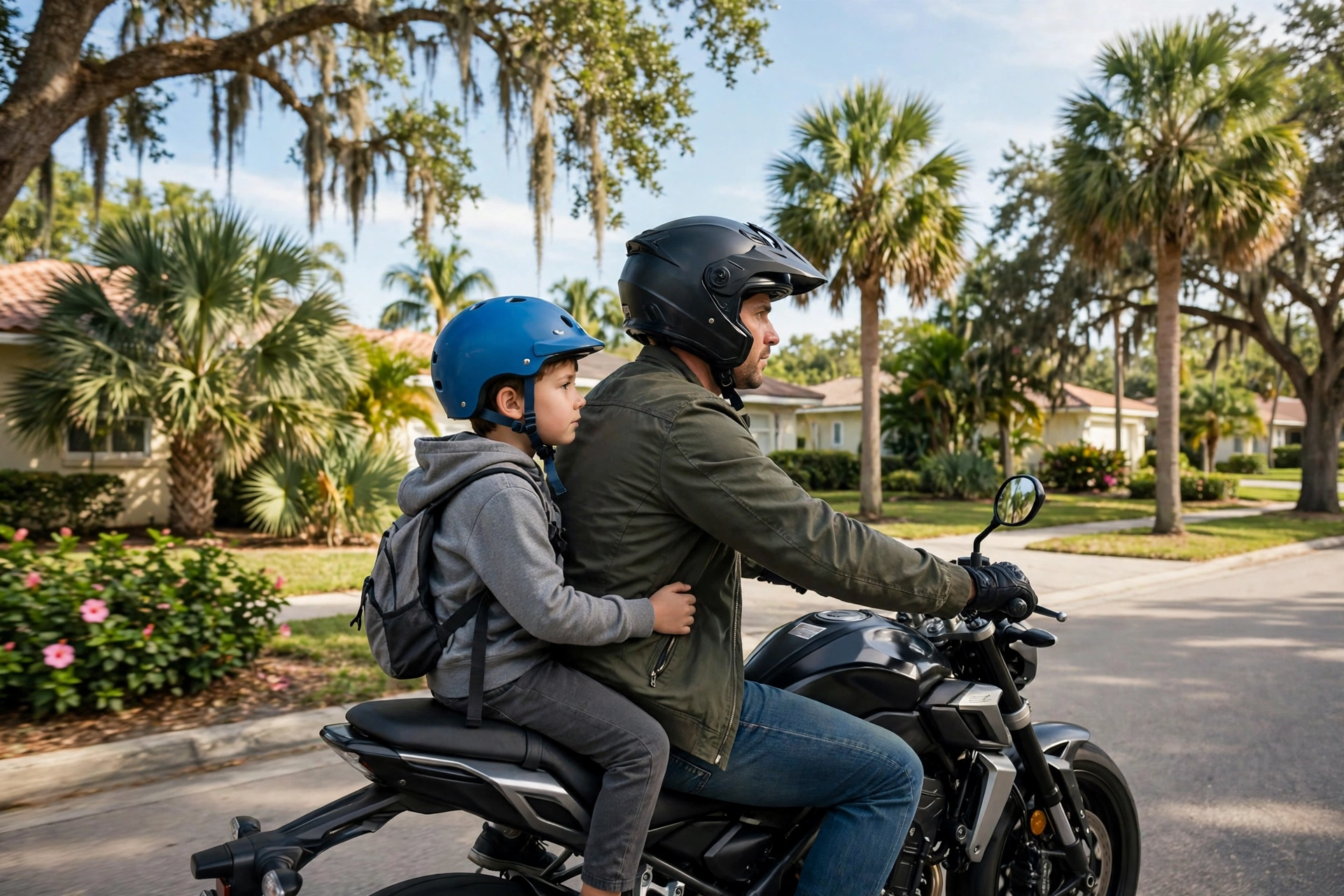
Florida has no minimum age for motorcycle passengers. State law does not specify a youngest age for riding on the back of a motorcycle. What Florida law does regulate is the equipment — the motorcycle must have a seat and footrests for the passenger — and helmets: passengers under 21 must wear one, while the exemption for riders 21 and over depends on carrying medical insurance coverage.
With no age written into the law, the decision falls to the adult rider. Here is what Florida actually requires, how the helmet rules work for young passengers, and the practical checks to use before carrying a child — whether that is a school run across town or a careful ride in a busy tourist area.
Is There a Minimum Age for Motorcycle Passengers in Florida?
No. Florida’s motorcycle statutes govern licensing, equipment, and helmets, but they do not name a minimum passenger age. A child is not made legal or illegal by a birthday; the question is whether they ride as a genuine passenger on a properly equipped motorcycle, with the required helmet.
This puts Florida in the majority of states on this question, and it often surprises riders because Florida law is detailed in other areas — the insurance-based helmet exemption for adults, for example, is quite specific. But on passenger age, the statute book is silent, and no local Florida ordinance fills the gap with a citywide age rule either.
The silence cuts both ways. It gives families flexibility, but it also means the operator carries the judgement call and the responsibility. Carrying a child who plainly cannot hold on, reach the pegs, or stay awake and attentive is reckless riding regardless of what the age law does not say, and it exposes the operator to serious consequences if a child is hurt.
What Equipment Does Florida Require for Passengers?
Florida law requires a motorcycle carrying a passenger to be equipped for it: a seat designed for a passenger and footrests for the passenger to use. The passenger is expected to ride on that seat, using those footrests — not on the fuel tank, not on a rack, and not side-saddle. If a child’s feet cannot reach the footrests, the motorcycle is, in practical terms, not equipped to carry that child.
The operator’s own obligations apply as they would on any ride: a valid motorcycle license or endorsement, a registered and insured motorcycle as Florida law requires, and full compliance with traffic laws. None of these change because the passenger is young, but all of them matter more when the person on the back cannot protect themselves.
Eye protection is part of the equipment picture in Florida as well. Florida requires riders to use an approved eye-protection device while operating a motorcycle, and any passenger benefits from the same thinking. For a child, a helmet with a drop-down or fixed visor is the simplest answer — it handles the eye-protection job while shielding against wind, insects, road grit, and the glare that makes young passengers squint and fidget. A child who can see comfortably is a child who sits still, and a still passenger is a safer passenger on any bike.
To see how Florida’s broader helmet framework compares with the rest of the country, our guide to helmet laws by state lays out the state-by-state picture in one place.
What Helmet Rules Apply to Young Passengers in Florida?
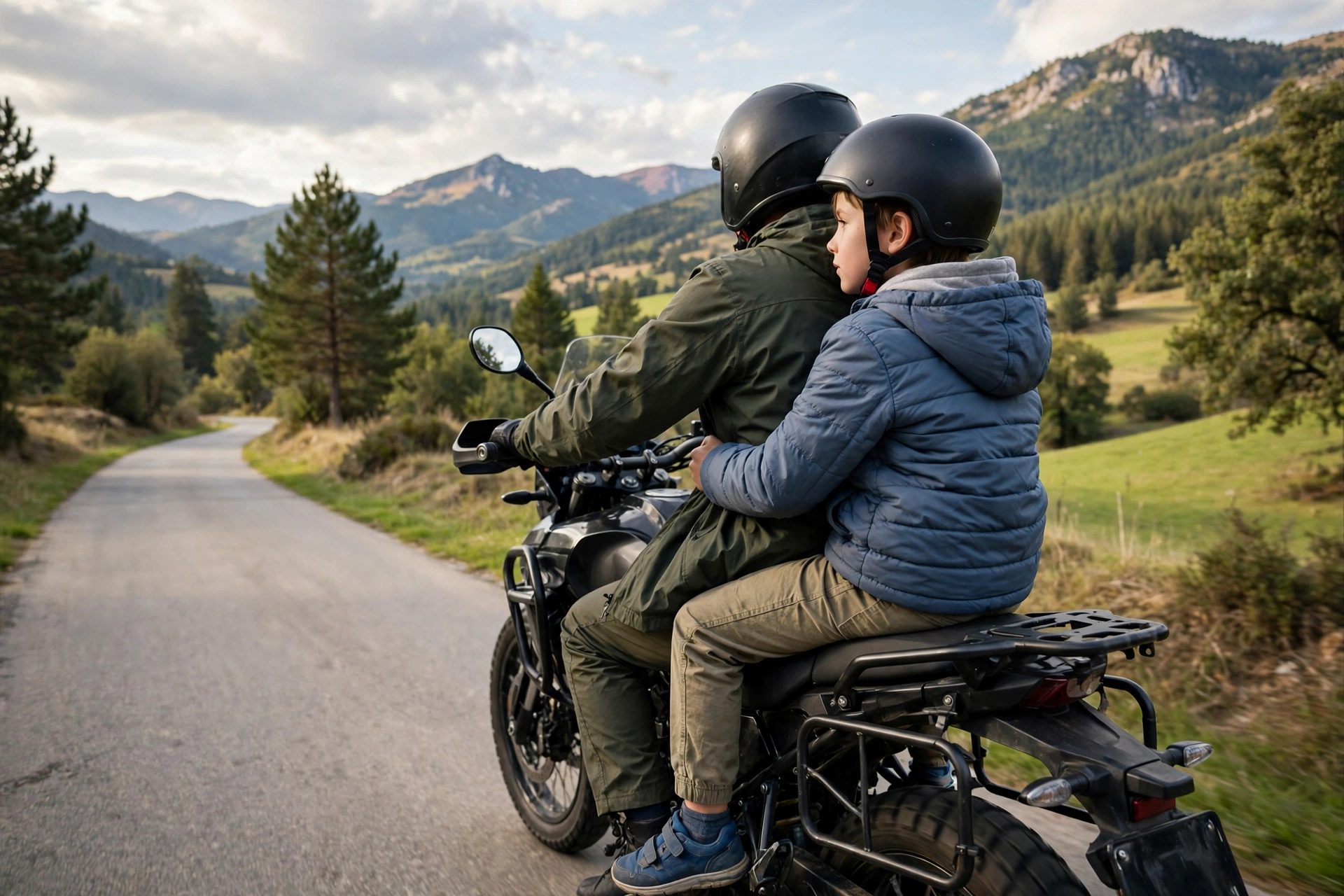
Florida requires helmets for all motorcycle riders and passengers under 21. The familiar Florida exemption — under which riders 21 and over may ride without a helmet — only applies when the rider carries medical insurance coverage meeting the law’s requirements, and it never extends to anyone under 21. For a child passenger, the rule is simple: a helmet is mandatory, full stop.
The helmet should be a genuine motorcycle helmet meeting the federal DOT standard, sized for the child’s head. Children are not small adults for fitting purposes: measure the head, choose the size that fits now, and check that the helmet sits level, feels snug without hurting, and does not shift when the child shakes their head. An oversized helmet bought “to grow into” can lift or rotate in a crash.
Florida adds its own practical wrinkle — heat and sudden rain. A ventilated helmet in a light colour keeps a child comfortable enough to sit still, and a visor helps with sun glare, insects, and the pop-up showers that soak unprepared riders across the state.
How Do You Decide Whether a Child Is Ready to Ride?
Use the same physical checks experienced riders rely on. Feet first: with the motorcycle upright and stationary, the child should rest both feet securely on the passenger footrests and be able to keep them there. Then holding on: the child must be able to grip your waist, a belt, or the passenger grab rails firmly for the entire ride, and understand not to let go at stops, when balance is trickiest.
Then attention: can the child follow basic instructions, stay awake, and sit reasonably still? Florida riding often means stop-and-go traffic in school zones and tourist corridors, where sudden braking and lane changes are routine. A child who is tired, restless, or frightened is not ready, whatever their age happens to be. Start with very short rides on quiet streets near home, agree on a squeeze signal for “stop, I need a break,” and build distance slowly.
Dress the child properly, too: long trousers, a jacket, gloves, and sturdy closed shoes at minimum, every ride. If any check fails, the answer is to wait and try again in a few months — growth spurts arrive fast at these ages, and a child who cannot ride safely today often can next year. Revisit the checks every season, because a child who was borderline in spring may pass comfortably by autumn, and their helmet fit should be re-confirmed at the same time.
Frequently Asked Questions
What is the minimum age for a motorcycle passenger in Florida?
Florida law sets no minimum passenger age. Legality turns on equipment — a passenger seat and footrests the passenger actually uses — and on the helmet rule for riders under 21.
Does a child passenger in Florida need a helmet?
Yes. Everyone under 21 on a motorcycle in Florida must wear a helmet. The insurance-based exemption that lets adults ride without one applies only to riders aged 21 and over.
Can an adult ride helmet-free in Florida while carrying a child?
An adult who qualifies for the exemption (21 or over, with the required medical insurance coverage) may legally ride without a helmet — but the child passenger must still wear one, and most riders choose to helmet up when setting the example for a young passenger.

Olivia
Writer at Helmet Today, covering helmet reviews, fit and riding safety.


