Your child has outgrown a helmet size when the helmet sits high on the head instead of low and level, the straps can no longer be adjusted snug, the fit dial is opened to its maximum and it still feels tight, or it leaves deep red marks on the forehead. Any one of those signs means it is time to measure again and move up a size — a too-small helmet leaves the forehead exposed and cannot protect the way it was designed to.
Children rarely announce that a helmet is too small; they just start resisting it, or parents notice it perched oddly in photos. Because head growth is gradual, the change sneaks up between seasons. This guide covers the signs to watch for, how growth actually progresses, and how to make the check a quick routine.
What Are the Clearest Signs a Helmet Is Too Small?
Position is the easiest sign to spot. A helmet that fits sits low and level, with the front edge about one to two finger-widths above the eyebrows. An outgrown helmet rides up and back, exposing the forehead and sitting more like a cap. If you keep pulling it down into place and it creeps back up, the shell is too small for the head inside it.
Pressure is the second sign. A helmet should feel snug and even, but a too-small one creates specific complaints: a tight band feeling, a headache after a short ride, or a deep red line across the forehead that lingers after the helmet comes off. Temporary light marks from pads are normal; a pronounced crease or a child who rubs their forehead after every ride is telling you something.
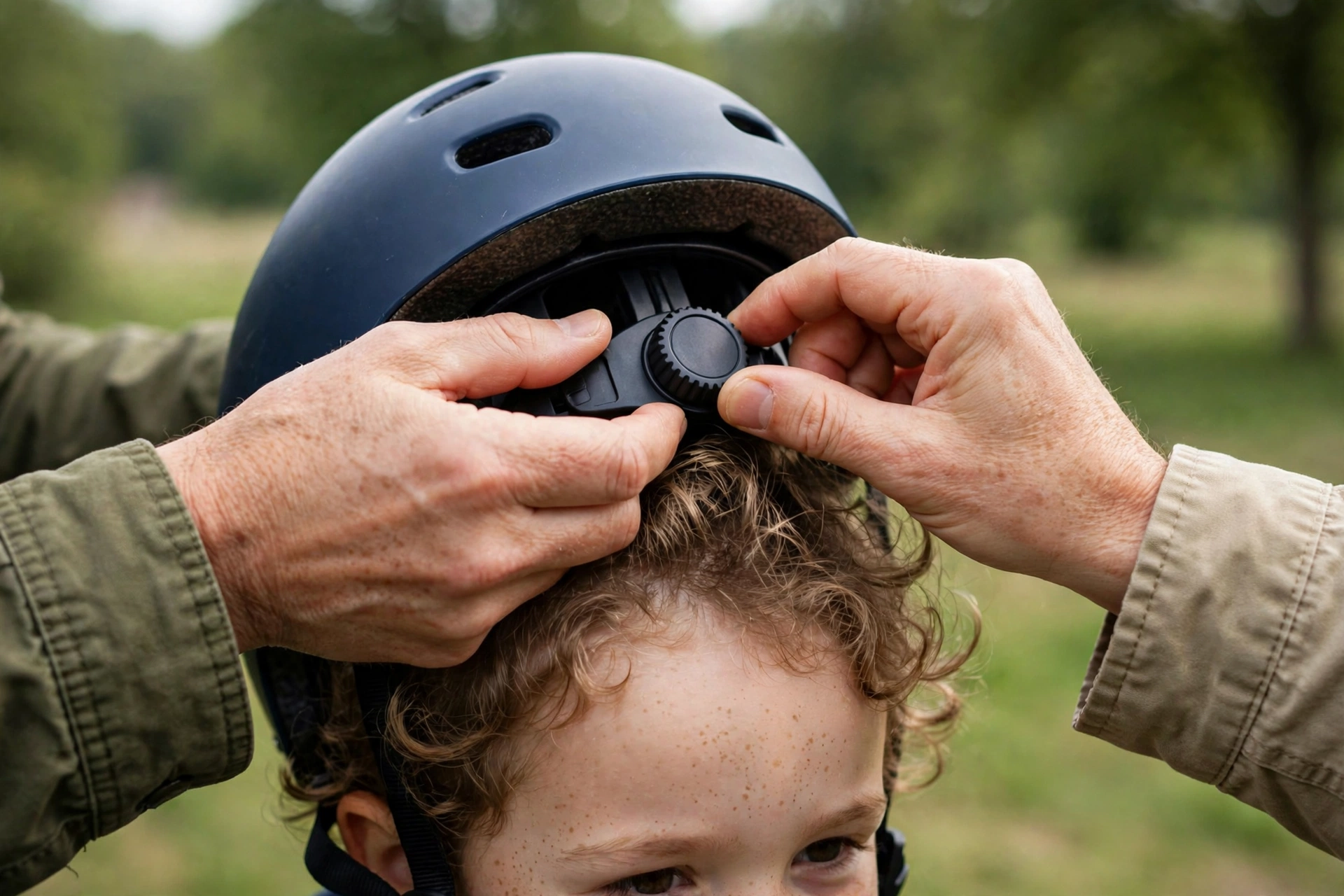
The third sign is the adjustment hardware running out of range. If the rear fit dial is fully expanded, the sizing pads are the thinnest set the maker supplies, and the helmet still will not sit right, there is nothing left to adjust — you have simply reached the end of that shell’s size range. Chin straps that have been let out to their last hole and still pull tight point the same way.
How Fast Do Children’s Heads Actually Grow?
In general terms, head growth is fastest in the first couple of years of life and slows steadily through childhood, but it never stops entirely until the late teens. That pattern is why toddlers can move through helmet sizes quickly — a helmet bought in spring can be snug by the following spring — while an older child may get several seasons from one size.
The practical trap is that growth comes in spurts rather than smoothly. A helmet that fit perfectly at the end of last summer may be too small after a winter growth spurt, even though it was barely worn in between. This is why checking by calendar — at the start of every riding season — works better than checking by how much the helmet has been used.
Remember too that size labels are only rough guides. In general terms, kids’ helmets are sold in bands based on head circumference in centimeters — toddler sizes around the high 40s to low 50s, child sizes through the low-to-mid 50s, and youth sizes approaching adult smalls — but the bands differ between brands. Your child’s measured circumference, not their age or the label on last year’s helmet, decides when a size is outgrown.
How Should You Check the Fit Each Season?
Make it a five-minute routine before the first ride of the season. Start by measuring: wrap a soft tape around the widest part of the head, about an inch above the eyebrows and ears, and compare the number with the size range printed inside the current helmet. If the measurement is at or beyond the top of that range, the helmet is done regardless of how it feels.
Then do the wear tests. Helmet on, level, straps fastened. The helmet should not rock side to side or slide forward when your child shakes their head, and the front edge should stay low over the forehead. Have your child look up at the ceiling: a helmet that is too small often gets pushed by the back of the head and tilts.
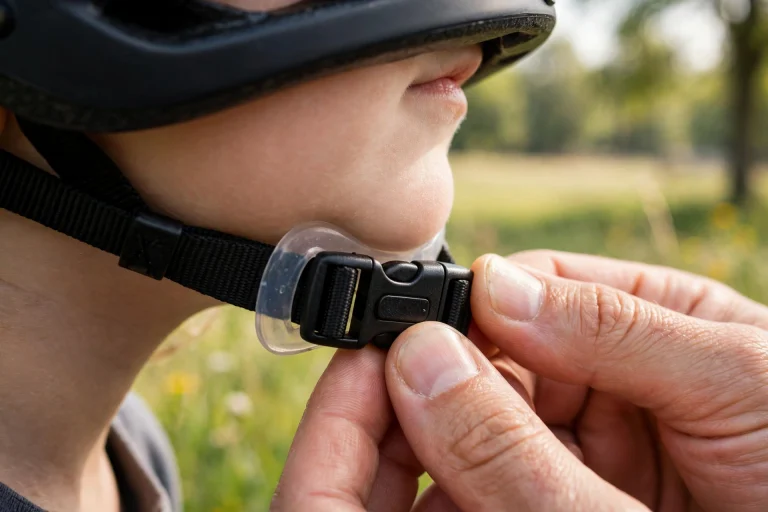
Finish with the strap check: side straps forming a V just below the ears, and about one to two fingers of room under the chin strap. If achieving that means every adjuster is at its limit, treat it as outgrown even if your child insists it feels fine — children adapt to a tight helmet and stop noticing, which is exactly why the checks have to be yours, not theirs.
Why Shouldn’t You Buy a Size Up “to Grow Into”?
Because a helmet only protects when it stays in position. An oversized helmet shifts in a fall, can rotate so it covers the wrong part of the head, and in the worst case can come off. The temptation is understandable — helmets are not free, and kids grow fast — but the safe version of saving money is a helmet with a good fit dial and pad sets that fine-tune within its correct size range, not a size beyond it.
When you do move up, it is worth comparing what the new purchase offers beyond size. Protection technology keeps improving at kid prices, and our guide to MIPS and rotational protection in kids’ helmets explains an option many parents add at replacement time. The priority order never changes, though: correct measured size first, secure fit second, features third.
What Should You Do With an Outgrown Helmet?
If the helmet has never been in a crash and is clean and undamaged, it can be handed down to a younger sibling whose measured head size falls within its range — hand-me-downs between sizes are one of the genuine economies of kids’ gear, as long as the size is right for the new wearer and the helmet is within the manufacturer’s suggested lifespan, in general terms a few years from purchase.
A helmet that has been crashed, has cracked foam, frayed straps, or a broken buckle should never be passed on. Cut the straps before discarding a damaged helmet so nobody retrieves it and uses it unknowingly.
When you buy the replacement, write the purchase date inside with a marker. That small habit makes the next outgrow-or-expire decision much easier, because you will know both the size history and the age of the helmet at a glance.
Frequently Asked Questions
Q: How often should I check whether my child’s helmet still fits?
A: At the start of every riding season at minimum, and sooner if your child complains of tightness, gets forehead marks, or has a growth spurt. Toddlers and young children may need checking twice a year because their heads grow fastest.
Q: The fit dial still has room — can the helmet really be too small?
A: Yes. The dial adjusts the fit band, not the shell. If the shell itself sits high, exposes the forehead, or leaves deep pressure marks, the helmet is too small even if the dial and straps can still be fastened. Shell position is the deciding test.
Q: Can a helmet be outgrown before it wears out?
A: Very often, yes — especially for children under about eight, whose heads grow quickly. Outgrowing is the most common reason kids’ helmets get replaced, ahead of damage or age. That is normal, and it is why measuring each season matters more than the helmet’s condition alone.

Olivia
Writer at Helmet Today, covering helmet reviews, fit and riding safety.