The right way to choose a helmet for pillion passengers is to treat your guest exactly like a rider: a properly fitted, certified helmet in the correct size for that person’s head — never a spare that is two sizes too big, never a novelty lid, and never an old helmet with an unknown history. A passenger has no handlebars to hold, no control over the bike, and the same exposure to the road as you do, so their helmet deserves the same care as your own.
Many riders keep a dusty “guest helmet” on a shelf and assume the job is done. This guide explains why fit matters just as much for passengers, how to build a sensible spare setup if you carry people regularly, and what to check before anyone swings a leg over your bike.
Why Does Fit Matter as Much for a Passenger as for the Rider?
In a crash, a passenger’s head is subject to the same forces as the rider’s — and a loose helmet can shift, block vision, or come off entirely at exactly the wrong moment. A helmet that is too big also moves around in the windstream, which distracts and frightens a nervous first-time passenger and can lift at speed, pulling on the strap.
Passengers also cannot compensate for a bad helmet the way riders unconsciously do. They are sitting higher, often in cleaner — and stronger — airflow, holding on and reacting to movements they did not initiate. A helmet that creeps down over their eyes or wobbles at every acceleration makes the whole ride feel unsafe, because for them it partly is.
Comfort counts too. A guest in a pinching, ill-fitting helmet will associate motorcycling with misery and may quietly decide never to ride again. A decent fit is the difference between a passenger who asks for another ride and one who never mentions it again.
Can One Spare Helmet Really Fit Every Guest?
Honestly, no — and this is the caveat behind every “universal spare helmet.” Head sizes vary by several centimeters between adults, and head shapes vary even more. A single medium spare will be genuinely right for only some of your guests, loose on smaller heads, and impossible on larger ones.
If you carry passengers often, the practical solution is a small range: in general terms, two spare helmets in the sizes that cover most adults — for example a smaller and a larger size — give you a far better chance of a true fit than one middle size. Some helmets also offer interchangeable cheek pads and liners, which let you fine-tune one shell across a wider span of faces honestly rather than pretending one padding setup fits all.
What never works is padding out a big helmet to fake a smaller fit with hats, hoods, or extra cloth underneath. That lifts the helmet away from the head, defeats the liner, and creates the illusion of snugness without the protection. If the spare wobbles on the shake test, the honest options are a different spare or no ride.
What Type of Helmet Suits a Passenger Best?
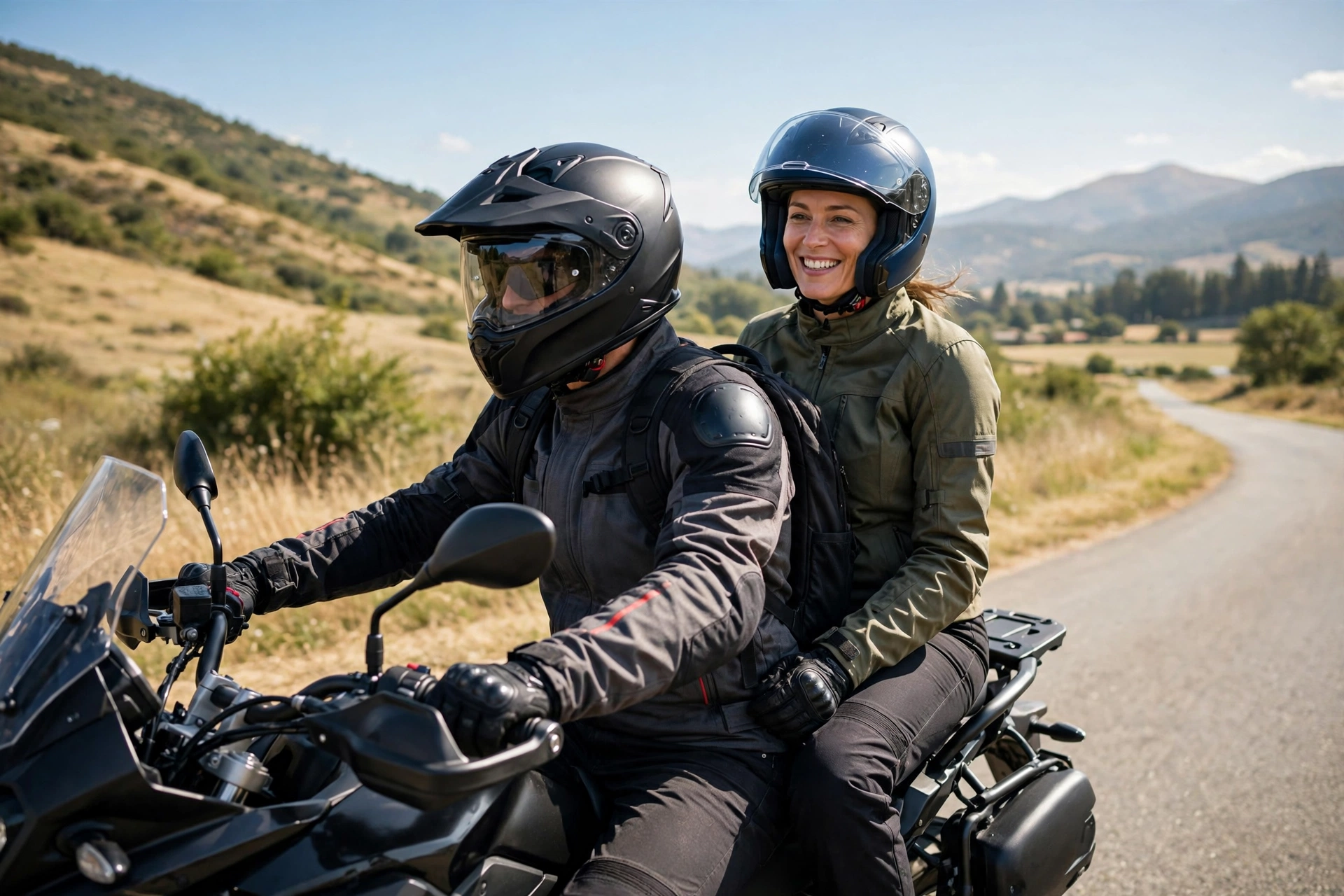
A full-face helmet offers a passenger the most protection and the least wind blast, and it is the best default choice for a spare. Open-face helmets leave your guest’s face exposed to wind, insects, road grit, and the weather, and a first-time passenger has no idea how intense highway airflow feels until they are in it.
Look for passenger-friendly features rather than racing spec. A drop-down sun visor saves your guest from squinting if they forgot sunglasses. A breathable, washable liner matters because multiple people will wear this helmet — hygiene is a real consideration with shared gear, and removable liners you can wash between guests keep the spare welcoming instead of grim.
Ventilation that is easy to operate with gloves, a simple and secure buckle your passenger can manage after one demonstration, and a clear shield in good condition (not the scratched cast-off from your last helmet) all make the difference between a spare that works and a spare that merely exists.
How Much Should You Spend on a Passenger Helmet?
You do not need to match the budget of your own premium lid, but “cheap and certified” has a floor. Every helmet you put on a passenger must meet the legal safety standard where you ride — DOT, ECE, or your local equivalent — with a genuine label. Below that line you are not saving money; you are handing your guest costume gear. Uncertified novelty helmets are never acceptable for a passenger, however short the trip.
In general terms, entry-level helmets from established manufacturers offer proper certification, decent liners, and modern features at modest cost, and they are the sweet spot for a spare. Spending more mainly buys quieter aerodynamics, lighter weight, and nicer materials — nice for your guest, but secondary to certification and fit.
Also budget for replacement. A shared spare gets knocked around, dropped, and borrowed; inspect it regularly and retire it after any drop onto concrete with real force, any crash, or when the liner and straps age out. A helmet’s history matters — systems like MIPS rotational protection only work as designed in a helmet that has not already absorbed an impact, so a spare with an unknown past is a spare to replace.
What Should You Check Before Your Passenger Gets On?
Run a two-minute routine every time. First, fit: put the helmet on your passenger yourself the first time, set the strap snug under the chin with roughly one to two fingers of room, and ask them to shake their head — the helmet should move with their head, not around it. Show them how the buckle and shield work while you are still parked, not at the first traffic light.
Second, communicate. Agree on simple signals for “slow down,” “I need to stop,” and “I am okay,” because a passenger in a full-face helmet at highway speed cannot talk to you. Explain how to lean with you in corners rather than against you, and how to hold on — to your waist or the grab rails, consistently, not grabbing at your shoulders mid-corner.
Third, start gently. A passenger’s first miles should be smooth and short, with easy acceleration and braking. Even a perfectly fitted helmet cannot fix a terrifying first ride, and your guest’s trust is part of the safety equation.
Frequently Asked Questions
Q: Can my passenger wear my old helmet if it is a bit too big?
A: No. A loose helmet can shift or come off in a crash and offers far less protection than a correctly fitted one. If your spare does not pass the shake test on your passenger’s head, use a different helmet or skip the ride.
Q: Is a cheap certified helmet okay for a passenger?
A: Yes — certification and fit matter far more than price. An entry-level helmet from a reputable maker with a genuine DOT or ECE label, in the right size, is a sound choice for occasional passengers.
Q: How do I keep a shared spare helmet hygienic?
A: Choose a helmet with a fully removable, washable liner and wash it between guests. A thin disposable or washable liner cap for each passenger is another simple option, provided it is thin enough not to change the fit.

Olivia
Writer at Helmet Today, covering helmet reviews, fit and riding safety.