Yes — in general terms, you can take a motorcycle helmet on a plane, and carrying it on board with you is by far the best way to do it. Helmets are not prohibited items, and most airlines accept one as part of your cabin baggage or as a personal item, though exact allowances vary by airline and fare. What you should avoid is putting a helmet in checked luggage unprotected, where baggage handling can deliver exactly the kind of impact a helmet is designed to absorb once — and then never again.
The details below cover how airlines typically treat helmets, how to carry one through the airport and on board, how to pack one if it absolutely must go in a suitcase, and the questions riders usually get wrong — like whether security will object, and whether wearing it onto the plane is a good idea.
Are Motorcycle Helmets Allowed in Cabin Baggage?
In general terms, yes. A helmet is ordinary personal protective gear, not a restricted item, and security screening has no problem with one passing through the scanner — it will simply be X-rayed like any other bag. The variable is not security; it is the airline’s baggage policy and the physical space on the aircraft.
How the helmet counts against your allowance differs between carriers. On some airlines it is accepted as a free personal item in addition to your cabin bag, worn or carried. On others, it counts as your one piece of cabin baggage, which means your other belongings must fit the personal-item dimensions. Budget airlines with strict cabin rules are the most likely to count it, and enforcement can vary even between flights on the same airline. The only reliable approach is to check your specific airline’s current policy before you travel — look at their sports equipment and cabin baggage pages, and if the helmet is not mentioned, a quick message to the airline gives you an answer you can rely on at the gate.
Be ready for the practical questions at the gate: a full-face helmet does not fit the standard baggage sizer, and it will not fit under the seat. If crew treat it as cabin baggage, the overhead locker is its home, so board early enough to find space. Most riders find crews are relaxed about helmets once they see it is simply being carried, especially on routes popular with riders, but the policy check beforehand is what protects you when they are not.
How Should You Carry a Helmet Through the Airport and On Board?
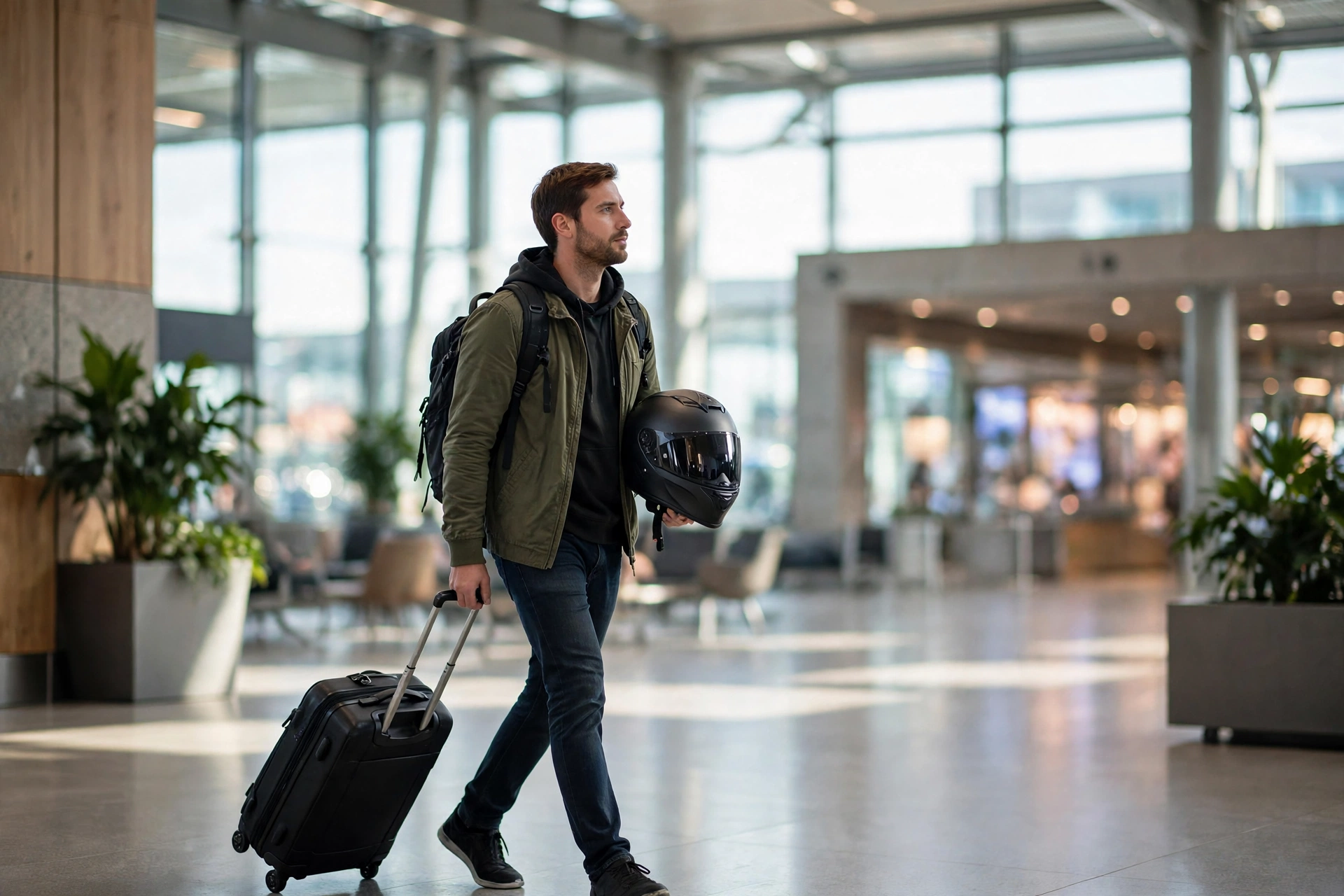
The standard method is simple: carry it by hand or in a helmet bag, exactly as you would off the bike. A padded helmet bag with a handle is ideal — it protects the shell and visor from knocks in the terminal, gives you a free hand through the carry handle, and makes the helmet read as luggage to staff rather than as a loose object. Many riders clip the bag to their backpack or cabin case with a carabiner so it travels as one unit.
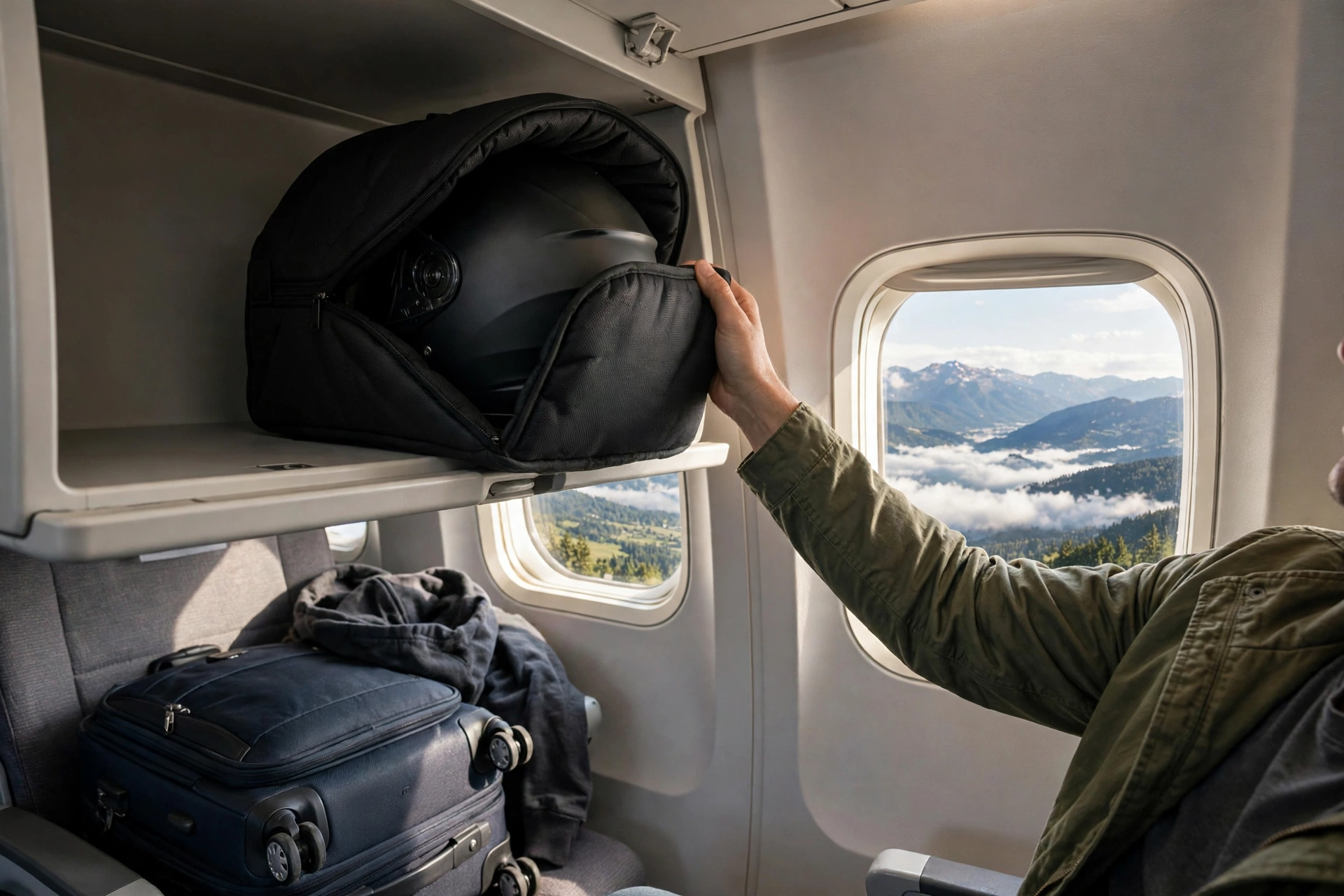
At security, place the helmet on the belt or in a tray as directed; it scans without issue. On board, stow it in the overhead locker, ideally in its bag, shell down and padded by your jacket or soft items around it so it cannot roll or be crushed by someone else’s hard case being forced in beside it. Retrieve it gently rather than letting it drop when the locker opens — helmets falling from overhead lockers is a surprisingly common way to damage one.
You may see riders wearing their helmet onto the plane. Crew generally ask for it to be removed and stowed before takeoff, and it is bulky and uncomfortable in a seat, so treat wearing as a way to get through the terminal hands-free at most — carrying or bagging it is simpler and raises no questions at all.
What If the Helmet Has to Go in Checked Luggage?
Sometimes it must — a one-way trip to buy a bike, a cabin allowance already full, or an airline that insists. A helmet in the hold faces conveyor belts, drops, and hundreds of pounds of luggage stacked on your case, so packing is protection, not tidiness. The method: clean the helmet, fill the inside completely with soft clothing so the shell is supported from within, wrap the outside in more soft layers, and place it in the center of a hard-shell suitcase surrounded by clothes on every side. Use the helmet bag as the first layer of padding.
Two extra precautions matter. Remove or protect the visor if your design allows — visors scratch and their mounts snap under point loads, and a spare visor or a visor cover in the helmet takes seconds. And take out any communication unit batteries if your setup has removable ones, following your airline’s rules for lithium batteries, which generally require them in the cabin.
Even packed well, understand the residual risk: a hard enough blow in the hold can compress EPS foam invisibly, the same one-time damage that retires a helmet after a crash, and helmets incorporating systems like MIPS rotational protection are built around liner condition too. Inspect the helmet carefully at your destination. If the trip is for riding at the other end — a tour start, a rental, a purchase — carrying the helmet on board is worth reorganizing your other baggage for.
What About International Flights and Riding at Your Destination?
The helmet rules of the flight itself barely change internationally; cabin allowances still come down to the individual airline. What does change is the riding at the other end. Your helmet’s certification is regional: a helmet legal at home may not meet the standard required where you are going, and vice versa — in general terms, the US uses its DOT standard while most of Europe requires ECE certification, and enforcement for visiting riders varies. If you plan to ride at your destination, it is worth checking the local requirement before you fly, particularly for organized tours and rentals where the operator may insist on a locally certified helmet.
Also think about the return leg. A helmet bought abroad has to travel home the same way, possibly before you have a bag routine for it, so keep the box or buy a helmet bag at the shop. And if you are flying to collect a motorcycle, plan the helmet into your cabin packing from the start — it is much easier than negotiating at check-in with a full-face helmet in one hand and a boarding pass in the other.
Frequently Asked Questions
Q: Does a motorcycle helmet count as hand luggage?
A: It depends on the airline. Some carriers accept a helmet as a free personal item carried in addition to cabin baggage; others count it as your cabin bag. Policies and enforcement vary, so check your airline’s current rules before you fly and be prepared for it to go in the overhead locker.
Q: Will airport security let a helmet through?
A: Yes. Helmets are not prohibited items and pass through the scanner like any other belonging. You may be asked to put it in a tray, and staff can inspect it, but there is no general security rule against carrying one. The airline’s baggage policy, not security, is the part to confirm.
Q: Is it better to wear my helmet onto the plane or pack it?
A: Carry it, ideally in a padded helmet bag — wearing it through the terminal is fine but crew will want it stowed for the flight, and it is awkward in a seat. Never put it in checked luggage if you can avoid it; if you must, pack the inside full of soft clothing and center it in a hard case.

Olivia
Writer at Helmet Today, covering helmet reviews, fit and riding safety.