A flip-up welding helmet lets you raise just the dark filter assembly and look at your work through a clear shield, without lifting the whole hood off your head. That single convenience is the main reason to buy one: inspecting and cleaning a weld between passes becomes a two-second flip instead of a full hood removal. The trade-offs are extra weight, a hinge that can wear, and sometimes a slightly smaller viewing area — so the design suits inspection-heavy work better than it suits everyone.
Flip-up helmets have been around for decades in passive form, and modern versions pair the lifting front with auto-darkening filters and clear grinding shields underneath. If your work involves constant checking — fabrication, repair work, multi-pass welds — the design deserves a serious look. Here are the pros and cons laid out honestly.
How Does a Flip-Up Welding Helmet Work?
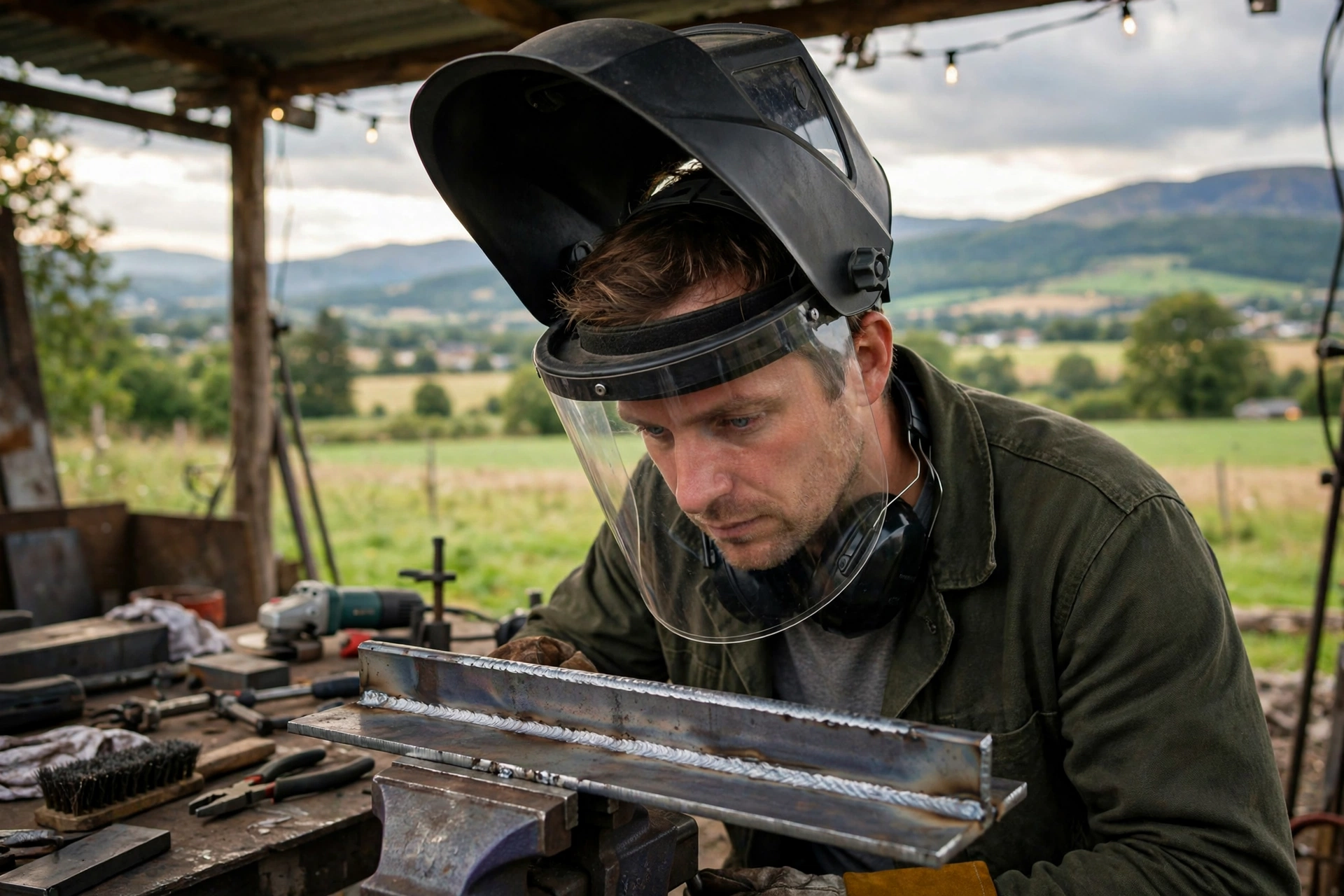
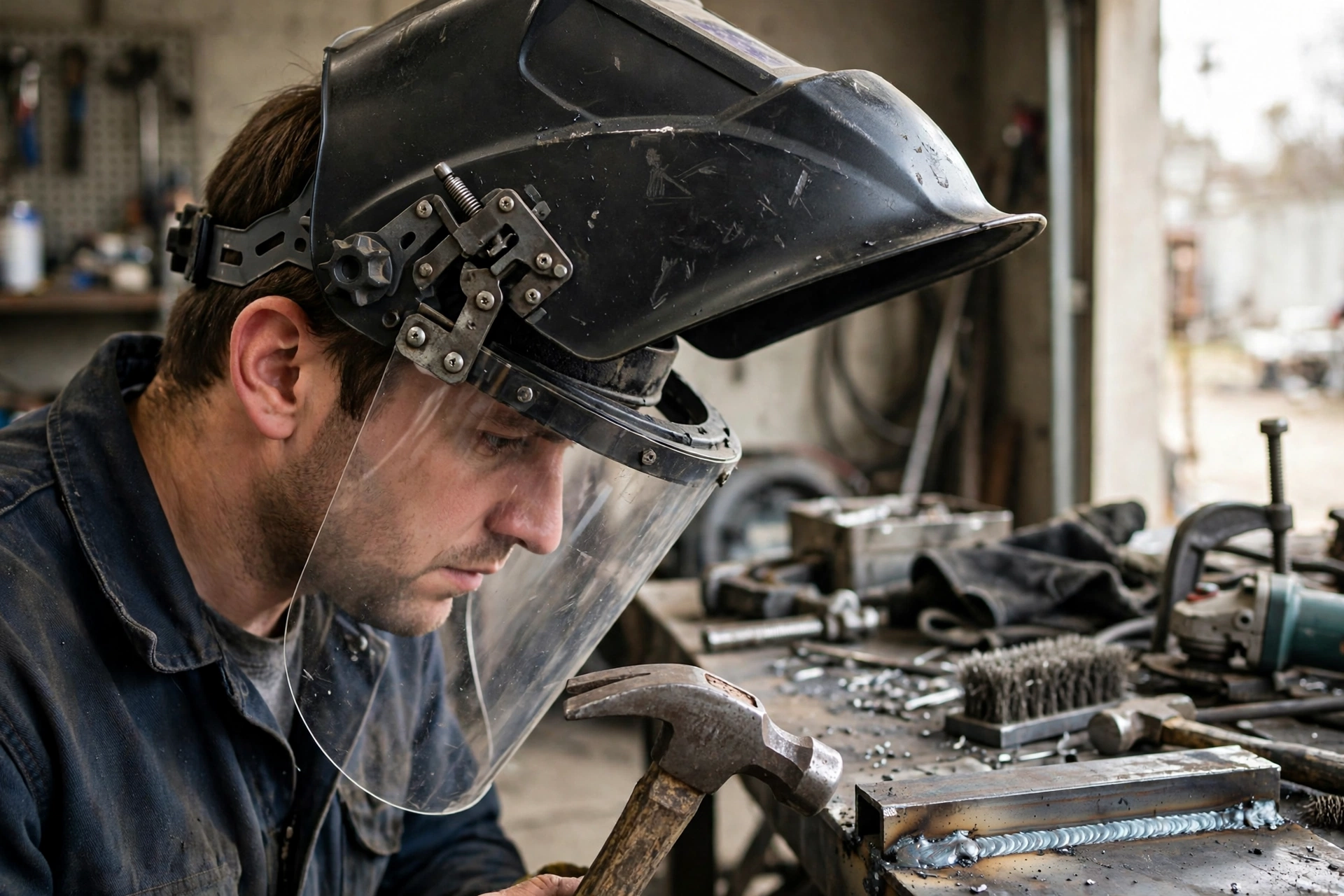
A flip-up helmet is built in two layers. The outer front section carries the welding filter and pivots upward on a hinge at the top of the shell. Underneath sits a clear, impact-rated face shield fixed to the helmet body. With the front down, you have a normal welding helmet; flip the front up and you are looking through clear plastic with your face still covered.
That division is what separates a true flip-up from simply nodding a regular helmet up onto your forehead. Your face stays protected by the clear shield the whole time, which matters when you move straight from welding into chipping, wire-brushing or grinding the bead you just laid down. Debris does not wait for you to swap gear.
Some designs take the idea further with a large inner clear shield sized specifically for grinding, effectively building a face shield into the helmet. Others are simpler: a passive flip front on a standard shell. In both cases the headgear stays adjusted on your head all day — the flip is the only moving part in your routine.
What Are the Main Advantages of a Flip-Up Helmet?
The headline advantage is weld inspection without losing your setup. Multi-pass welds, root passes and repair work all demand a close look between beads: is the fusion right, is there slag trapped, does this need grinding before the next pass? With a flip-up, you check in seconds with both hands free and the helmet’s fit undisturbed, instead of breaking your position and re-finding it.
Safety during the in-between work is the second win. Chipping hammers, wire wheels and grinders throw debris at exactly the moment a conventional welder has the hood up and only safety glasses on. The clear under-shield on a flip-up keeps face protection in place through all of it, and in general terms that continuity is where the design earns its keep.
Comfort and workflow add up over a shift. Lifting a full hood dozens of times a day — and re-settling the headgear each time — is a small annoyance that compounds. A quick flip reduces that friction, keeps your hands cleaner, and lets you talk to a fitter or inspector without stripping your head protection off first.
What Are the Downsides to Weigh Up?
Weight is the most consistent complaint. Two shells, a hinge and two viewing layers add up, and the extra mass tends to sit toward the front of the helmet, which your neck notices by mid-afternoon. If you already run a large-viewing-area auto-darkening helmet, a flip-up version will feel heavier again. For all-day overhead work, that difference is not trivial.
The hinge is one more mechanism to wear, loosen or break. Hinges that develop play let the front section sit slightly crooked, and a front that does not close fully and squarely can leak light around the filter — a serious fault, not a cosmetic one. Hinges also collect spatter and dust, so they need occasional cleaning and inspection that a fixed helmet never asks for.
Viewing area and cost round out the trade-offs. On some models the flip mechanism eats into the space available for the filter, so the dark viewing window is smaller than on a comparable fixed helmet. And because there are effectively two products in one shell, flip-up helmets generally cost more than an equivalent fixed model with the same filter.
Who Gets the Most Out of a Flip-Up Design?
Fabricators and repair welders are the natural audience. Their work is a constant loop of weld, inspect, chip, grind, reposition, weld again — exactly the rhythm the flip was invented for. If a large share of your day happens with the hood up but work still in your hands, the flip-up removes a genuine bottleneck.
MIG and stick welders running multi-pass joints benefit most, since slag removal and bead inspection are built into their process. TIG welders, whose work is cleaner and who often need the largest, clearest view through the filter, tend to gain less and may prefer the lighter weight and bigger window of a fixed helmet.
Beginners fall somewhere in the middle. A flip-up makes it easier to check your own beads and learn from them, which is valuable — but a lighter, simpler helmet that you forget you are wearing also has real merit while you are building basic technique.
What Should You Check Before Buying One?
Flip the helmet in the shop, repeatedly. The hinge should move with firm, even resistance, stop positively in both positions, and hold the front section up without drooping. When closed, check that the filter sits flush with no gap at the edges where light could sneak past. Wear it for a few minutes to judge the balance — front-heavy helmets announce themselves quickly at the neck.
Check the clear under-shield as carefully as the filter. It should be properly impact-rated, replaceable, and big enough to give a genuinely useful clear view for grinding. Ask how the flip mechanism is serviced and whether the clear shield and hinge parts are stocked as spares; a helmet you cannot get parts for has a built-in expiry date.
Finally, compare weight and filter size against the fixed equivalent from the same maker. If the difference is small and your work is inspection-heavy, the flip-up case is strong. If the fixed model is noticeably lighter with a bigger window and your work is long uninterrupted beads, the simpler helmet is probably the smarter buy.
Choosing between helmet designs is really about matching gear to how you actually work — the same discipline that matters with any head protection. A rider weighing up MIPS and other helmet safety systems faces the same kind of honest trade-off between features, weight and fit. The best helmet, in the shop or on the road, is the one whose strengths line up with your real routine.
Frequently Asked Questions
Q: Can I grind with the front flipped up?
A: Yes — that is one of the design’s main purposes. The clear shield underneath is your grinding face protection. Just keep the shield clean and replace it when it clouds, and always wear safety glasses underneath as a second layer.
Q: Does the flip mechanism weaken the helmet?
A: Not when it is well made and maintained. The shell and shields remain protective equipment. What matters is keeping the hinge tight and the closed front seated flush — a sloppy hinge that leaks light is a reason to repair or retire the helmet.
Q: Are flip-up helmets available with auto-darkening filters?
A: Yes, many are. The flip front carries an auto-darkening cartridge just like a fixed helmet, with the clear shield beneath it. Check that the cartridge’s shade range and sensor setup suit your processes before buying.

Olivia
Writer at Helmet Today, covering helmet reviews, fit and riding safety.