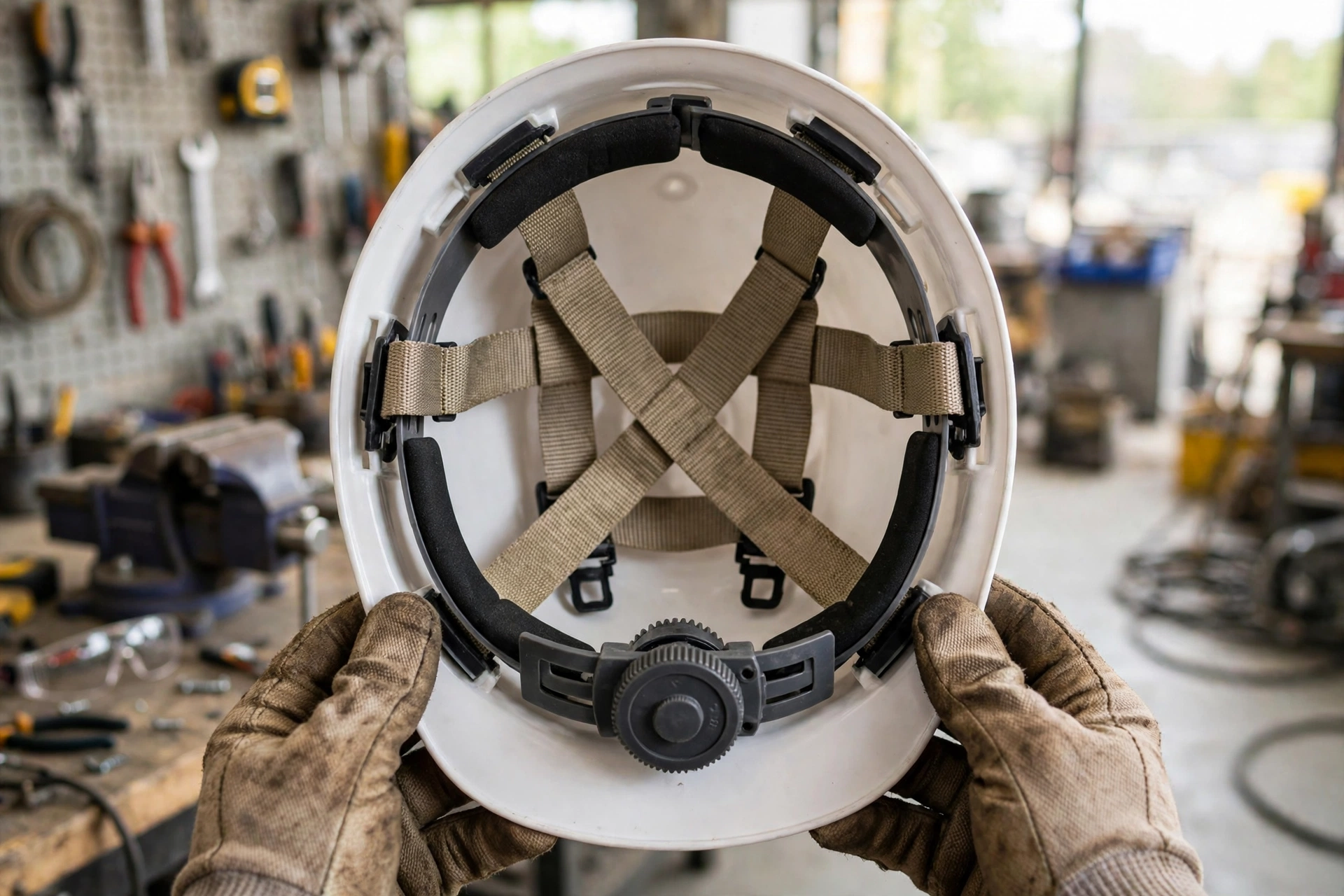
A hard hat suspension is the system of straps and a headband inside the shell that holds the hard hat about an inch or so off your head, and that gap is what protects you: when something strikes the shell, the suspension flexes and spreads the force so only a reduced share reaches your skull. You adjust it with the size adjuster at the back — usually a ratchet knob or pin-lock — plus the height and strap settings, until the hat sits level, snug, and does not rock or slip.
Many workers treat the suspension as packaging and never touch it after the first day. This guide explains what the suspension actually does, what its parts are, and how to adjust it properly.
What Is a Hard Hat Suspension?
The suspension is everything inside the shell that touches your head: a headband that circles your forehead, a set of straps that cross over the crown, and usually a sweatband at the front and a pad at the back. The shell itself never rests directly on your skull — the suspension holds it suspended above you, which is where the name comes from.
That air gap is the heart of the design. A hard hat does not protect like a padded cap, by cushioning. It protects by distance and deflection: the shell takes the blow, the straps stretch and give, and the energy is spread over a wider area and a longer moment before any of it reaches your head.
Suspensions are replaceable parts, not permanent fixtures. Makers design them to be swapped out when they wear, stretch, or get damaged, and a hard hat with a tired suspension is not giving you the protection its label promises.
Why Does the Suspension Matter So Much for Protection?
Because the suspension does most of the energy management. When a falling tool strikes the crown, the shell resists penetration while the straps flex downward into the gap, absorbing and spreading the force. If the suspension is worn, stretched, or adjusted so the shell sits too low, that travel distance shrinks and more of the impact reaches your head.
Fit matters the same way. A suspension adjusted too loose lets the hat shift, tilt, or come off entirely in a fall or a gust of wind — and a hard hat only protects the head it is still on. One adjusted too tight creates pressure points that guarantee you will take it off, which defeats it just as completely.
It also holds the hat level in the position the shell was designed for. A hat tipped back or worn at an angle exposes parts of the head the shell was meant to cover and changes how a blow lands on the straps.
What Are the Parts of a Suspension System?
Suspensions are usually described by their number of points — most commonly 4-point or 6-point — which is the number of places the straps anchor to the shell. More points spread a load across more straps and tend to feel more stable, while 4-point systems are simpler and lighter. Neither is automatically better; condition and fit matter more than the count.
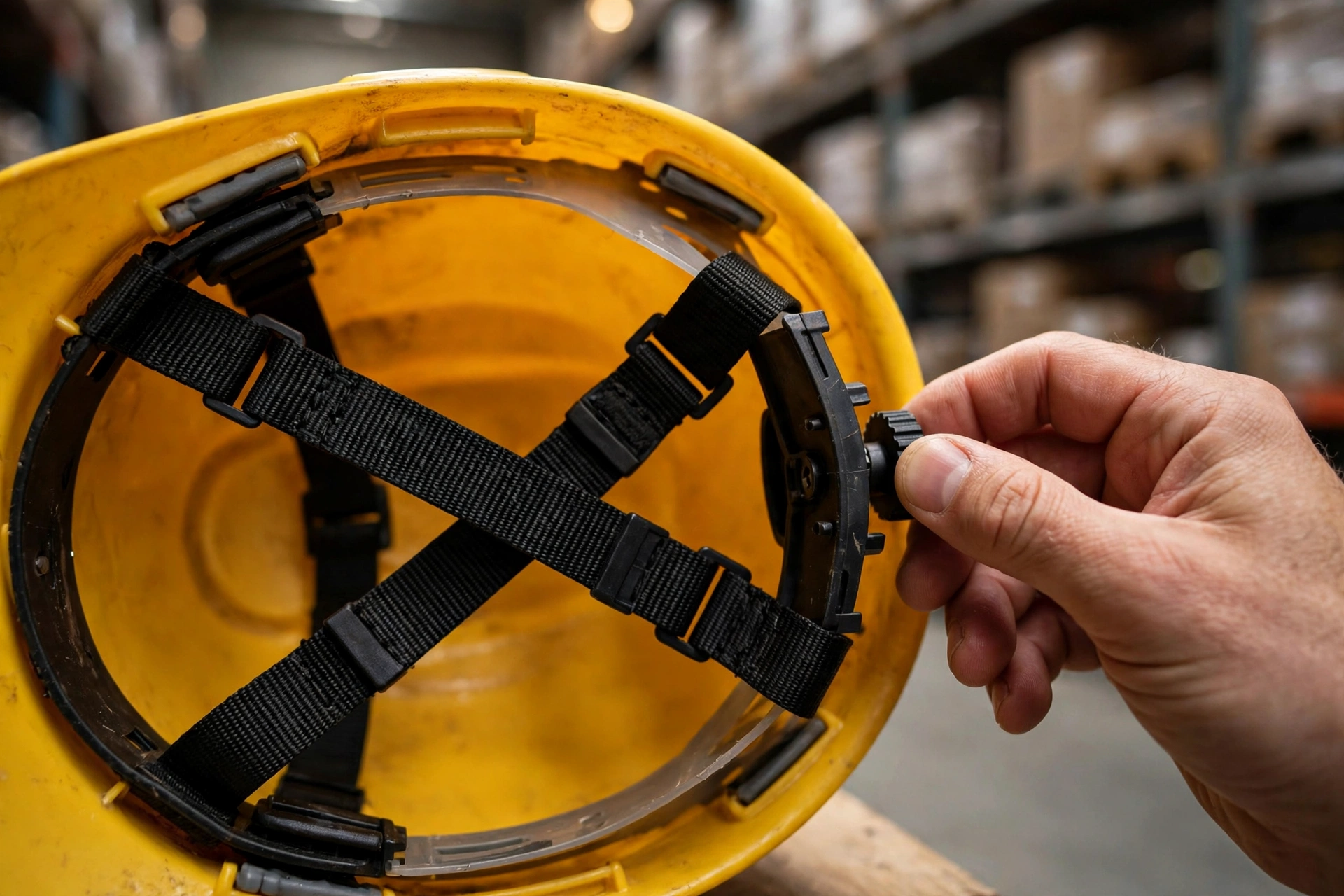
The size adjuster comes in two common forms. A ratchet suspension turns a knob at the back to tighten or loosen the headband in small steps, which is quick to adjust, even with gloves on. A pin-lock suspension pushes the band in or out to snap a pin into one of a row of holes — cheaper, and it stays where you set it, but slower to change.
Many suspensions also let you set the height — how high or low the shell rides above your head — by moving the straps between slots. Lower is usually more stable; higher gives more clearance and airflow. Follow the maker’s markings, because changing height changes the protective gap.
How Do You Adjust a Hard Hat Suspension?
- Set the size adjuster first. Put the hat on, then turn the ratchet knob — or set the pin-lock — until the headband is snug all the way around, firm enough that the hat does not shift when you shake your head, but not so tight it leaves you with a headache.
- Check the height setting. The shell should sit with a clear gap above your crown and the headband should sit level, roughly just above your eyebrows, not riding up on top of your head or sliding down over your ears.
- Balance front and back. The hat should sit level, not tipped forward or back. If it tilts, adjust where the straps sit in their slots until it settles flat.
- Test it. Shake your head, look up and down, and bend over. The hat should move with your head without rocking, slipping, or pressing in one spot.
It is the same principle that governs other kinds of head protection: in sports helmets, the liner and systems such as rotational-impact systems like MIPS only manage crash energy as designed when the helmet is positioned correctly and held firmly in place. A suspension is the hard hat’s version of that fit system, and it deserves the same care.
How Do You Know the Suspension Is Worn Out?
Look for straps that are frayed, stretched, faded, or brittle, a headband that no longer holds its adjustment, a ratchet that slips, or a sweatband that is permanently compressed and cracked. Any of those means the suspension is no longer doing its job evenly.
Replace the suspension — or the whole hat — after any significant impact, even if the shell looks fine, because straps that have absorbed one big hit may have stretched in ways you cannot see. In general terms, makers suggest replacing suspensions far more often than shells, since straps and plastic age with sweat, sunlight, and daily flexing.
The quick daily habit is a squeeze-and-look check before the shift: flex the straps, confirm the adjuster holds, and make sure nothing is cracked. It takes ten seconds and it is the difference between wearing protection and wearing a plastic shell.
Frequently Asked Questions
Q: Can I swap a suspension between different hard hat brands?
A: In general terms, no — suspensions are made for specific shells, and the anchor points and gap height differ between models. Use the replacement suspension the maker lists for your exact hard hat so the protective gap stays as designed.
Q: Is a 6-point suspension safer than a 4-point?
A: Not automatically. Six points spread force across more straps and often feel more stable, but a well-fitted, well-maintained 4-point suspension on the right shell protects as its standard intends. Fit and condition matter more than the point count.
Q: How often should a hard hat suspension be replaced?
A: Follow the maker’s guidance for your model, and replace it sooner if straps fray, stretch, or stop holding adjustment, or after any significant impact. Many workers replace the suspension well before the shell reaches the end of its own service life.

Olivia
Writer at Helmet Today, covering helmet reviews, fit and riding safety.