
A hard hat should fit snugly and level on your head, with the sweatband sitting about an inch above your eyebrows, the suspension adjusted so the hat does not wobble, slip or tip when you move, and a clear gap between the top of your head and the shell. In general terms, a well-fitted hard hat feels secure without pressure points, stays put when you bend and shake your head, and is worn with nothing underneath it except the manufacturer’s own liners.
Hard hats only protect as designed when they sit where the designer intended. A loose hat can shift or come off in the very moment it is needed, and a badly adjusted one gets taken off — which protects nobody. This guide covers how to adjust a suspension properly and the fit mistakes worth avoiding.
How Tight Should a Hard Hat Feel?
Snug, even and comfortable. The sweatband should contact your forehead and the harness should hold the hat firmly enough that it does not rock when you shake your head firmly from side to side, nod, or bend over as if picking something up. If it slides, tips forward over your eyes, or can be knocked askew with a light tap, it is too loose.
Too tight is a fault as well. Headaches, a red groove across the forehead after a short wear, or a constant awareness of pressure mean the suspension is a size too small or wound too tight — and a hat that hurts will not stay on anyone’s head for a full shift.
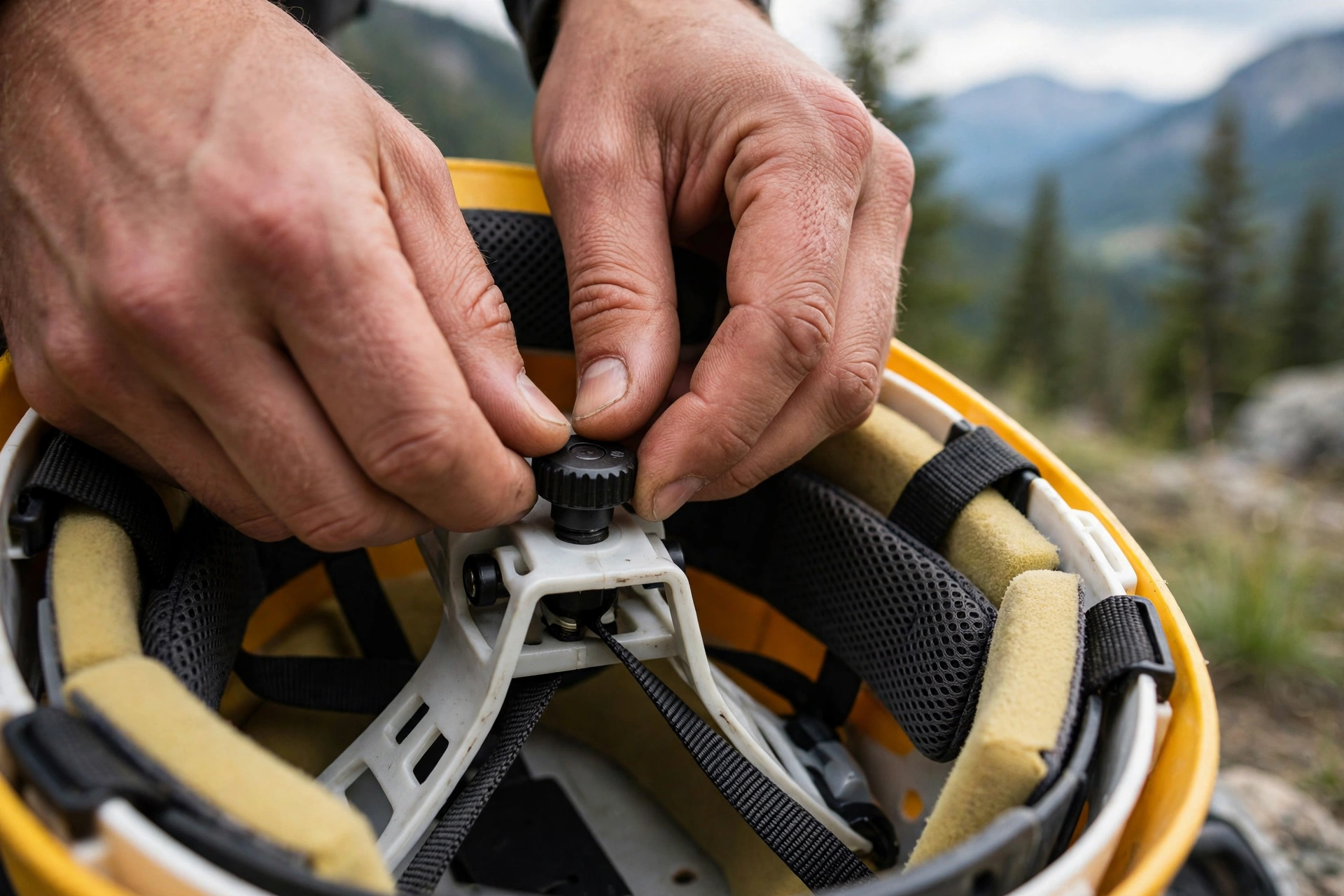
Most suspensions adjust in one of two ways: a pin-and-hole strap you set to a numbered size, or a ratchet wheel at the back you turn while wearing the hat. Ratchets make fine adjustment easy, including over a thin winter liner made for the hat. Set the size with the hat on your head, not in your hands.
Where Should a Hard Hat Sit on Your Head?
Level, not tilted. The brim should run roughly parallel to the ground, with the front sweatband sitting low on the forehead, around 2 to 3 centimetres — about an inch — above the eyebrows. Wearing the hat tipped back on the head is a common habit and a real problem: it exposes the forehead, changes the angle at which the shell and suspension meet a blow, and makes the hat far easier to knock off.
Tipping it forward is no better, cutting into your upward view and pressing the band into the brow. If you find yourself constantly tipping a hat back to see overhead work, the correct fix is a reverse-wearing model worn properly, not a standard hat perched at an angle.
The shell must also clear the top of your head. The suspension holds the shell away from your skull — that gap is where the energy of a falling object is absorbed — so the harness should be set at a depth that keeps the clearance the manufacturer intends. Never let the shell rest directly on your head, and never modify the suspension to make the hat sit lower for looks.
Can You Wear Anything Under a Hard Hat?
Only what the manufacturer provides or approves. Winter liners designed for the hat, which fit inside the suspension without changing its geometry, are fine and make cold work far more bearable. Purpose-made sweatbands and hygiene inserts from the maker are fine too.
Ordinary beanies, hoods, caps and bandanas are not. Anything bulky under the suspension raises the hat, fills the protective gap, and lets the hat slide and roll on the padding. A peaked cap underneath is the worst offender, pushing the hat up and forward. If you are cold, get the proper liner; if you wear religious headwear or have a medical need, raise it with your employer, who can source compatible arrangements — do not improvise under a safety helmet.
Hair matters as well. Very thick or long hair piled on top of the head changes the fit in the same way as a beanie. Tie long hair low, at the nape, so the suspension can sit where it should.
Do You Need a Chin Strap on a Hard Hat?
For many tasks, a chin strap is the difference between a fitted hat and a missing one. Any work at height, work in wind, work where you lean out or look down, and work around moving air from plant or rotors can lift or knock a hat off — and a hat on the ground protects nothing. Type 2 hard hats, tested for side impacts, commonly come with chin straps for exactly this reason: side protection assumes the hat stays on.
Where straps are fitted, wear them fastened and adjusted, not dangling. A strap should sit snugly under the chin without choking — roughly two fingers of slack is a common guide — and should be the maker’s strap for that hat, attached at the proper points.
If your site or task risk assessment calls for a strap, it is part of the PPE, not an accessory. If your hat has no strap and your work involves height or wind, ask for one that does.
How Can You Check Your Hard Hat Fit in One Minute?
Run this sequence whenever you pick up a new hat or readjust your own. One: put the hat on level, sweatband about an inch above your eyebrows. Two: adjust the suspension until the hat is snug all the way around. Three: shake your head firmly, nod, and bend right over — the hat should not slip, tip or fall. Four: push up gently under the brim on each side; the hat should resist and settle straight back. Five: check you can feel clearance between the shell and the top of your head, and that nothing unapproved is underneath.
If the hat fails any step, readjust or change size before starting work, not during it. Fit problems do not improve over a shift; they get worked around by taking the hat off, which is the worst outcome of all.
Fit discipline is universal in head protection. A motorcycle or bicycle helmet protects only when it sits level and snug, which is why the fitting advice around technologies like those in our guide to what MIPS means in a helmet always starts with position and straps. Hard hats ask the same of you: level, snug, strapped where needed — and worn for every minute the hazard is overhead.
Frequently Asked Questions
Q: Should a hard hat leave a mark on your forehead?
A: A faint, temporary line from the sweatband after a long shift is normal. A painful groove, a headache, or a mark that lasts for hours means the hat is too tight or the wrong size or shape for your head — get it refitted or exchanged.
Q: Can I wear a beanie under my hard hat in winter?
A: Not an ordinary one — it fills the protective gap and makes the hat unstable. Use a winter liner made by the hard hat’s manufacturer to fit inside the suspension, which keeps you warm without changing how the hat sits and works.
Q: My hard hat keeps slipping forward. What is wrong?
A: Usually the suspension is too large a setting, the sweatband is worn, or hair is piled under the harness. Tighten or resize the suspension, tie long hair low at the nape, and check the hat sits level; if it still slips, try a different model or add the maker’s chin strap.

Olivia
Writer at Helmet Today, covering helmet reviews, fit and riding safety.