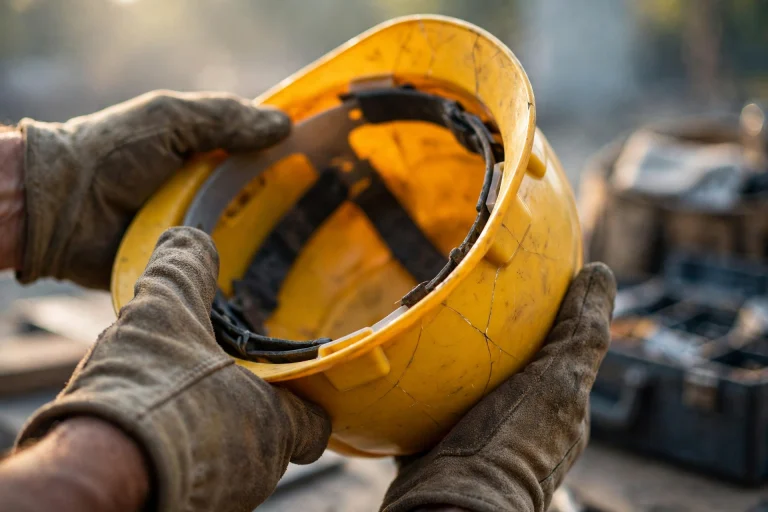
It depends on the hazard — and in a warehouse, the honest answer is often both, in different zones. Where anything can fall from racking, mezzanines, or a raised load, warehouse workers need a rated hard hat. Where the only risk is bumping your head on low beams, shelf edges, or vehicle frames, a bump cap is the right tool. In general terms, the employer’s hazard assessment makes the call — not comfort, habit, or what the last workplace did.
Warehouses mix both hazards under one roof, which is why this question causes so much confusion. This guide explains the difference between the two products, which tasks point each way, and how the decision should be made.
What Is the Difference Between a Hard Hat and a Bump Cap?
A hard hat is tested protective equipment: a rigid shell held off the head by a suspension, built and certified to take the energy of a falling object — a tool, a fitting, a case of stock dropping from height. It is designed for hazards that come from above, with force.
A bump cap is a much lighter product: a thin rigid insert, usually worn inside a cap, that protects your scalp from bumps, scrapes, and cuts when you walk into a stationary object — a low beam, a shelf edge, a trailer frame. It is built for hazards you move into, at walking speed, under your own power.
Neither works like a sports helmet. There is no deep crushable liner and no equivalent of rotational-impact systems like MIPS in either product: the hard hat manages falling-object energy through shell strength and suspension distance, and the bump cap simply puts a hard layer between your scalp and a sharp edge. A bump cap is not a weak hard hat — it is a different tool that was never tested against falling objects at all.
Which Warehouse Jobs Need a Hard Hat?
Any work under stored height points to a hard hat. Picking or working beneath high racking, walking aisles where stock is stacked overhead, and working under mezzanines all share the same risk: something above you can come down, from a badly stacked case to a fitting knocked off a shelf.
Loading docks are hard hat territory in most facilities: loads move overhead on forklifts, items shift in trailers, and dock work puts people below raised loads and raised doors. The same applies anywhere forklifts lift loads above head height along their travel paths.
Maintenance raises the stakes further. Working under conveyors, racking repairs, and any task where colleagues are working above you — on ladders, platforms, or mezzanine edges — means falling tools and parts are a realistic hazard, and a hard hat is the appropriate protection.

When Is a Bump Cap Enough in a Warehouse?
A bump cap fits the low, tight, ground-level jobs: order picking in low shelving areas, work inside trailers and vehicle bodies, stockrooms with low pipework, and tasks where workers regularly duck under beams, conveyors, or shelf ends. The hazard is the worker’s own head meeting a stationary edge, and the bump cap handles exactly that.
Comfort is a genuine safety factor here. A bump cap looks and feels like an ordinary cap, so people actually wear it all shift. In a zone with no falling-object risk, the bump cap that stays on protects better than the hard hat that gets taken off because it is hot, heavy, or always catching on low shelving.
The boundary condition is absolute, though: the moment a bump-cap zone gains an overhead hazard — new high racking, overhead work, raised loads passing through — the zone’s head protection has to be reassessed and upgraded.
Who Decides Which One a Job Needs?
In general terms, the employer does, through a hazard assessment of each area and task. Head protection rules, standards, and enforcement vary by country and by site, but the principle is consistent: someone competent walks the space, identifies whether objects can fall or only be bumped into, and sets the PPE for each zone.
Workers should not downgrade on their own judgment. If your zone is signed and briefed as hard hat, wearing a bump cap because it is cooler is a rule breach and a real risk, however sensible it feels. The channel for disagreement is raising it with a supervisor so the assessment can be reviewed.
Assessments also need revisiting. Warehouses change constantly — racking goes higher, a mezzanine is added, a new contract brings overhead handling — and yesterday’s bump-cap area can become today’s hard hat area without anyone announcing it.
What Goes Wrong When the Wrong One Is Chosen?
The dangerous error is a bump cap under a falling-object hazard. A case of stock or a steel fitting falling from racking delivers energy a bump cap was never built to handle, and the wearer believes they are protected when they are effectively bare-headed against that risk.
The opposite error is quieter but also common: mandating hard hats everywhere, including low picking zones where workers constantly strike them on shelving. The predictable result is hats carried, hooked on belts, or left at workstations — zero protection against even the bumps the rule was meant to cover. Zone-based rules with the right product in each zone get worn; blanket rules often do not.
A third confusion is the loose insert in an ordinary baseball cap. Dedicated bump caps are made and marked as a unit; loose inserts vary in fit and coverage, and an unmarked cap can look protected while offering very little. Whatever your zones use, it should be a recognizable, specified product.
Frequently Asked Questions
Q: Can a bump cap protect me from a box falling off a shelf?
A: No. Bump caps are not built or tested for falling objects — protection against things dropping from height is exactly what a hard hat is for. In racking aisles and under stored loads, wear the hard hat.
Q: Are baseball caps with inserts the same as bump caps?
A: Not reliably. A proper bump cap is manufactured and marked as one product. Loose inserts in fashion caps vary in coverage and retention, and neither option — insert or bump cap — protects against falling objects.
Q: Our warehouse has both kinds of area. What should I do?
A: Follow the zone rules: many sites run hard hats in racking aisles and docks, bump caps in low picking areas, and you swap at the boundary. If a zone’s hazards have changed, tell a supervisor so it can be reassessed.

Olivia
Writer at Helmet Today, covering helmet reviews, fit and riding safety.