Replace a whitewater helmet after any significant impact, when the foam or shell shows damage, when straps or buckles are worn, or when it no longer fits snugly — and in general terms, also when it has simply aged beyond the maker’s guidance, even if it looks fine. A helmet that has crushed its foam once, or whose materials have quietly degraded, cannot be trusted to protect you the same way again.
This guide explains the clear replacement triggers, the hidden ones, and how to judge an older helmet honestly.
Should You Replace a Whitewater Helmet After a Crash?
Yes, after any hard hit. A whitewater helmet manages impact by spreading force through the shell and crushing or compressing the foam liner beneath it. That crushing is the protection working — but it is a one-time event in the area that took the blow. Foam that has already compressed cannot absorb the same energy a second time in the same spot.
The tricky part is that the damage is not always visible. A helmet can take a rock strike hard enough to dent the liner while the outer shell springs back and looks almost unmarked. If you remember the hit — a loud crack against rock, a dazed moment, a swim after striking something — treat the helmet as spent, however good it looks on the outside.
Smaller knocks are a judgement call. Helmets get bumped in car parks, dropped on boat ramps, and knocked against rocks at low speed all the time, and not every scuff ends a helmet’s life. The honest test is energy: a slow tip against a rock while scrambling is different from a head-first strike in current. When in genuine doubt, err toward replacement; it is the cheapest safety decision in paddling.
What Visible Damage Means a Helmet Is Finished?
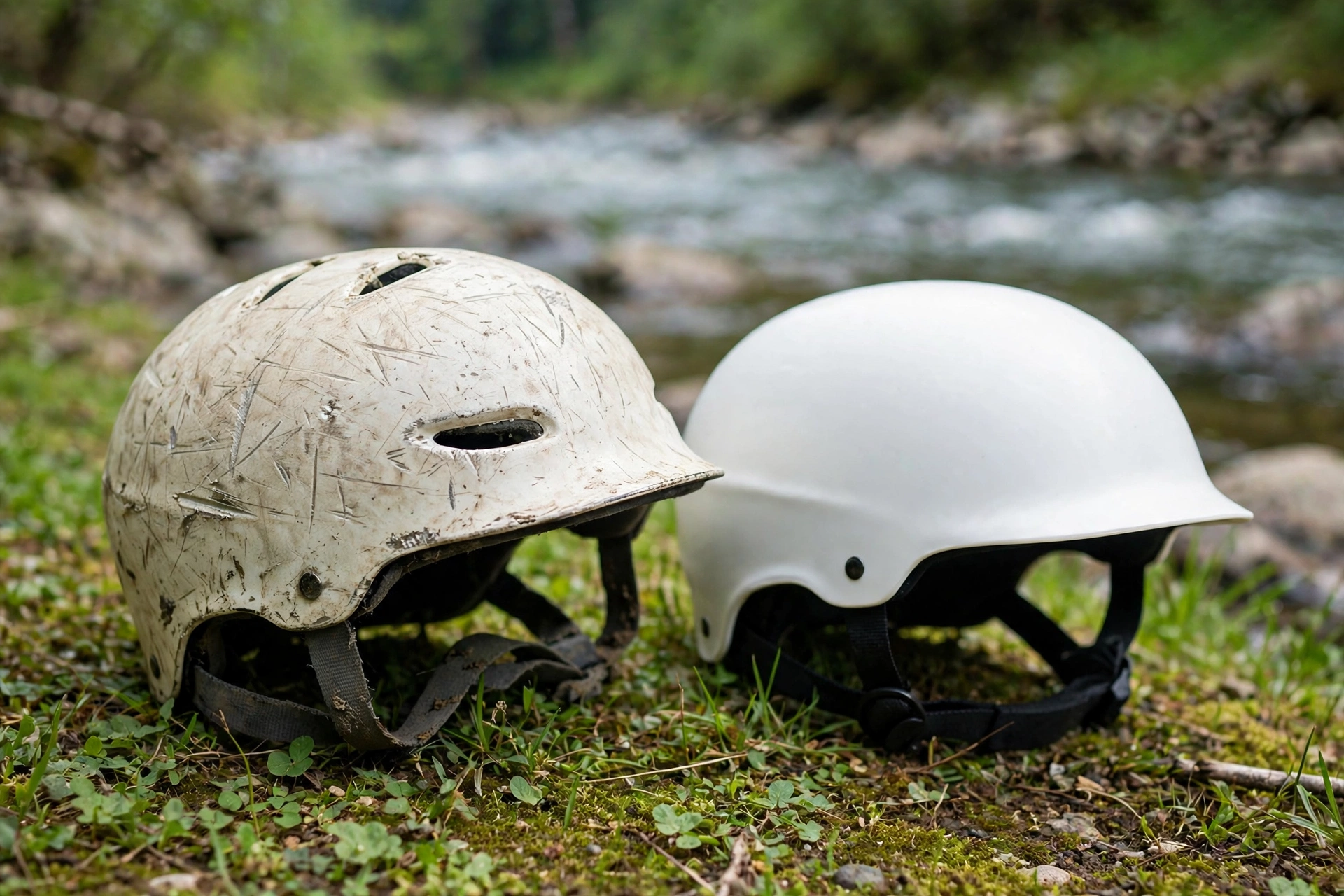
Inspect the shell first. Cracks, deep gouges, soft spots, or areas that flex differently from the rest of the shell all mean the structure is compromised. On plastic shells, look for pale stress marks around impact points and fittings. On any shell, a dent that stays dented is a warning, not a battle scar.
Then inspect the inside. Press the foam liner gently around its whole surface: it should feel firm and even. Crushed, cracked, crumbling, or permanently flattened foam — especially foam that has separated from the shell — means that area can no longer do its job. Check the comfort padding too; it is not the protective layer, but padding that has rotted or compressed to nothing changes the fit, and fit is part of protection.
Finally, check the retention system. Frayed or sun-bleached straps, a buckle that slips or cracks, rivets pulling through, and a rear adjuster that no longer holds its setting are all replacement-level faults, because a helmet that comes off or shifts in a swim protects nothing. If straps or buckles are replaceable with the maker’s own parts, that can be a repair; anything structural cannot.

How Long Does a Whitewater Helmet Last Without a Crash?
Even a helmet that never takes a hit ages. In general terms, the materials that protect you — foam, shell plastic, glues, webbing — slowly degrade with ultraviolet light, heat, sweat, sunscreen, insect repellent, and repeated soaking and drying. River helmets live a hard life: sun on the roof rack, heat in the car, and immersion on every trip.
Makers typically give a service-life guideline in the helmet’s paperwork or on their website, expressed in years of use from purchase. Follow your maker’s guidance where you have it; where you do not, treat a heavily used helmet that is several seasons old with growing suspicion, especially if it has lived outdoors or in a hot vehicle rather than stored cool and dry.
Age alone is not the whole story, though. A lightly used helmet stored properly may be in better shape at the top end of its guidance than a younger helmet that has been baked, dropped, and left wet in a gear bag all season. Age, storage, and condition work together — judge all three, not just the calendar.
Can a Poor Fit Be a Reason to Replace a Helmet?
Yes. A helmet protects only where it sits, and it has to stay there in moving water. If a helmet has always rocked, tipped over your eyes, or ridden up off your forehead, it was never the right size or shape for your head, and a season of padding wear will only have made it looser. Replace it with a size or model that sits level and snug and stays put when you shake your head hard.
Fit can also change at your end. Significant changes in hair volume, weight, or simply wearing different layers such as a thick neoprene hood in winter can shift how a helmet sits. Refit your helmet with the layers you actually paddle in, and check it at the start of each season.
There is a protection angle here too. A helmet that moves on your head exposes areas it was meant to cover and can rotate in an angled impact, which matters because real river hits are rarely square-on; modern helmet design also looks at how angled blows create rotational forces, as explained in this guide to what MIPS is for helmets. A snug, stable fit is what lets any of those design features work as intended.
How Should You Inspect and Retire an Old Helmet?
Inspect at the start of every season and after every memorable knock. Work through a simple routine:
- Shell: look and feel for cracks, dents, soft spots, and stress marks
- Foam: press around the liner for crushed, cracked, or loose areas
- Straps and buckle: check for fraying, fading, slipping, and clean clicks
- Fit: put it on with your normal layers, fasten it, and shake-test it
If it fails any part of that check, retire it rather than demoting it to a loaner. A spent helmet handed to a friend, a child, or a beginner is still a spent helmet — and beginners, who fall and swim most, need working protection most. Do not sell or give away a helmet you have retired for safety reasons.
Retire it decisively. Cut the straps before disposal so nobody fishes it out and uses it, and replace it with a new, well-fitting watersports helmet in good condition. Your head is the one piece of paddling kit you cannot upgrade later.
Frequently Asked Questions
Q: My helmet looks fine after a rock hit. Can I keep using it?
A: Be cautious. Shells can spring back while the foam underneath stays crushed, and that hidden damage is invisible from outside. If the hit was hard enough to remember clearly — a loud strike, a daze, a swim — the safe general rule is to replace it.
Q: Can I repair a cracked whitewater helmet with glue or tape?
A: No. The shell and foam work together as a tested system, and glue, tape, or resin repairs do not restore that system and can even attack the foam. Replaceable straps or pads from the maker are the only real repairs; structural damage means a new helmet.
Q: How often should I replace a helmet that has never crashed?
A: Follow the maker’s service-life guidance for your model where it exists, and weigh your own use: heavy sun, heat, and soaking shorten a helmet’s life, while cool, dry storage protects it. When an un-crashed helmet is several seasons old and fails any part of a careful inspection, replace it.

Olivia
Writer at Helmet Today, covering helmet reviews, fit and riding safety.