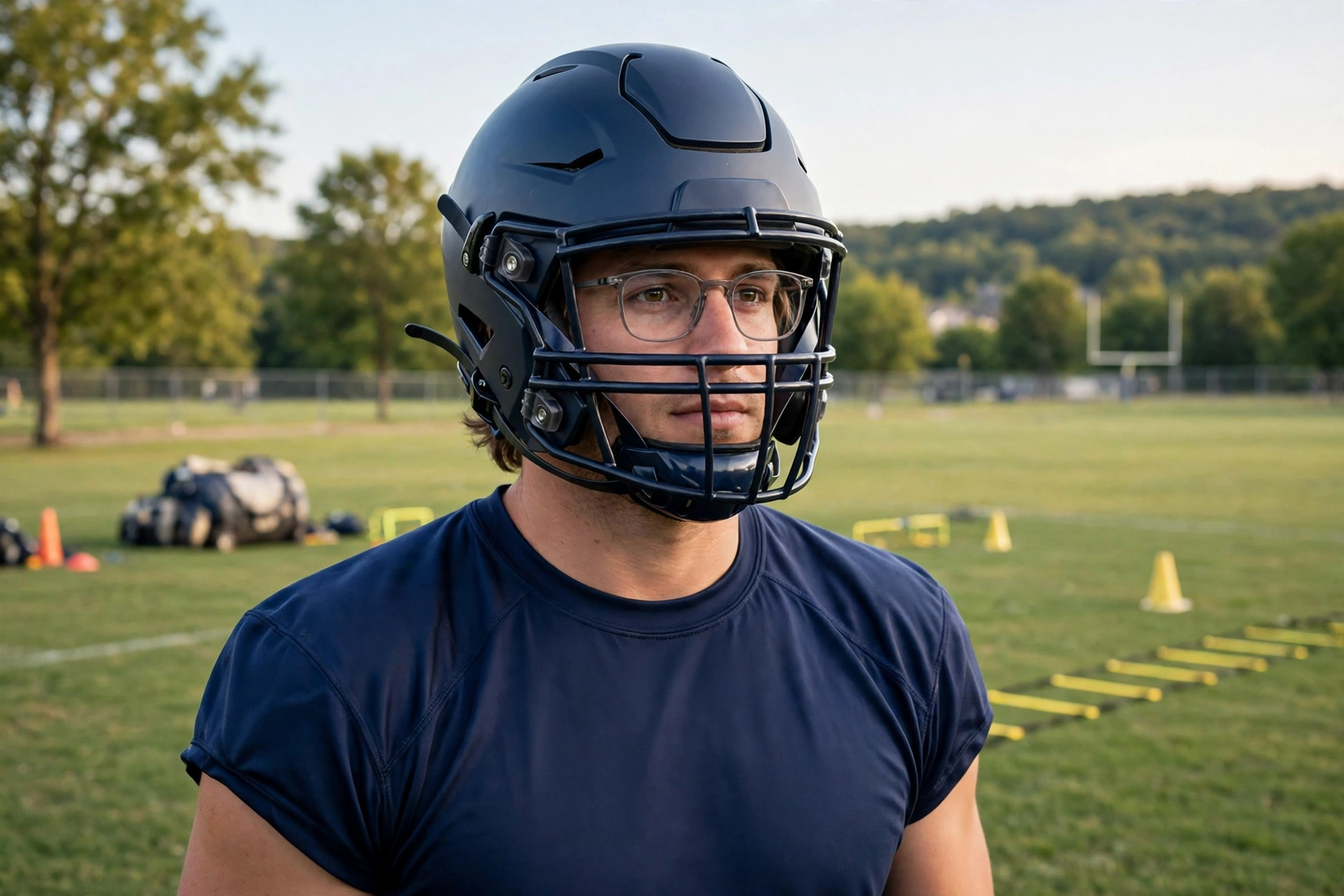
Yes, you can wear glasses under a football helmet: fit the helmet correctly to your head first, then choose slim, flat-armed frames that slide under the padding without lifting it, check the facemask clears the frames, and use a sports strap if the glasses slip — never buy a bigger helmet just to make room for glasses. Many players at every level wear them; the fit checks below are what make it work.
This guide covers the helmet and frame checks glasses wearers should make, how sports goggles compare, and how to stop glasses moving during a game.
Can You Wear Glasses Under a Football Helmet?
Plenty of football players do, from youth leagues up. The helmet’s shell and padding sit over the ears and temples, exactly where glasses arms run, so the combination is a fit question rather than a yes-or-no question: some helmet-and-frame pairings work immediately, and others need the frame changed, not the helmet.
The sequence is fixed. A helmet protects by sitting in its designed position, snug and level, so the helmet is always fitted to the bare head first, exactly as for any player. Only then are the glasses tried inside it. Working the other way round — choosing a helmet that feels comfortable over thick glasses — produces a helmet that is too loose where it matters.
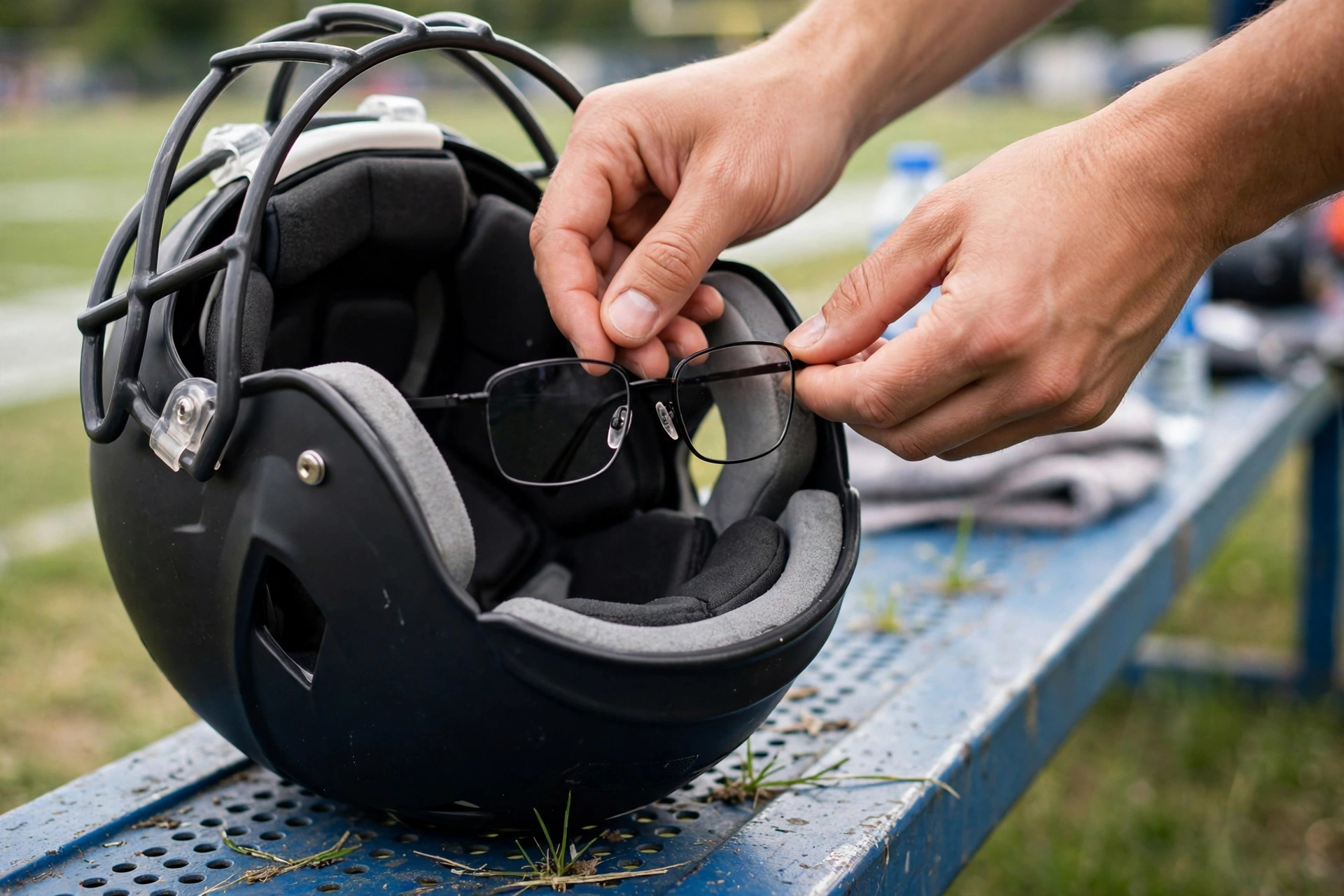
Put the glasses on after the helmet, sliding the arms in straight from the front and guiding them over the ears until the frames sit normally. Practise the routine at home; on the sideline you want it to take seconds.
Which Glasses Frames Work Best for Football?
Thin, straight temple arms are the key feature. Slim metal or flexible plastic arms that run flat against the head pass under helmet padding with the least disturbance, while thick, wide fashion frames get squeezed, bend, and push the helmet’s padding out of place.
Flexibility helps too: spring or flex hinges tolerate the helmet going on and off repeatedly, and a frame that can give slightly survives the sideline better than a rigid one. A dedicated sports pair is a smart investment for a regular player — chosen purely for how it behaves under a helmet, and keeping a breakage from ending both the game and your everyday vision.
- Thin, flat arms: slide in without lifting the padding
- Flexible hinges: survive repeated helmet removal
- Close, secure fit: frames adjusted to grip properly do not need pushing up
- Shorter arms: less length to clash with ear and jaw padding
Whatever the frame, never modify the helmet for it. Cutting or removing padding to make space trades certified protection for convenience, and no frame is worth that.
Glasses or Sports Goggles: Which Is Better for Football?
Prescription sports goggles are the main alternative. They are built for impact environments, sit close to the face, and are held by a wide strap rather than ear arms, which removes the temple-pressure question entirely. For players whose frames simply fight their helmet, goggles often end the argument.
Regular glasses keep some advantages: your exact prescription, natural peripheral vision, and no strap to manage. Goggles can feel restrictive and may interact with the helmet’s padding where the strap runs. There is no universal winner — the test is the actual combination on your head, helmet on, moving and shaking as you would in a game.
One rules note: in general terms, what eye protection is permitted can be covered by league rules, and protective eyewear standards may be referenced, so check your league’s requirements before relying on goggles for games. Contact lenses are the third option and remove the equipment issue altogether, but they are not for everyone.
How Do You Stop Glasses Slipping During a Game?
Slipping is usually an adjustment problem with the glasses, not the helmet. Frames properly adjusted by an optician — arms gripping behind the ears, nose pads set so the frames sit at the right height — stay put through most activity. If they still move, a slim sports retainer strap that holds the glasses gently against the head is the standard fix, provided it lies flat and does not bunch under the padding.
Sweat is the other enemy. A sweatband or the helmet’s own front padding in good condition keeps sweat from running onto the frames and lenses. Wipe lenses with a clean microfibre cloth at breaks rather than a jersey, which smears.
Test whatever solution you choose at full practice intensity before a game. Glasses that survive a warm-up but slide in the fourth quarter are telling you the retainer or the adjustment needs another look — the bench, mid-game, is the worst place to discover it.
Do Glasses Change How Well a Helmet Protects You?
Only through fit — which is why the checks above matter so much. A helmet protects by holding its liner in the correct position against the head through the whole event of a hit, including the angled impacts that add a twisting, rotational element, the subject of this guide to what MIPS is for helmets. Frames that lift the padding at the temples or tilt the helmet back mean the liner starts from the wrong place.
Football adds a facemask to the picture. Check the mask clears your frames with room to spare: a facemask that presses on glasses, or glasses knocked askew whenever the mask takes a knock, is a pairing to change — usually by choosing a different frame or mask style, never by loosening the helmet.
Finally, consider the frames themselves in a collision: in a heavy impact they can bend or break, which is another reason a slim, flexible sports pair beats your best everyday glasses on the field. Fitted helmet, frames that sit flat, mask clear — glasses then become a non-issue, and plenty of players prove it every week.
Frequently Asked Questions
Q: Should I get a larger helmet size to fit my glasses?
A: No. A size up means a helmet that rocks and shifts, costing real protection. Fit the helmet to your head correctly, then make the glasses work within it — slim flat-armed frames, or sports goggles if frames will not cooperate. If one helmet model presses on your frames, try another model in the right size.
Q: Can glasses fog up inside a football helmet?
A: It happens far less than behind a hockey visor because a football helmet is open at the face, but a cold day plus hard breathing can mist lenses. Anti-fog treatments made for glasses help, as does putting glasses on early so they reach face temperature gradually, and keeping lenses properly clean.
Q: Are glasses allowed in football games?
A: In general terms, glasses are widely worn at all levels of football, and the practical issues are fit and safety rather than permission. League rules can cover eyewear, so a quick check of your competition’s rulebook — and choosing sturdy, flexible frames — covers you fully.

Olivia
Writer at Helmet Today, covering helmet reviews, fit and riding safety.