Choose football helmet jaw pad thickness by the fit test: the right pads press your cheeks firmly and evenly so the helmet cannot rotate or lift, without squeezing so hard that your jaw aches, your teeth bite your cheeks, or you get a headache — most players start with the standard thickness fitted for their helmet size and go one step thicker if the helmet moves, one step thinner if it squeezes painfully. Jaw pads are a fit adjustment, and small changes make a big difference.
This guide explains what jaw pads do, how thickness changes the fit, the signs yours are wrong, and how to swap them.
What Do Jaw Pads Actually Do in a Football Helmet?
Jaw pads are the padded sections inside the lower sides of the helmet, sitting against your cheeks and jaw. They have two jobs. The first is stability: together with the chin strap, they lock the lower helmet to your head so it stays positioned when you run, cut, and take contact from any direction.
The second is padding at a vulnerable point. Side impacts arrive at the jaw and cheek area, and the pads put cushioning and the helmet’s protective structure between the hit and your face. They are part of the fit system around the main liner, not decorative foam.
Because they grip the widest moving part of your head — the jaw talks, shouts, and breathes hard all game — jaw pads are also the part of the fit players notice most. Getting their thickness right is the difference between a helmet you forget about and one that distracts you for four quarters.
How Does Jaw Pad Thickness Change the Fit?
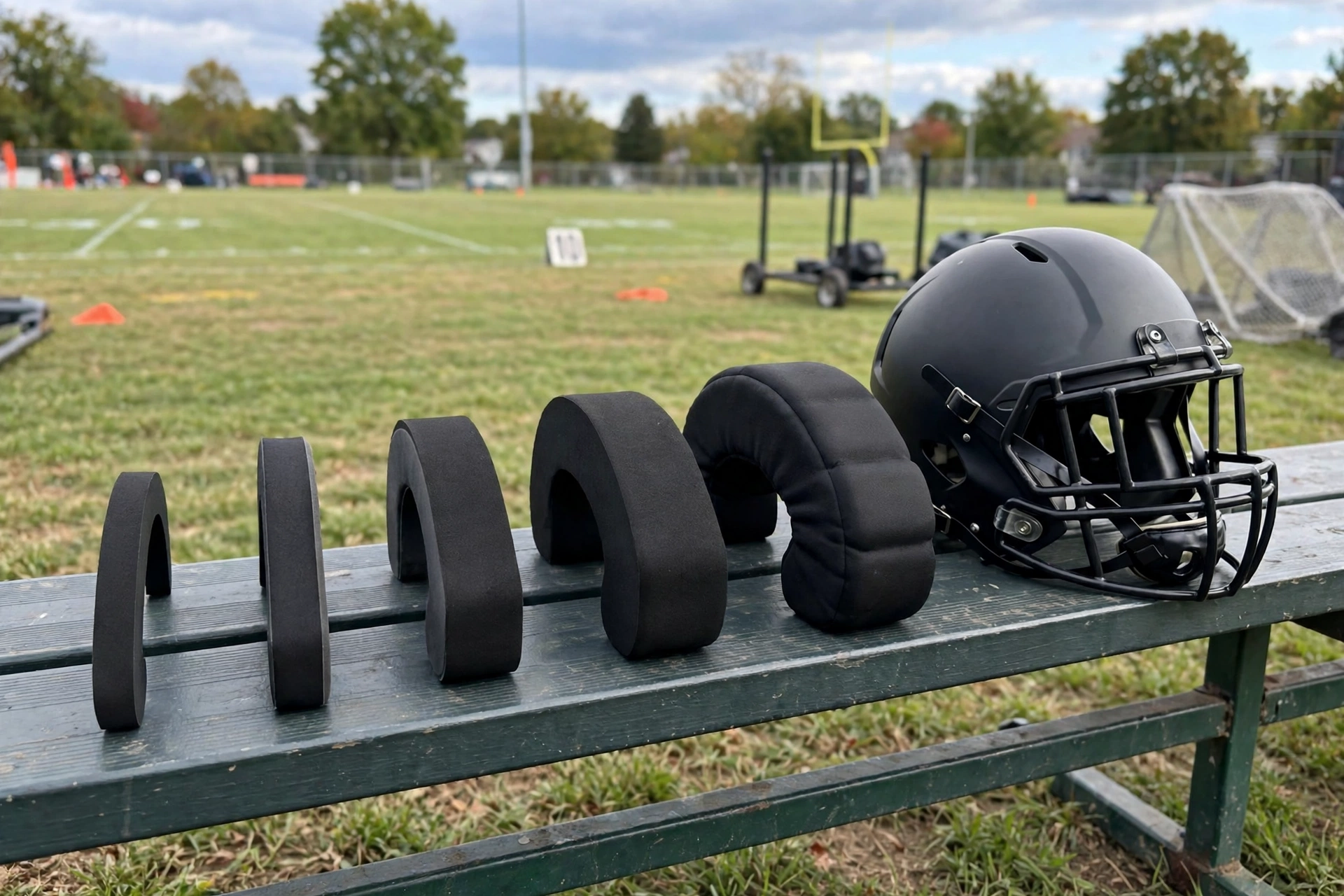
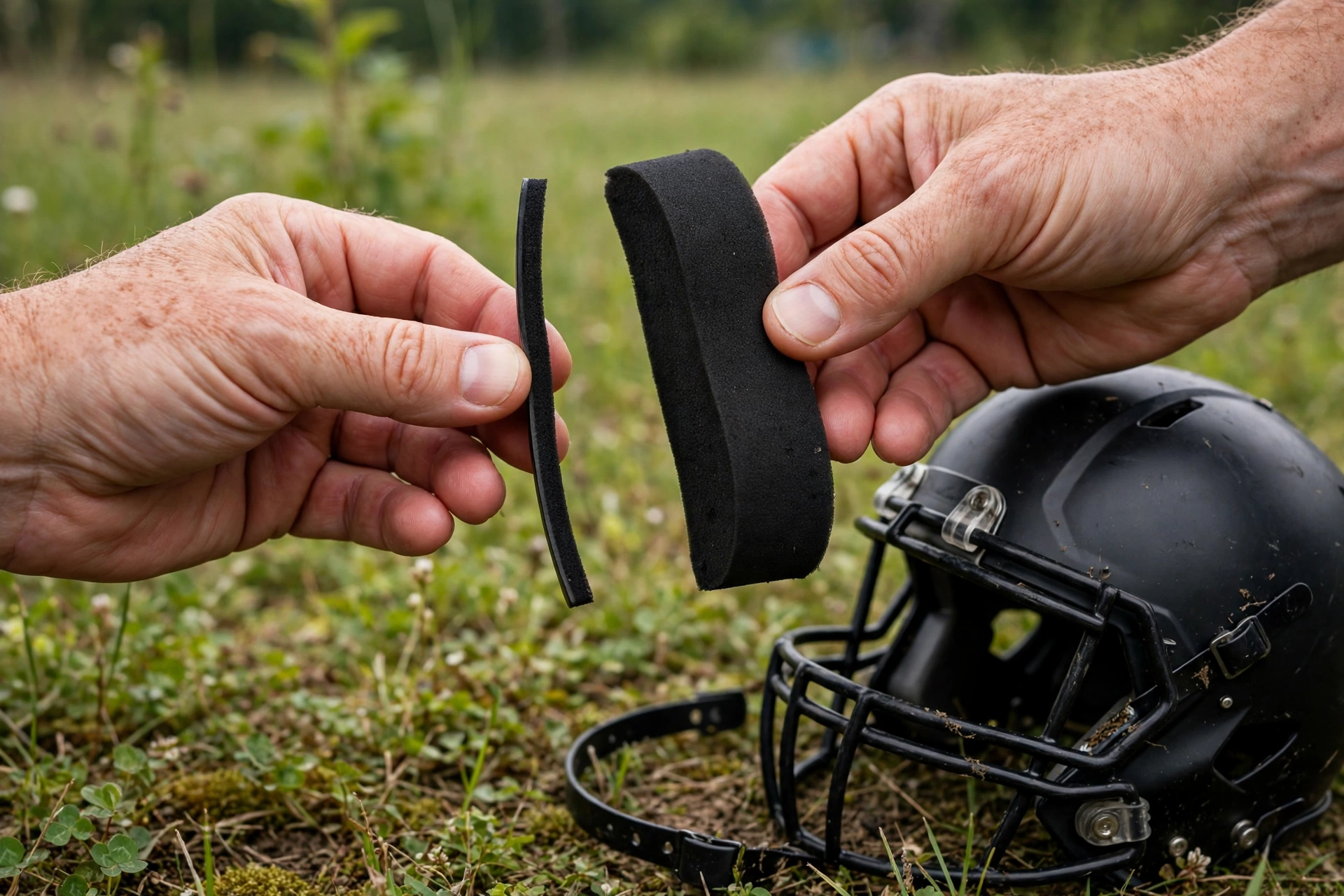
Thicker jaw pads take up more space, pushing the helmet’s grip inward: the cheeks are held more firmly, side-to-side movement reduces, and the helmet generally sits more securely — at the cost of more squeeze. Thinner pads do the opposite, giving a wide jaw room and relieving pressure, at the cost of stability if you go too far.
Pads are usually sold in a small range of thicknesses for each helmet model, and the steps between them are modest. That is deliberate: jaw fit is fine-tuning, layered on top of choosing the correct shell size. Thickness cannot fix a helmet that is the wrong size overall — a shell too big stays too big at the crown whatever the jaw pads do, and a shell too small cannot be rescued by the thinnest pads made.
- Go thicker: helmet rotates, shifts on contact, or feels loose at the cheeks despite a snug crown
- Go thinner: jaw ache, cheek biting, headaches, or pads bulging the helmet outward
- Stay standard: firm, even cheek pressure with no pain and no movement — the target state
Always match pads to your exact helmet model. Jaw pads are shaped for their shell; another model’s pads may clip in and still sit wrong.
How Tight Should Jaw Pads Feel When They Are Right?
Firm and even is the target — the same principle as cheek fit in any helmet. On a correctly fitted helmet, the jaw pads press your cheeks noticeably, often described as slightly puffed cheeks, and when you grip the facemask and try to move the helmet, your skin and cheeks move with it rather than the helmet sliding over them.
Run the movement tests. Shake your head hard, nod, and open your jaw wide and talk: you should be able to shout calls and breathe without the pads locking your jaw, and the helmet should return to the same position after every movement. Then wear it for fifteen minutes. Correct firmness fades into the background; wrong pressure builds into a hot spot or an ache that will only grow during a game.
Check both sides match. One pad thicker, thinner, or not fully seated tilts the whole helmet subtly, and players feel it as a strange one-sided pressure long before they can see it in a mirror.
What Are the Signs Your Jaw Pads Are the Wrong Thickness?
Too thin shows up as movement. The helmet rotates when you are hit or when you turn suddenly, the facemask can be pushed around by hand, and the chin strap seems to be doing all the work alone. Players often compensate by overtightening the chin strap, which just moves the discomfort to under the chin without fixing the stability.
Too thick shows up as pain: aching jaw joints near the ears, sore cheeks, headaches starting at the temples, numbness, or finding yourself opening your mouth against the pads constantly. A helmet that hurts gets worn reluctantly and adjusted constantly, and a distracted player is a less safe player.
Old pads can mimic wrong thickness. Foam compresses permanently over seasons of use and sweat, so pads that once fitted thin out and loosen. Before changing thickness, check the condition: if the pads are flat, cracked, or no longer springy, a fresh set in your original thickness may restore the fit exactly.
How Do You Change Football Helmet Jaw Pads?
On most helmets, jaw pads snap or fasten in with buttons, posts, or hook-and-loop, and changing them is a bench job of a few minutes — check your maker’s instructions for your model. Remove one pad at a time so you can mirror its position and orientation with the new one, and keep left and right organised as you work.
Firmly seat every fastener. A pad that feels attached but has one snap unfastened will work loose in play and change the fit mid-game, so press and tug each point to confirm. Refit the chin strap afterwards, because pad thickness changes how the strap sits and how snug it needs to be.
Then repeat the movement tests at practice before trusting the new setup in a game. And remember why this fine-tuning matters: in a real impact the helmet must not rotate out of position, because its liner — including systems aimed at the rotational forces described in this guide to what MIPS is for helmets — only protects the head it is correctly positioned on. Jaw pads that hold the helmet true are doing safety work, not just comfort work.
Frequently Asked Questions
Q: Do thicker jaw pads give more protection?
A: Not directly — jaw pads are primarily a fit component, and their protective contribution comes from keeping the helmet correctly positioned. The right thickness is the one that holds the helmet stable without pain. Simply choosing the thickest pads does not add safety and can reduce it if the squeeze makes the helmet sit or feel wrong.
Q: Can I mix different pad thicknesses on each side?
A: Only to solve a genuine asymmetry, and it is rarely the answer — most one-sided pressure comes from a pad not seated properly or a helmet sitting crooked. Check seating and helmet position first. If your face is truly asymmetrical, a fitter can help; do not improvise a lopsided setup on guesswork.
Q: How often should jaw pads be replaced?
A: When they stop doing their job: permanently compressed, cracked, torn, no longer springy, or the helmet has started moving despite correct sizing and a snug strap. In a programme helmet, pad condition is part of the inspection and reconditioning cycle; for your own helmet, check them at the start of every season and whenever the fit feels different.

Olivia
Writer at Helmet Today, covering helmet reviews, fit and riding safety.