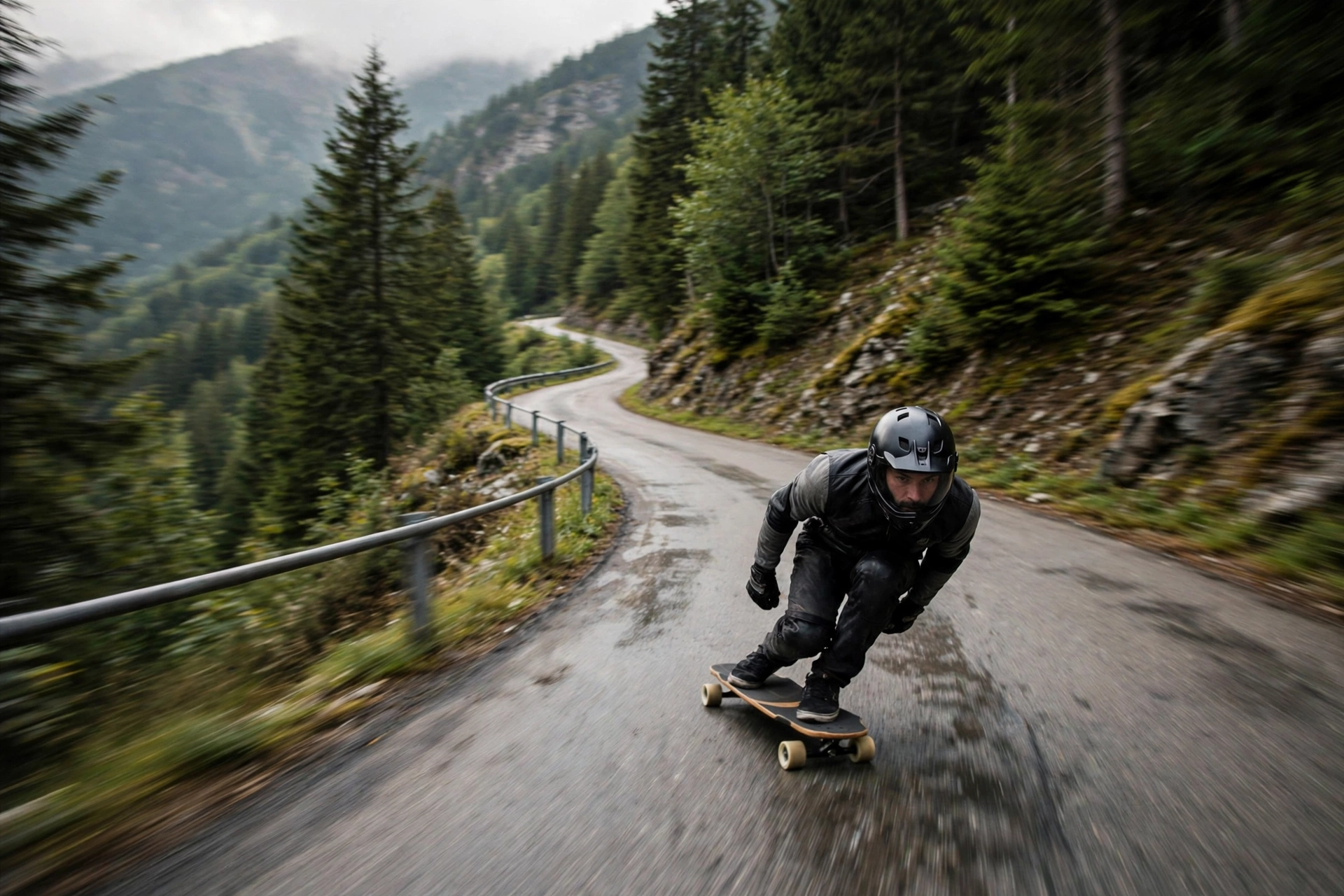
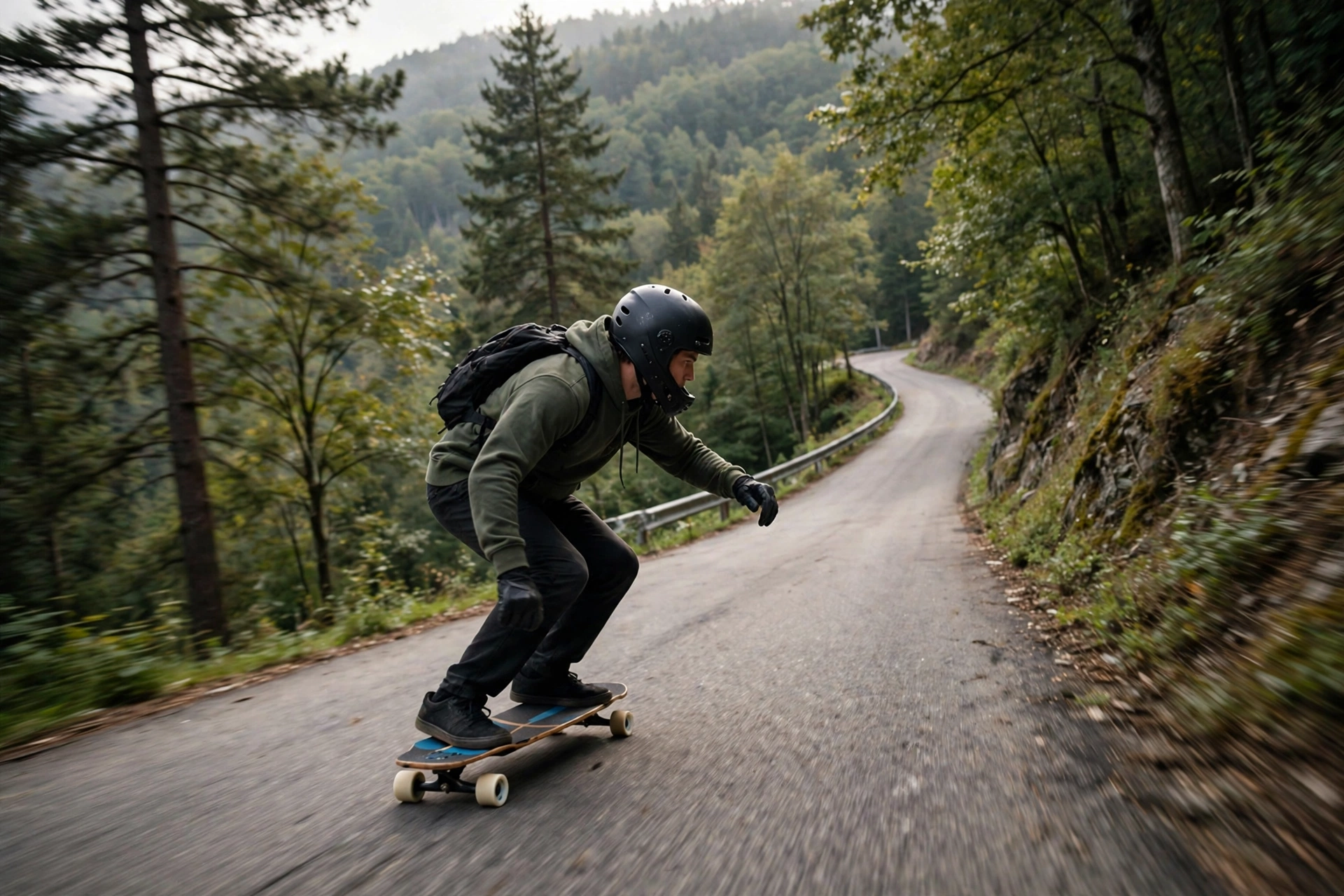
For downhill longboarding, a full-face helmet is the safer choice in general terms — speeds are high, falls are hard, and the face and jaw are genuinely at risk. An open-face skate helmet protects the skull well at park speeds, but downhill longboarding regularly involves speeds where a face-first slide or a tumble becomes likely, and only a full-face helmet protects the chin and jaw.
Downhill longboarding sits in a different world from cruising or park skating. You are descending hills, sometimes on open roads, building speed that a push or a carve cannot match. This guide explains when full-face protection matters, what the trade-offs are, and how to choose between the two styles honestly.
How Fast Does Downhill Longboarding Get?
Downhill speeds vary enormously with the hill, the rider, and the setup — gentle mellow hills may feel relaxed, while steep descents build speed very quickly. Even a moderate hill can carry a rider far faster than any flat-ground skating, and at those speeds a fall involves far more energy than a park fall. That energy is the core reason the helmet question changes for downhill.
Speed also changes how falls happen. At low speed, a skater can often run out a fall or roll. At downhill speed, a slide or a high-side can happen too fast to react, and the rider may tumble or slide face-first along the tarmac. Road rash on the body is painful enough; the same slide applied to an unprotected chin or jaw is a serious injury.
Traffic adds another layer. Many downhill runs use public roads, shared with cars, and a fall or a swerve near traffic raises the stakes further. A full-face helmet does not make road riding safe on its own, but it does protect the parts of the head that an open-face helmet leaves exposed.
What Does a Full-Face Helmet Protect That an Open-Face Does Not?
The obvious difference is the chin bar. A full-face helmet wraps protection around the jaw, chin, and lower face, which are common contact points in a forward fall or a face-first slide. Dental injuries, broken jaws, and facial cuts are among the injuries downhill riders report most, and a chin bar is designed specifically to reduce them.
The chin bar also adds structure. In a full-face helmet, the shell forms a complete loop around the head, which can help the helmet stay in place and spread impact forces. An open-face helmet, however well it fits, has no structure below the level of the ears, so a blow to the lower face has nothing to meet it.
There are secondary benefits too. A full-face helmet shields the face from wind, road debris, insects, and cold air at speed — all real comfort factors on a long descent. Many downhill helmets also have a visor or goggle setup that keeps vision clear at speed, which matters when you are reading the road ahead at pace.
What Are the Downsides of a Full-Face Helmet?
Full-face helmets are heavier, hotter, and more restrictive than open-face helmets. The extra weight can tire the neck on a long session, and the enclosed design traps heat — a real issue on a warm day or a long climb back up the hill. Ventilation on downhill helmets has improved a lot, but a full-face will never breathe like an open-face skate helmet.
Hearing and communication suffer too. A full-face helmet muffles sound, which makes it harder to hear other riders, spotters, or traffic. Downhill riders often rely on spotters calling out hazards on blind corners, so a helmet that blocks those calls needs to be weighed against its protection. Some riders use communication systems, but not everyone does.
Vision can also be affected. A full-face helmet with a visor narrows peripheral vision slightly compared with an open face, and a visor can fog in cold or humid conditions. These are manageable issues — anti-fog treatments and good visor design help — but they are real trade-offs, not imaginary ones.
Cost is a final factor. Good downhill full-face helmets generally cost more than open-face skate helmets, and they need replacing after a hard crash just like any helmet. For a rider who only occasionally rides a gentle hill, that cost may feel hard to justify, which is where honest self-assessment matters.
When Might an Open-Face Helmet Be Acceptable?
For mellow, low-speed downhill — gentle slopes, low traffic, a rider who is comfortable and in control — an open-face certified skate helmet is a reasonable choice, and many riders use one in exactly that setting. The key words are low speed and low consequence: if a fall would be a slide at jogging pace onto a quiet road, the risk profile is much closer to park skating than to racing.
Freeride is a grey area. Freeride involves slides and tricks at moderate speeds, often on the same hills as downhill, and falls are frequent by design. Many freeriders wear full-face helmets for that reason, even though the speeds are lower than pure downhill racing. If your riding involves deliberately breaking traction and sliding, the case for full-face protection strengthens.
What does not work is using an open-face helmet for fast downhill because a full-face feels hot or looks less casual. Comfort is a real consideration, but it should drive you toward a better-ventilated full-face helmet, not toward leaving your jaw unprotected at speed. Choose the helmet for the fastest, hardest fall your riding could produce, not for the average run.
How Should a Downhill Helmet Fit?
A downhill full-face helmet should fit snugly all round, with the chin bar sitting close to — but not pressing on — the chin. The helmet should not rock or lift when you shake your head, and the cheek pads should hold your cheeks gently without squeezing. Vision should be clear through the eyeport or visor, with no pressure on the brow.
Certification matters here as much as anywhere. Look for a helmet certified for the kind of riding you do, and check whether it carries a standard that covers higher-speed impacts. Some downhill helmets also include rotational impact protection, which aims to reduce twisting forces in angled falls — a common fall type at speed. This guide to what MIPS means for helmets explains how one such system is designed to work.
Finally, replace any downhill helmet after a hard crash, and inspect it regularly for cracks, loose padding, or a wobbly chin bar. A downhill helmet that has already absorbed a serious impact has done its job once; do not ask it to do it again.
Frequently Asked Questions
Q: Do I need a full-face helmet for freeride longboarding?
A: In general terms, yes, most freeriders choose full-face protection because slides and falls are frequent and the face is exposed. For very gentle, low-speed freeride, an open-face certified helmet may be acceptable.
Q: Can I use a downhill mountain bike helmet for longboarding?
A: Many downhill bike full-face helmets are used by longboarders, and they offer similar face protection. Check the certification, fit, and ventilation, and make sure the helmet suits skating falls as well as bike falls.
Q: Is a full-face helmet too hot for summer downhill?
A: It is hotter than an open-face, but modern downhill helmets have large vents and airflow channels that help considerably. Choose a well-ventilated model and accept some warmth as the price of face protection at speed.

Olivia
Writer at Helmet Today, covering helmet reviews, fit and riding safety.