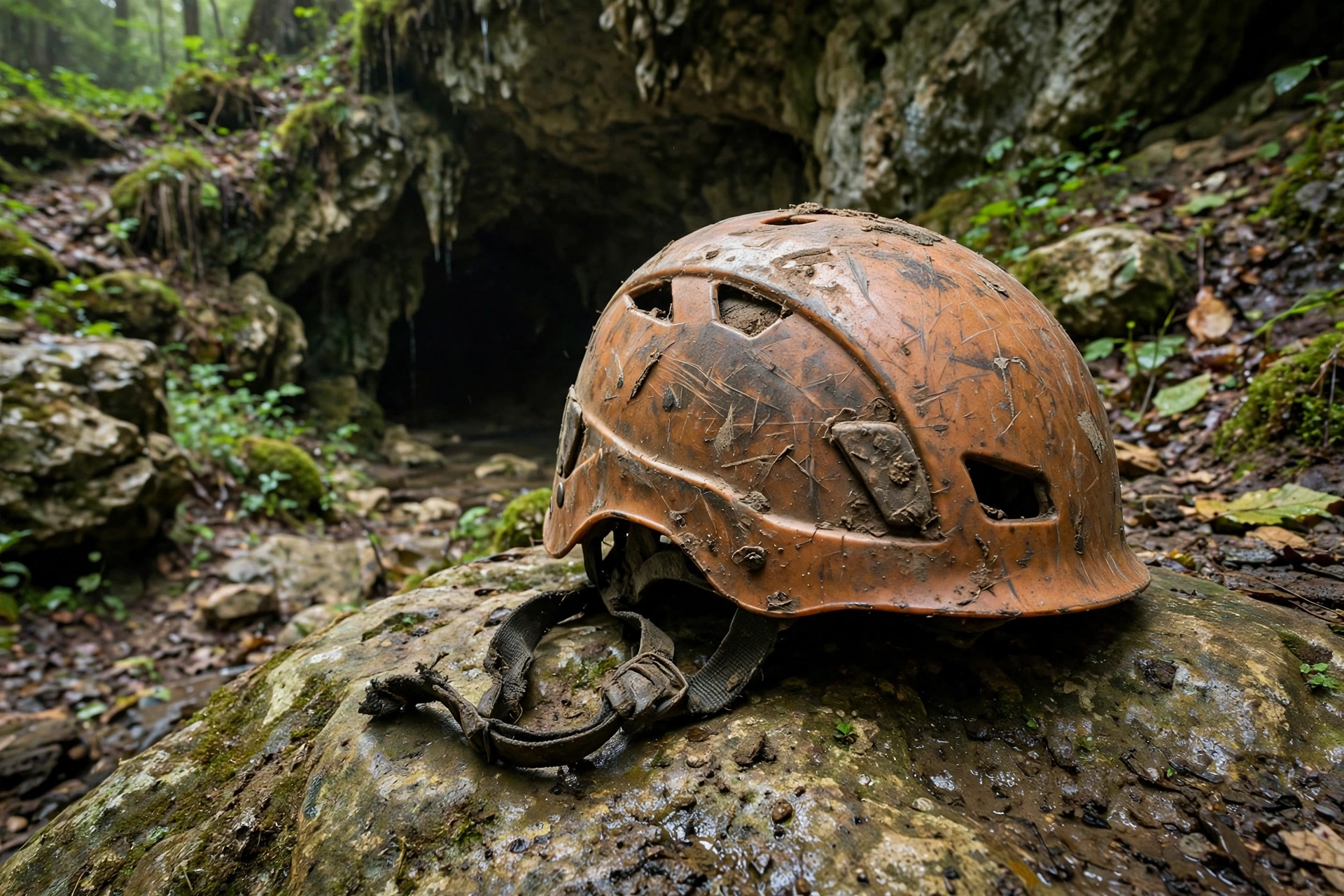
Replace a caving helmet when it has taken a real impact, shows cracks or damaged foam, no longer fits snugly, or is simply old after many seasons of hard underground use. In general terms, a caving helmet that you have to wonder about has usually already told you the answer.
This guide explains how caving helmets age, the warning signs to check for, and how to decide between repair and replacement.
Why Do Caving Helmets Wear Out?
Caving is unusually hard on helmets. Every trip adds scrapes against rock, knocks in low passages, exposure to mud and water, and sometimes a genuine fall or rock strike. The shell, foam, straps, and fittings all absorb that wear, and none of them lasts forever.
The energy-absorbing liner is the part that matters most. In foam-lined helmets, the foam crushes to absorb impact, and once crushed it does not recover. In hard-shell helmets, the suspension or liner system degrades with age, sweat, and repeated wetting. Either way, the helmet’s ability to protect you declines gradually, often without any dramatic visible sign.
Time alone also ages a helmet. Plastics become brittle with age, ultraviolet light, and repeated wet-dry cycles, and straps and buckles weaken with salt, mud, and constant adjustment. A helmet stored for years in a damp shed is not the same helmet it was when it was put away.
What Are the Signs a Caving Helmet Needs Replacing?
Cracks in the shell are the clearest sign. Inspect the shell in good light, inside and out, looking for hairline cracks, white stress marks, deep gouges, and any area where the shell feels brittle or flexes oddly. A cracked shell should be retired immediately, not patched.
Damaged or compressed foam is the second sign. Peel back the comfort padding and look at the liner: crushed areas, flaking material, or foam that has gone hard and chalky all mean the liner is past its best. If the helmet rocks or feels loose even after adjusting the fit system, the liner or padding has likely compressed beyond recovery.
Worn straps, buckles, and fit systems are the third sign. Frayed straps, cracked buckles, a dial that slips, or a cradle that no longer holds its setting all undermine the helmet’s ability to stay in place. A helmet that cannot stay put cannot protect you reliably.

Should You Replace a Caving Helmet After an Impact?
Yes, after any significant impact. A rock strike, a fall where your head hits stone, or a hard drop onto rock can damage the liner even if the shell looks fine. The whole point of the liner is to deform to absorb energy, and that deformation is often hidden under the shell or padding.
Minor bumps are different. A helmet that brushes a low ceiling or taps a rock in a crawl has not necessarily suffered damage — caving helmets are built to take that kind of contact. The line is between everyday contact and a real impact: if the hit was hard enough to make you stop and check, it was hard enough to warrant a careful inspection, and if that inspection finds any damage, replacement.
When in doubt, retire the helmet. The cost of a new caving helmet is small next to the risk of trusting a liner that has already done its job once.
Can a Worn Caving Helmet Be Repaired Instead?
Some parts can be replaced: comfort padding, chin straps, buckles, lamp clips, and fit-system parts are all consumables, and most makers sell them as spares. Replacing worn padding or a frayed strap can restore fit and comfort, and it is worth doing before you write a helmet off.
What cannot be repaired is the protective structure itself. A cracked shell, crushed foam liner, or damaged suspension system cannot be safely fixed with glue, tape, or filler. Any repair that claims to restore a cracked shell should be treated with scepticism — the helmet’s strength comes from its structure, and a repair cannot recreate it.
A good rule is this: replace the soft parts freely, but retire the helmet when the hard parts fail. Keeping a helmet going with new padding is sensible maintenance; keeping a cracked helmet going with tape is not.
How Can You Make a Caving Helmet Last Longer?
Store it properly: indoors, out of direct sun, away from heat and chemicals, and dry before storage. A helmet left wet and muddy in a bag will age far faster than one that is rinsed, dried, and stored on a shelf. Rinse mud and grit out of straps, buckles, and vents after every trip.
Handle it like protective equipment. Do not drop it down pitches, sit on it, or use it as a bucket for gear. Small knocks add up, and the helmet that is treated carefully is the one that reaches the end of its natural service life instead of an early one.
When you do replace it, choose the replacement with fresh eyes rather than automatically buying the same model. Helmet design moves on, and modern impact protection such as rotational-impact liners like MIPS is designed to reduce twisting forces in angled impacts — the kind of glancing blow a cave roof delivers all too often.
Keep a simple log of your helmet’s history if you cave regularly: when you bought it, any significant impacts, and when you replaced padding or straps. It takes a minute after each trip, and it removes the guesswork when you are deciding whether a helmet is due for replacement. A helmet with a known history is far easier to judge than one you are trying to remember across several seasons of muddy trips.
Frequently Asked Questions
Q: How long does a caving helmet last?
A: In general terms, a caving helmet used regularly may last several seasons, but condition matters more than the calendar. Replace it sooner if it is cracked, damaged, loose, or has taken a significant impact.
Q: Can I keep using a caving helmet after a small bump?
A: Everyday contact with low ceilings and rock in crawls is normal and does not automatically mean replacement. A hard impact, rock strike, or fall where your head hits stone should trigger a careful inspection and usually replacement.
Q: Does a caving helmet expire if it sits in storage?
A: Materials age slowly even in storage, especially in damp, hot, or sunny conditions. A helmet stored for many years should be inspected for brittle plastic, degraded straps, and compressed padding before you trust it underground.

Olivia
Writer at Helmet Today, covering helmet reviews, fit and riding safety.