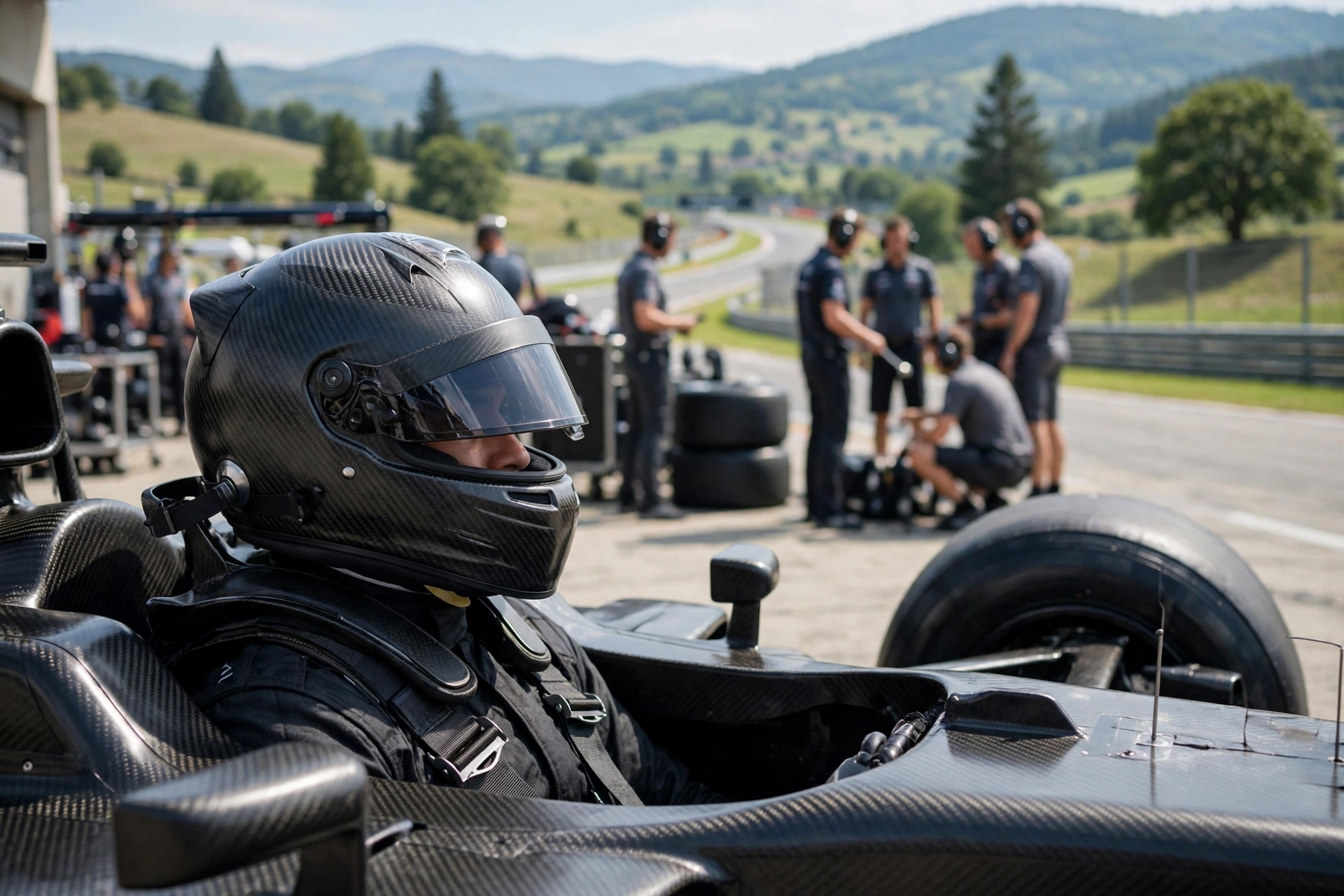
A Formula 1 helmet is a full-face, carbon-fibre helmet built for the fastest circuit racing in the world — a lightweight, aerodynamic design that protects the driver at very high speeds while carrying a visor, a drinking system, and radio communication in a tight cockpit. Formula 1 cars are open-wheel, open-cockpit single-seaters that race at speeds far beyond most other motorsport, so the driver’s head is exposed to the wind, to debris thrown up from the track, and to the forces of a crash at high speed. The helmet is one of the most important pieces of safety equipment in the car, and it is built to a demanding standard that covers impact protection, fire resistance, and the ability to work with the head restraint and harness systems in the cockpit. In general terms, it is a specialist helmet, custom-fitted to each driver, and not something a club racer would buy off the shelf.
This guide explains what a Formula 1 helmet is, how it is made and fitted, and what makes it different from other motorsport helmets. It covers the materials and construction, the visor and ventilation, the communication and drinking systems, and the care that goes into keeping such a helmet ready to race. Even if you never sit in a Formula 1 car, understanding how these helmets work shows what the best helmet technology can do.
What Makes a Formula 1 Helmet Different?
The first difference is the standard it must meet. Formula 1 helmets are built to the most demanding helmet standard in motorsport, which tests them for impacts from many angles, for penetration by sharp objects, and for fire resistance. The shell is made from carbon fibre, which is both very strong and very light, and the inside is shaped to fit the driver’s head exactly. Because the cars are so fast, even a small stone kicked up from the track can hit with serious force, so the visor and shell are designed to resist debris as well as impacts.
The second difference is how the helmet works with the rest of the cockpit. A Formula 1 driver wears a head restraint device that connects the helmet to the seat, a six-point harness, and a fireproof suit and balaclava. The helmet has to fit with all of that, and it has to stay in place under the heavy braking and cornering forces of a Formula 1 car, where the driver’s head is pushed hard in every direction.
How Is a Formula 1 Helmet Made and Fitted?
A Formula 1 helmet starts with the driver’s head. The helmet maker takes detailed measurements and often a scan of the driver’s head, then builds a shell and lining shaped to that individual. The shell is laid up from layers of carbon fibre, cured under heat and pressure, and then trimmed and finished by hand. The lining is fitted to the driver’s head shape, with padding placed to hold the helmet steady without creating pressure points. The result is a helmet that fits like a glove and stays put through every corner.
Fitting is not a one-off job. Drivers try the helmet in the car, strapped into the seat with the head restraint and harness, and the fit is adjusted until the driver can see clearly, breathe easily, and turn their head enough to check the mirrors and the cars around them. If you are learning about how helmets handle different kinds of impact, reading about what MIPS is for helmets can help you understand one of the technologies used in modern helmet design.
What About the Visor and Ventilation?
The visor on a Formula 1 helmet is a critical part of the design. It has to give the driver a wide, clear view of the track at very high speed, resist impacts from stones and debris, and stay clear in rain. Drivers use tear-off strips to clear the visor during a race, and the visor itself is made from a tough, optically clear material that is tested for penetration. In wet races, the visor may have a special coating to help water run off, and drivers may change visor tints as the light changes through the day.
Ventilation in a Formula 1 helmet is carefully managed. The driver’s head sits in the airflow over the car, and the helmet has vents that bring in fresh air and let warm air out, keeping the driver cool and the visor clear of mist.
How Do Communication and Drinking Systems Work?
Formula 1 helmets carry more than protection. A radio system is built into the helmet, with earpieces and a microphone, so the driver can talk to the pit wall throughout the race. The team gives the driver information about gaps, strategy, and warnings about other cars, and the driver reports back on how the car feels. The radio has to work clearly at high speed, over engine noise and wind, and it has to be comfortable enough to wear for the whole race.
The helmet also carries a drinking system. A tube runs from a drink bag in the car into the helmet, so the driver can take a sip on the straights. Races can last up to two hours in hot conditions, and drivers lose a lot of fluid through sweat, so staying hydrated matters. It is a small detail, but it is one of many that keep a driver at their best for the full distance.
What Care Does a Formula 1 Helmet Need?
Formula 1 helmets are looked after by the team’s specialists, and the care is thorough. Before every session, the helmet is checked for damage, the visor is inspected for scratches, and the radio and drinking systems are tested. The lining is kept clean and dry, and the helmet is stored in a protective case when it is not being used. Any helmet that has been involved in a crash is taken out of service and examined, and if there is any doubt about its condition, it is replaced.
The lesson for any driver is that a helmet is only as good as its condition. Even a top-level helmet needs regular checks: look for cracks, check the visor, test the fasteners, and keep the lining clean. Store it away from heat, fuel, and chemicals, and never hang it by its straps or drop it onto a hard floor. A helmet is a piece of safety equipment, and treating it with care is part of respecting what it does for you.
Frequently Asked Questions
Q: Can a club racer buy a Formula 1 helmet?
A: In general terms, Formula 1 helmets are custom-built for individual drivers and are not sold as a standard product. Club racers should choose a helmet that meets the approval required for their own series.
Q: Why are Formula 1 helmets so light?
A: They are made from carbon fibre, which is strong and light, and the low weight reduces strain on the driver’s neck under heavy braking and cornering. A lighter helmet also helps the driver stay comfortable over a long race.
Q: Do Formula 1 drivers wear a balaclava under the helmet?
A: Yes. Drivers wear a fireproof balaclava under the helmet, which protects against fire and helps the helmet fit snugly. It also keeps sweat out of the lining and makes the helmet more comfortable to wear.

Olivia
Writer at Helmet Today, covering helmet reviews, fit and riding safety.