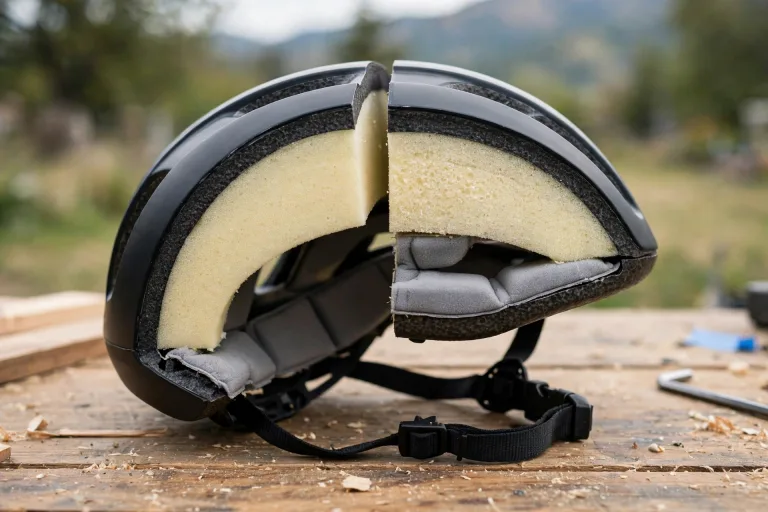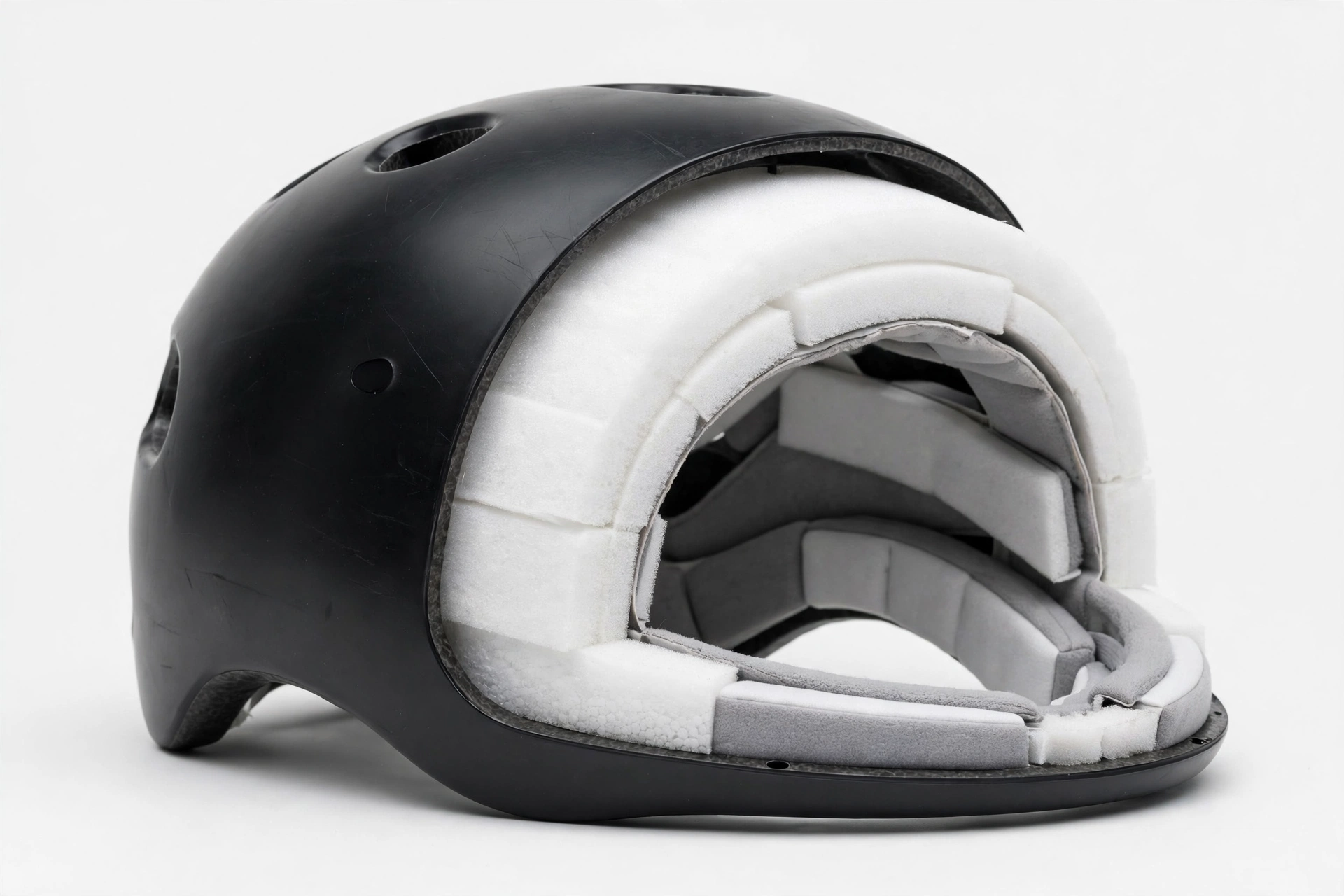
A helmet is made from a hard outer shell, a foam liner that absorbs impact, and a comfort and retention system of padding, straps and a buckle. The shell spreads the force of a knock across a wider area, the foam liner crushes slowly to soak up energy, and the straps keep the helmet in place on your head. Together, these parts turn a sharp, concentrated blow into something your head can cope with far better.
What is the outer shell made from?
The outer shell of most modern helmets is made from a tough plastic such as polycarbonate, or from a composite material such as fibreglass or carbon fibre on higher-end models. Its job is to spread the force of an impact, resist penetration from sharp objects, and hold the foam liner together. A smooth, hard shell also slides more easily across a road surface, which can help reduce twisting forces on the head in a fall. The shell is usually only a millimetre or two thick on a cycling helmet, yet it is strong enough to do its job because the foam underneath provides the real cushioning.
Cheaper helmets often use a thicker, heavier plastic shell, while premium helmets use thinner, lighter materials bonded directly to the foam. This is why two helmets that look similar can feel very different in weight and price. Whatever the material, the shell should be free of cracks and damage — a cracked shell means the helmet should be replaced.
What is inside the helmet?
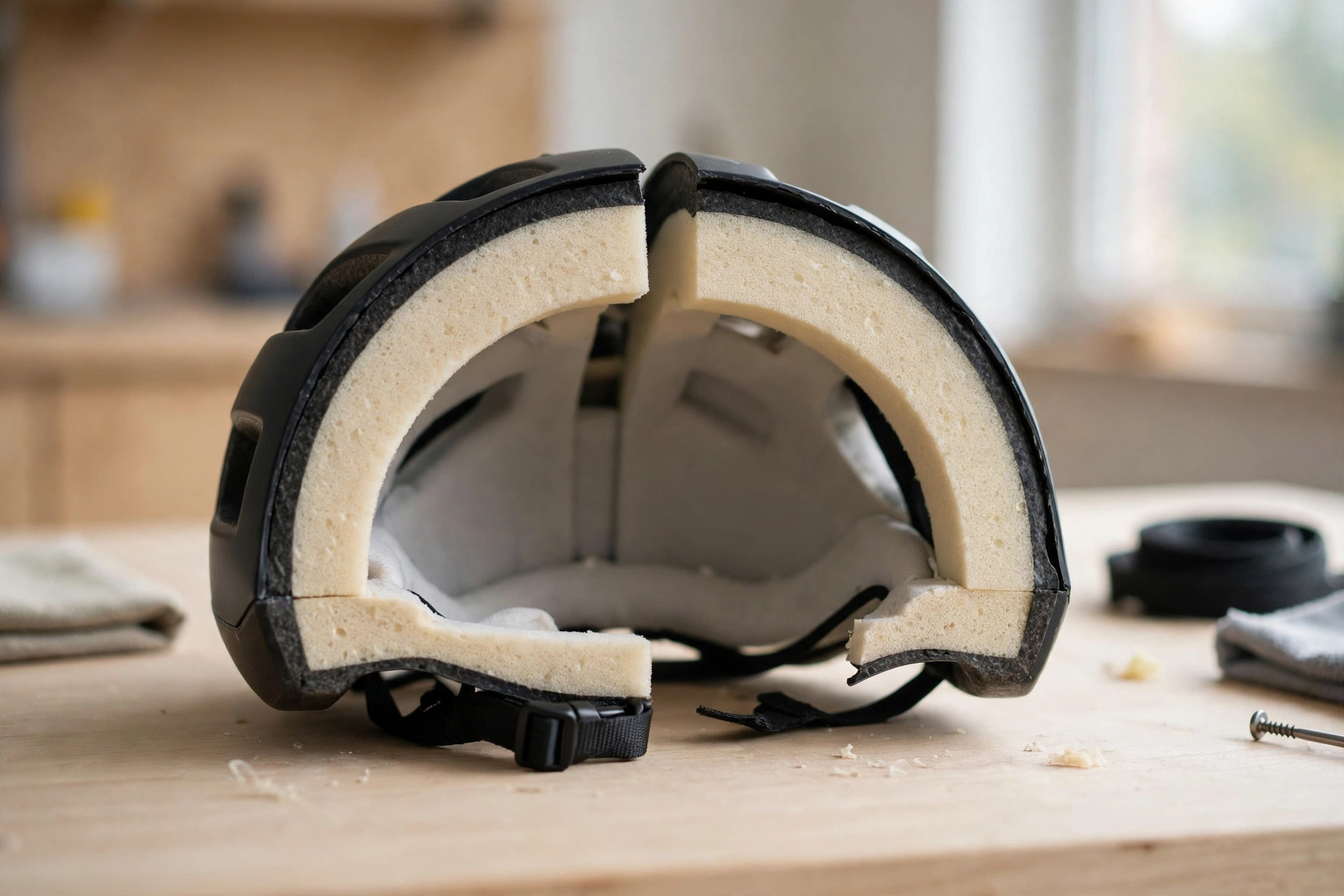
Inside the shell sits the liner, usually made from expanded polystyrene foam, often shortened to EPS. This foam is the part that does most of the protective work: it compresses on impact, slowing your head down over a slightly longer distance and absorbing energy that would otherwise reach your skull. Some helmets also use other foam types or additional layers, such as multi-density foam or gel pads, to fine-tune how the helmet responds to different kinds of impact. The density of the foam matters too — denser foam suits harder, faster impacts, while softer foam handles slower knocks better, which is why some helmets mix the two.
Modern helmets may also include a slip-plane layer — a thin sheet inside the helmet that lets the shell move slightly relative to your head during an angled impact. This idea is used in MIPS helmets, and it is designed to reduce the twisting forces that can occur when you hit the ground at an angle. Not every helmet has this feature, but it has become common on mid-range and premium models.
What are the straps and padding made from?
The straps are usually made from woven nylon webbing, with a plastic buckle under the chin and small adjusters on the sides. Nylon is strong, light and resistant to sweat and weather, which is why it is used on almost every helmet. The straps need to be adjusted so they sit snugly: loose straps let the helmet shift or come off in a crash, which defeats the purpose of wearing one.
The comfort padding inside the helmet is normally a soft foam covered in fabric, often with a moisture-wicking surface. These pads sit against your forehead and the sides of your head, and they make the helmet comfortable enough to wear for hours. Many helmets come with spare pads of different thicknesses, so you can fine-tune the fit, and the pads can usually be removed and washed. Washing the pads now and then keeps the helmet fresh and stops sweat and grime from building up, which also helps the pads last longer.
How are vents and fit systems built in?
Vents are simply openings moulded through the shell and liner, shaped to let air flow over your head as you move. The number and size of vents affect both cooling and weight: more vents usually mean a cooler helmet, but the shell and foam still need enough material left to protect you. Good helmets are designed so the vents channel air without weakening the structure.
The fit system is usually a dial at the back of the helmet connected to a cradle that wraps around the back of your head. Turning the dial tightens or loosens the cradle, letting you get a snug fit without changing pads. Some helmets also have adjustable height for the cradle, so it can sit comfortably above or below a ponytail, and the whole system is held in place by small plastic anchors inside the liner. If the dial ever stops clicking or the cradle feels loose, the fit system may be worn out — and a helmet that cannot be adjusted to fit snugly should be replaced.
Do different helmets use different materials?
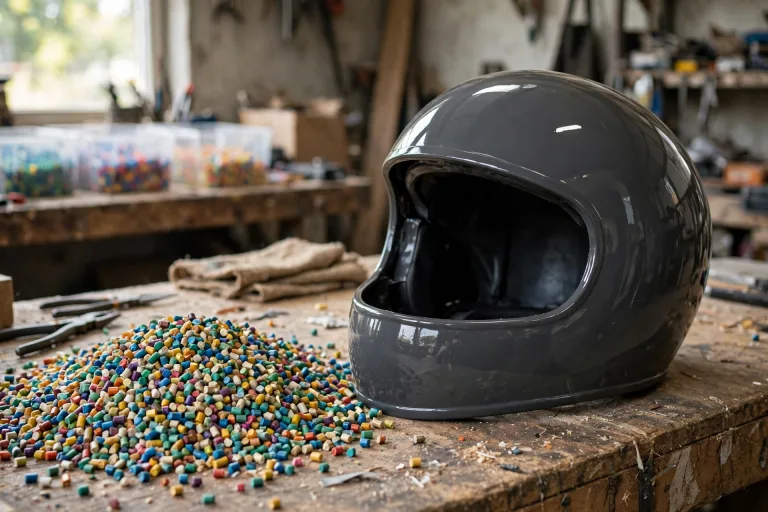
Yes. A road cycling helmet, a mountain bike helmet, a skate helmet and a motorcycle helmet all start from the same basic idea — shell, liner and straps — but the materials and thicknesses differ a lot. Motorcycle helmets, for example, use much thicker shells and denser foam because the speeds involved are far higher, while a skate helmet may use a softer, multi-impact foam designed to survive several smaller knocks rather than one big one.
Work helmets and climbing helmets are different again: they often use a hard plastic shell with a suspension system inside rather than a full foam liner, because they are designed mainly to protect against falling objects. The lesson is simple: buy a helmet made for the activity you do, and do not assume a helmet built for one sport will protect you properly in another. Checking the label or the product description for the intended use takes only a moment, and it is the easiest way to make sure the materials inside your helmet match the risks you actually face.
What is the foam inside a helmet called?
It is usually expanded polystyrene, or EPS foam. It compresses on impact to absorb energy and protect your head.
Can a helmet be repaired if the shell cracks?
No — a cracked shell or a helmet that has taken a hard knock should be replaced, because the protective foam inside may be damaged even if the outside looks only slightly marked.
Why do some helmets cost much more than others?
Premium helmets often use lighter materials such as carbon fibre, more vents, better fit systems and extra features like a slip-plane layer, while budget helmets use heavier plastics and simpler fittings.

Olivia
Writer at Helmet Today, covering helmet reviews, fit and riding safety.