Angular acceleration in a helmet crash is the sudden speeding up of the twisting motion of your head when the helmet hits a surface at an angle. Instead of stopping in a straight line, the head is forced to rotate quickly, and that rapid twist is what makes angled impacts different from straight ones. The helmet’s job in this case is to reduce how sharply the head twists, not just how hard it stops.
The word angular refers to rotation, and acceleration means a change in speed. When your head is moving along and suddenly starts spinning, or spins much faster in a very short time, that is angular acceleration. It is measured in general terms by how quickly the twisting motion changes, and it is the part of a crash that is hardest for the brain to cope with.
What does angular mean in a crash?
Angular means to do with turning or rotating. A straight fall has no angular element: the head moves in a line and stops in a line. An angled fall adds rotation, because the helmet catches on the surface and the head is dragged around a point, like a ball spinning after it bounces off a wall at an angle.
Think of a cyclist who falls and whose helmet grazes the road. The head is still moving forward when the helmet touches the ground, so the contact point grips while the rest of the head keeps moving, and the head twists. That twist is the angular part of the crash, and it happens at the same time as the straight-line stop. Most real crashes contain some angular movement, which is why it matters so much in helmet design.
How does a glancing blow twist the head?
A glancing blow twists the head because the helmet meets the surface off-centre. The point of contact acts like a pivot, and the momentum of the moving head turns around it. The shell can also grip the surface for a brief moment, which adds to the twist, while the head inside keeps moving and is dragged around.
The result is a rapid rotation that starts suddenly and stops suddenly. In general terms, the more angled the blow and the more the shell grips, the stronger the twist. A smooth shell that slides easily can reduce this effect, because it lets the helmet glance off the surface instead of catching on it. That is one reason helmet shells are made smooth and rounded rather than rough or angular.
Why is twisting harder on the brain?
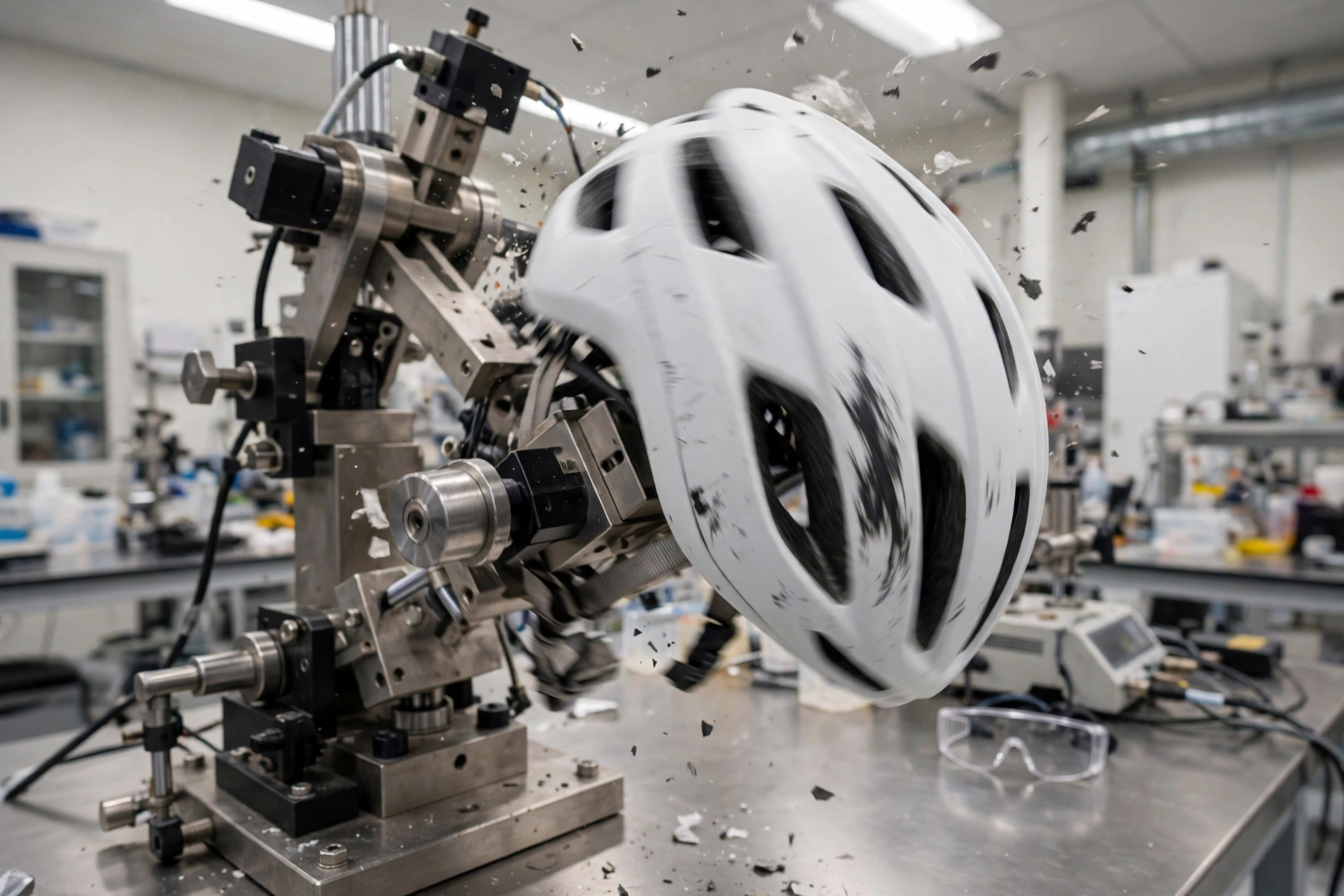
The brain is soft tissue that floats inside the skull, and it copes better with straight-line movement than with twisting. A straight stop pushes the brain against the skull in one direction, but a twist can stretch and shear the brain tissue, because different parts of the brain move at different speeds during a rotation.
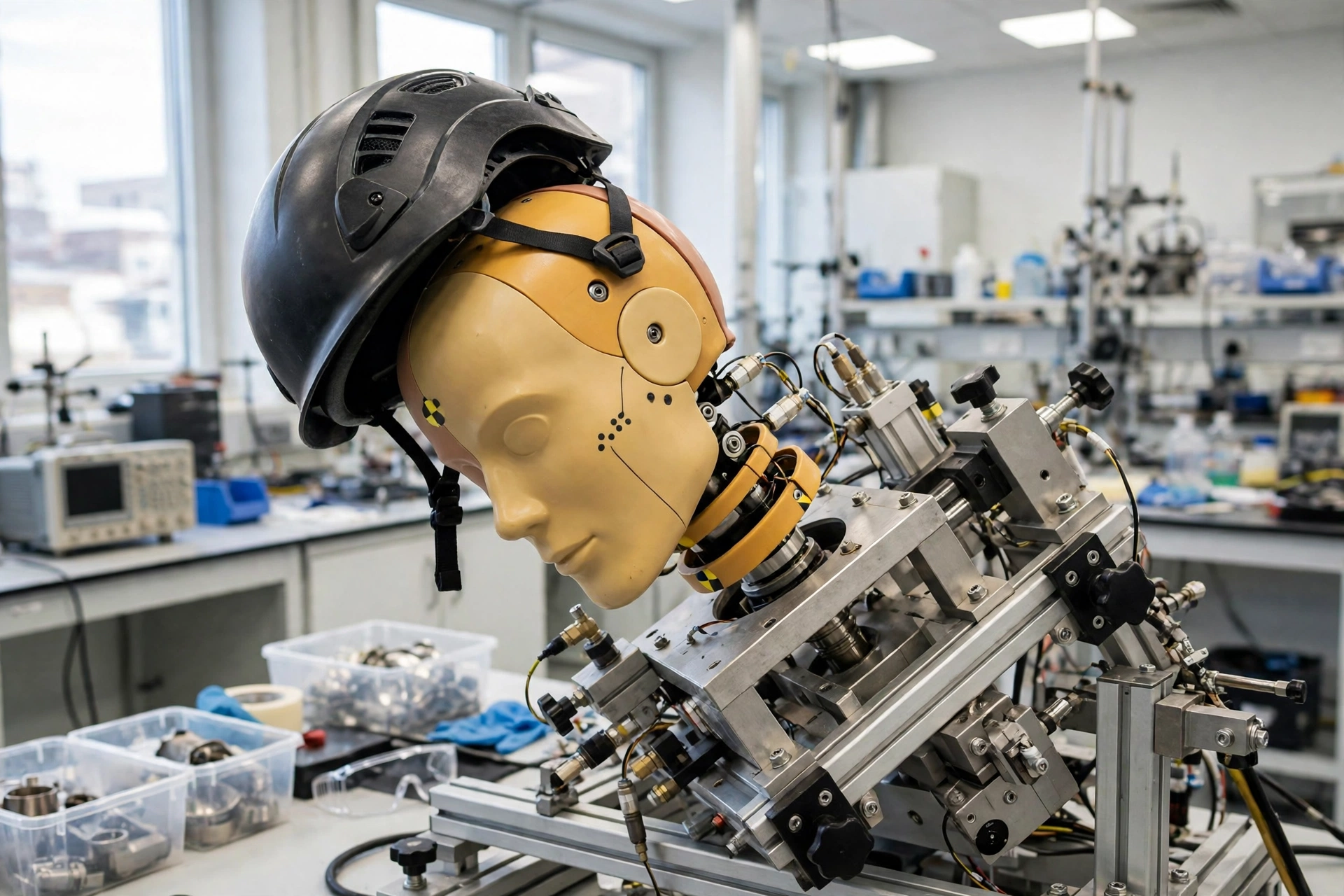
This stretching is what makes rotational forces a concern in helmet safety. Even a twist that lasts a fraction of a second can strain the delicate structures inside the brain, which is why researchers and helmet designers pay close attention to angular acceleration. It is one of the reasons modern helmet testing now looks at rotation as well as straight-line force, instead of testing straight impacts alone. Reducing the sharpness of the twist is just as important as reducing the hardness of the stop.
What happens inside the helmet during a twisting impact?
Inside the helmet, a twisting impact loads the liner unevenly. One side of the liner is crushed more than the other, because the force is not spread evenly across the impact area. The fit system and comfort padding are also pulled sideways, and the helmet may try to rotate on the head while the head itself is twisting the other way.
The shell spreads the straight part of the force as usual, but the liner cannot absorb a twist in the same way it absorbs a straight blow. Foam crushes well when it is squeezed, but it is less good at dealing with sideways, shearing movement. That is why extra design features are needed for angled impacts, and why fit matters: a helmet that stays snug lets those features work, while a loose helmet can shift and leave the head exposed.
How do helmets reduce twisting forces?
Helmets reduce twisting forces in a few ways. A smooth outer shell helps the helmet slide across a surface instead of gripping it, which keeps the twist smaller from the start. Some helmets also have a low-friction layer inside that lets the shell move a small amount relative to the head, so the shell can rotate without dragging the head around with it.
One well-known example of such a layer is MIPS, a system designed to allow a small slip between the helmet and the head during an angled impact. The movement is tiny, but it is enough to reduce the twisting force that reaches the brain. The shell and liner still handle the straight part of the impact, while the slip layer deals with the rotation, and together they cover more of what happens in a real crash.
What should riders know about angular impacts?
Riders should know that angled impacts are common, and that a helmet’s ability to handle them matters. When choosing a helmet, it is worth looking for features designed for rotational forces, and for a smooth shell shape that is less likely to catch on a surface. No helmet can remove all twisting force, but a helmet designed with rotation in mind gives you better protection in the kinds of falls that happen most often.
Fit is just as important as features. A helmet that is snug and level, with the straps fastened correctly, stays in place during a crash and lets the shell, liner, and slip systems do their jobs. A loose helmet can twist on the head before the protection even starts working. After any crash, the helmet should be replaced, because the liner and the slip layer may have been used up even if the outside looks fine.
Is angular acceleration the same as spinning?
Not quite. Spinning is the rotation itself, while angular acceleration is how quickly that rotation speeds up or slows down. A sudden change in the twisting motion is what strains the brain.
Do straight falls involve angular acceleration?
A perfectly straight fall has very little rotation in it, but most real falls are not perfectly straight. Even a small angle at the moment of impact can add a twisting element to the crash.
Can a helmet stop all twisting force?
No. A helmet can reduce the twisting force that reaches your head, but it cannot remove it entirely. That is why helmets lower the risk of injury rather than guaranteeing protection in every crash.

Olivia
Writer at Helmet Today, covering helmet reviews, fit and riding safety.