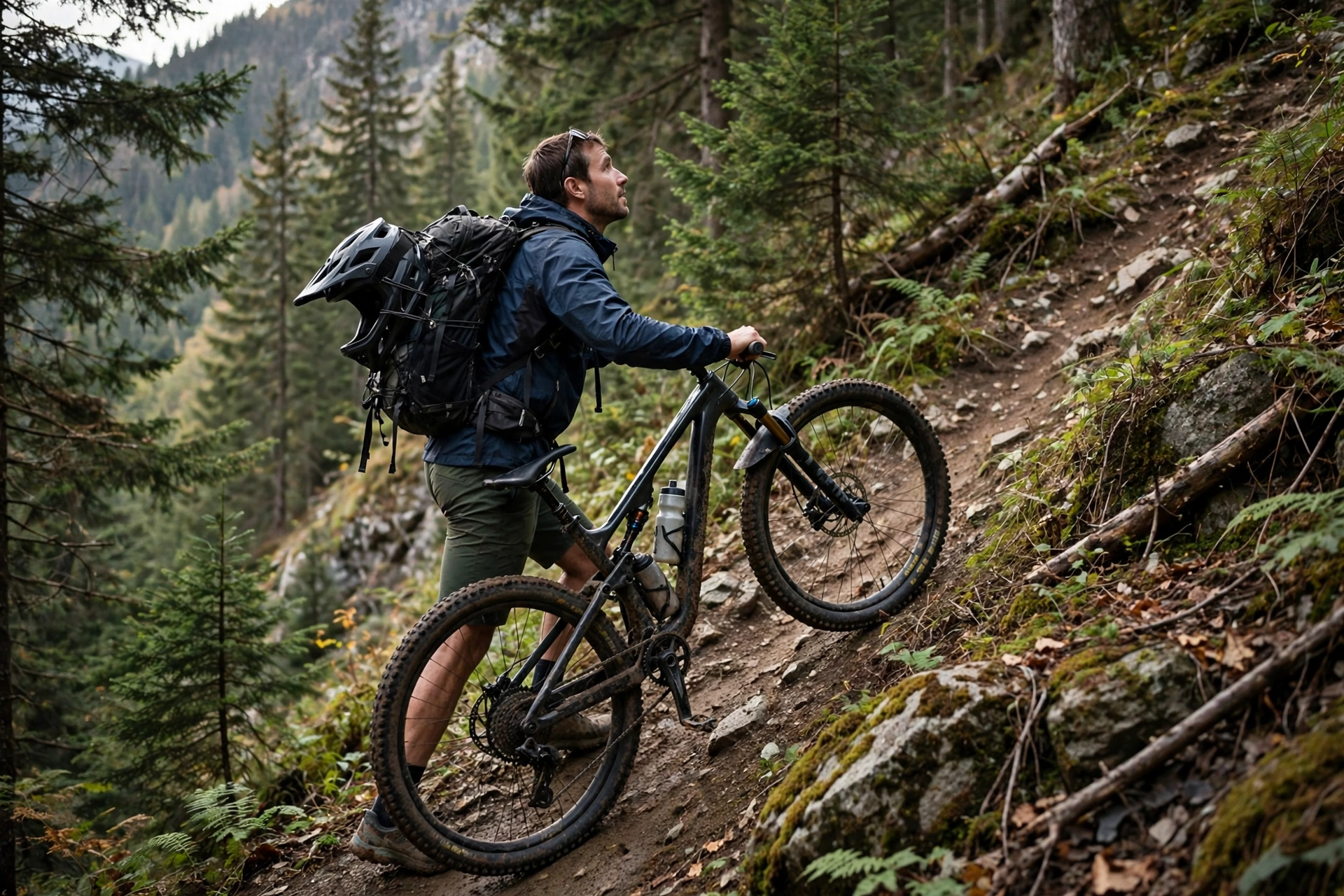
In general terms, the best way to carry a full face MTB helmet on climbs is to strap it to the outside of your pack, hang it from your handlebars, or wear it with the chin bar removed if it is a convertible helmet. Full-face helmets are bulky, heavy, and hot to pedal in, so many riders who climb to their descents want the helmet off their head on the way up — but a helmet swinging loose, banging against a frame, or stuffed inside a pack gets damaged and gets in the way. The right carrying method keeps the helmet secure, protected, and easy to reach at the top.
Which method works best depends on your setup: whether you ride with a pack, what kind of climbs you do, and whether your helmet is a dedicated full-face or a convertible. This guide covers the options and their trade-offs.
Can You Strap a Full Face Helmet to Your Pack?
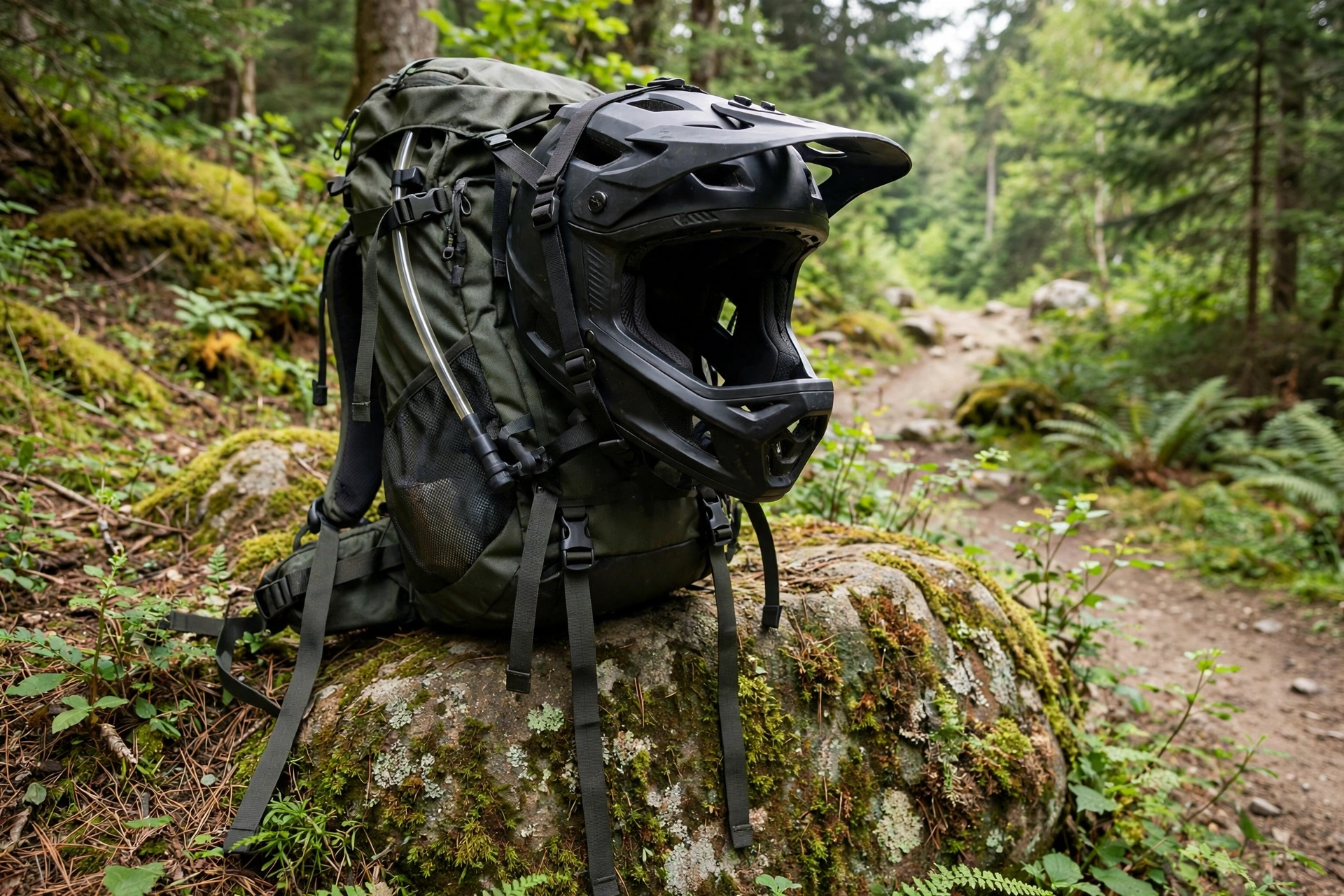
Yes, and for most riders this is the best option. Many riding packs have external helmet-carry systems: straps, a net, or a dedicated cradle that holds the helmet against the outside of the pack. The helmet sits securely, stays ventilated, and does not take up space inside the pack.
If your pack has no helmet carry, you can improvise with compression straps or a small cargo net, threading straps through the helmet’s vents or around the chin bar. Make sure the helmet is snug against the pack and cannot swing: a helmet bouncing on your back is annoying on a climb and can throw your balance on technical sections.
Position matters too. Centring the helmet on the pack keeps the weight balanced, while hanging it off one side pulls you sideways. Check that the helmet does not block access to your water, tools, or pockets, and that straps do not press on the visor or goggles if you carry those with the helmet.
Is Hanging a Helmet From the Handlebars a Good Idea?
It can work for short, smooth climbs, but it has drawbacks. Hooking the helmet over a bar end or hanging it from a strap around the bars keeps it off your back, but the helmet swings, catches wind, and can interfere with steering or brake levers. On rough or narrow trails it may also bang against the frame or snag branches.
If you do hang a helmet from the bars, use a short strap that holds it tight against the bars rather than a long loop that lets it dangle. Keep it clear of the front wheel, cables, and levers, and check it before technical sections — a helmet that drops into the front wheel is a crash waiting to happen.
For most riders, the bars are a backup rather than a first choice. They suit gentle fire-road climbs where the bike is stable and the helmet is easy to grab at the top, but for singletrack climbs a pack carry is safer and more comfortable.
Should You Just Wear the Helmet on the Climb?
Sometimes, yes — and many riders do. A lightweight full-face helmet, or a convertible helmet with the chin bar removed, is wearable on climbs, especially short ones. Wearing the helmet means it cannot fall off, get damaged, or be forgotten, and you are protected if you fall on the climb itself.
The downside is heat and weight. Full-face helmets are hotter than open-face helmets, and on a long, steep climb the difference is significant. If you wear a full-face helmet uphill, open the vents fully, take the chin bar off if the design allows, and pace yourself — overheating on a climb is a real risk on hot days.
A convertible helmet is the ideal compromise here: climb with the chin bar off and the helmet in open-face mode, then clip the bar on at the top. You carry the bar in a pack pocket or strapped to the pack, which is far easier than carrying a whole helmet. If you ride a dedicated full-face helmet, though, wearing it is often simpler than carrying it, at least for shorter climbs.
What About Carrying a Helmet Without a Pack?
Riders without packs have fewer options, but there are still workable ones. A helmet can be carried by its chin bar in one hand on a gentle climb, though that ties up a hand and gets tiring on long ascents. Some riders clip the helmet to a hip pack or a waist strap, or use a dedicated helmet-carry strap that slings the helmet over a shoulder.
Another option is to leave the helmet at the top of the descent when the route allows it — for example, on shuttle or uplift days, or when riding a loop that returns to the same point. If you do, store it somewhere safe and visible, not on the ground where it can be run over or filled with dust.
Whatever you do, avoid stuffing a full-face helmet into a small bag or wedging it under bungee cords so tightly that the shell or visor bends. Helmets are designed to take impacts, not sustained pressure in odd directions, and a visor or mount bent out of shape in a bag is a needless repair.
How Do You Protect a Helmet While Carrying It?
Keep the helmet’s inner liner facing your pack or body, so the shell takes any knocks rather than the pads. Avoid letting the helmet bang against hard objects — repeated knocks can crack the shell or compress the foam, even without a crash. If the helmet shares a pack with tools, keep the tools in a separate pocket.
Watch the visor and goggles too. A visor can snap if it catches on a strap or branch, and goggles left loose with a helmet can scratch. Stow goggles inside the helmet’s eyeport or in a soft pouch, and make sure straps do not pull the visor sideways.
Finally, think about the helmet’s other protection systems. Rotational impact layers sit inside the helmet and are protected by the shell, but a helmet that is repeatedly dropped or crushed in transit still suffers. This guide to what MIPS means for helmets explains how one such system works — and like any helmet component, it lasts longest when the helmet is carried with care.
Frequently Asked Questions
Q: What is the easiest way to carry a full face helmet uphill?
A: Strapping it to the outside of a riding pack is usually easiest — it stays secure, ventilated, and out of the way, and you can reach it quickly at the top of the climb.
Q: Can I hang my helmet from my handlebars?
A: For short, smooth climbs, yes, if it is held tight and clear of levers and the front wheel. For technical singletrack climbs, a pack carry is safer.
Q: Is it better to wear a full face helmet on climbs?
A: For short climbs, wearing it is simplest and keeps you protected. For long, hot climbs, carrying it — or using a convertible helmet with the chin bar off — is more comfortable.

Olivia
Writer at Helmet Today, covering helmet reviews, fit and riding safety.