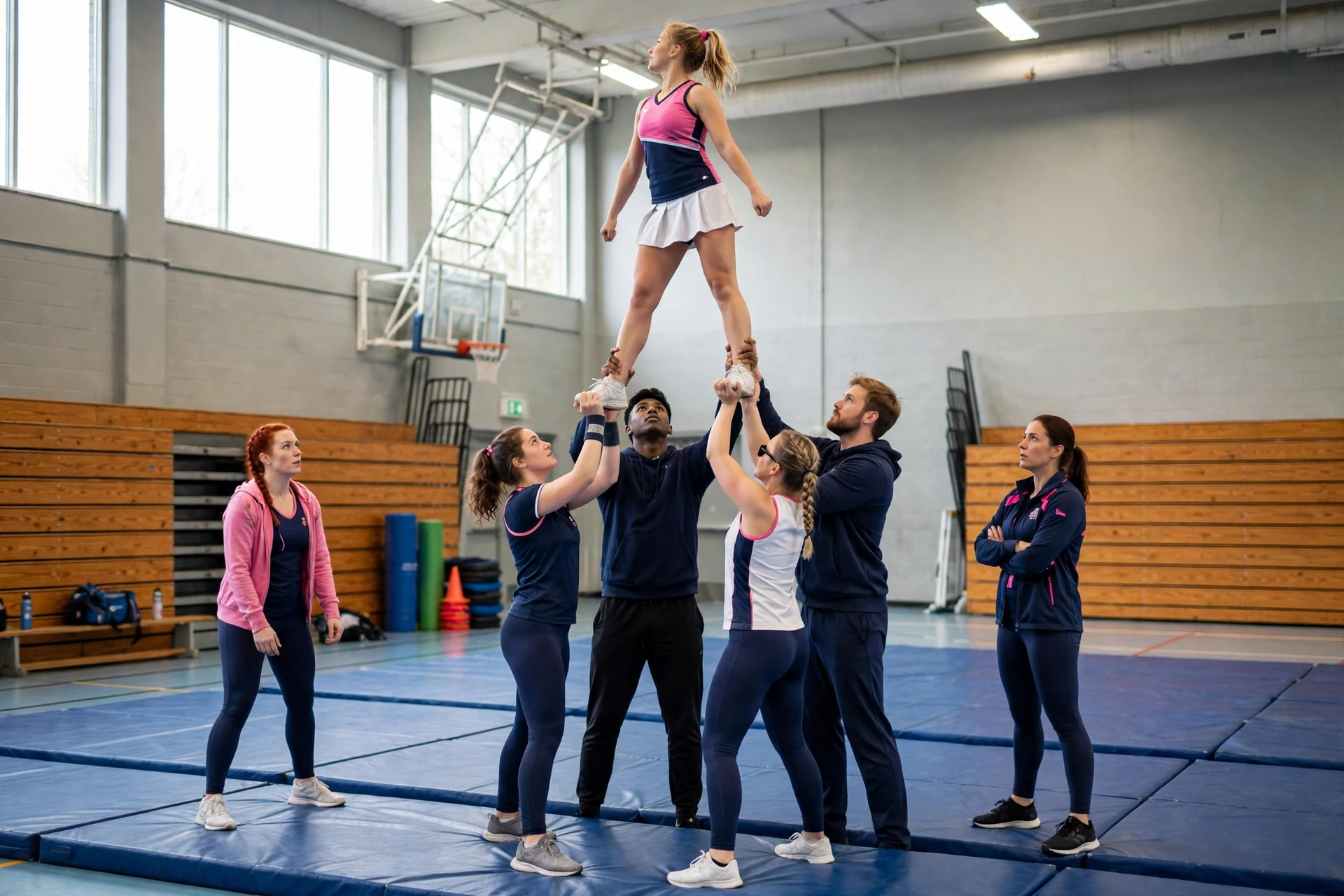
In general terms, cheerleaders do not wear helmets for stunts, because a helmet can make stunts less safe by changing balance, blocking grip, and getting in the way of catching. Cheerleading stunts involve lifting, throwing, and catching flyers, and the people at the base need a clear grip on the flyer’s body and feet. A helmet on the flyer changes the shape of the head and can make it harder to catch them safely, while a helmet on the base can block their view and their grip.
That answer surprises many people, because helmets are normal in so many other sports. Cheerleading is different because it is a close-contact team activity where the safety system is the people themselves: the bases, the spotters, and the mats. Head protection in cheerleading comes from good technique, careful spotting, and a safe landing surface, rather than from a helmet.
Why do cheerleaders not wear helmets for stunts?
The main reason is grip. In a stunt, the bases hold the flyer’s feet, ankles, or body, and the spotter watches the flyer’s head and shoulders. A helmet adds bulk and a hard, slippery surface where the spotter or the base may need to support the flyer. If the flyer comes down awkwardly, a helmet can make it harder to guide them to a safe landing, and it can also hit a base or a spotter in the face.
Balance is another reason. A helmet changes the weight and the feel of the head, which matters when the flyer is balancing on one foot at the top of a pyramid or being thrown into the air. A flyer needs to feel their own body position clearly, and a helmet can dull that sense. In tumbling, a helmet can also catch on the mat or change the way the head moves through a flip, which can make the skill less safe rather than more safe.
Are cheerleading stunts dangerous without helmets?
Cheerleading stunts do carry a risk of injury, including head injuries, and that risk is taken seriously by coaches and governing bodies. Most injuries in cheerleading happen to the flyer, often in falls from a stunt or a pyramid, and they can include sprains, fractures, and concussion. The risk is managed through training, not through helmets.
Coaches reduce the risk by teaching skills step by step, by using mats and crash mats for practice, by making sure there are enough spotters, and by only allowing a skill in performance when the team can do it safely in practice. A stunt that is not ready is not performed, and a flyer who is tired, ill, or unsure does not go up. These rules are the safety system in cheerleading.

Do cheerleaders wear helmets for any part of cheerleading?
Helmets are not part of standard cheerleading, but there are some situations where head protection is used. In some youth or school programmes, a soft head guard may be used for beginners who are learning tumbling, although this is not common. A head guard is not a helmet, and it does not protect against the same forces as a hard-shell helmet.
Some cheerleaders wear a helmet for a different activity, such as cycling to practice or riding a scooter, but that is not part of the sport itself. There have been trials of soft headgear for cheerleading, and some researchers have suggested it could reduce the risk of minor head knocks, but no major cheerleading body requires helmets, and most coaches do not use them, because the grip and balance problems remain.
What keeps cheerleaders safe instead of helmets?
The first layer of safety is coaching. A good coach teaches skills in small steps, checks that each athlete is ready before moving on, and stops a stunt if it is not working. The second layer is spotting. A spotter stands close to the stunt, watches the flyer, and is ready to catch or guide them if something goes wrong. A stunt should never be practised without a spotter.
The third layer is the surface. Stunts are practised on mats, and competitions are held on a sprung floor or a matted surface that absorbs some of the force of a fall. Hard floors, concrete, and grass are not suitable for stunts. The fourth layer is the team itself: bases and flyers train together, learn each other’s timing, and build trust, so the stunt is a team skill, not an individual one.
What should a parent ask a cheerleading coach about safety?
If your child is starting cheerleading, ask the coach about their qualifications and about the programme’s safety rules. Ask how skills are taught, how many spotters are used, and what surface the team trains on. Ask whether the team follows the rules of a recognised governing body, and what happens if an athlete is injured, including how concussion is recognised and managed.
Also ask about conditioning and warm-up, because strong, flexible athletes are less likely to be injured. A good programme includes strength training, stretching, and rest, and it does not push athletes into skills they are not ready for. If a coach cannot answer these questions, or if the team practises stunts on a hard floor without spotters, that is a warning sign. Some helmets in other sports use a slip layer such as MIPS to reduce rotational forces, but in cheerleading the safety system is coaching, spotting, and mats, not headgear.
Has anyone tried helmets for cheerleading?
Yes, the idea has been discussed and tested in a small way. Some researchers and coaches have looked at soft headgear for flyers, and a few programmes have tried it for beginners. The results have been mixed, because while a soft head guard can reduce the force of a minor knock, it does not prevent concussion, and it can still interfere with grip and balance.
There is also a practical problem: cheerleading is a performance sport, and a helmet changes the look of the routine. That is not the main reason helmets are not used, but it is part of why there has been little pressure to adopt them. The main reason remains safety: the people who run the sport believe that good coaching, spotting, and mats protect cheerleaders better than a helmet would, and that a helmet could make some stunts more dangerous rather than less.
Do cheerleaders wear helmets in competitions?
No, in general terms, cheerleaders do not wear helmets in competitions. The rules of the major cheerleading bodies do not require helmets, and teams perform stunts and tumbling without them, on a matted surface, with trained spotters.
Would a helmet protect a cheerleader who falls from a stunt?
A hard helmet could reduce the force of a head impact, but it could also make the fall harder to control, because it changes grip and balance. Coaches and governing bodies believe that spotting, mats, and good technique are a better way to manage the risk, which is why helmets are not used.
Should my child wear a helmet for cheerleading practice?
Talk to the coach before you decide. A helmet is not part of standard cheerleading, and a coach may advise against it because it can interfere with stunting. If you are worried about head injuries, ask the coach about their safety rules, spotting, and concussion policy instead.

Olivia
Writer at Helmet Today, covering helmet reviews, fit and riding safety.