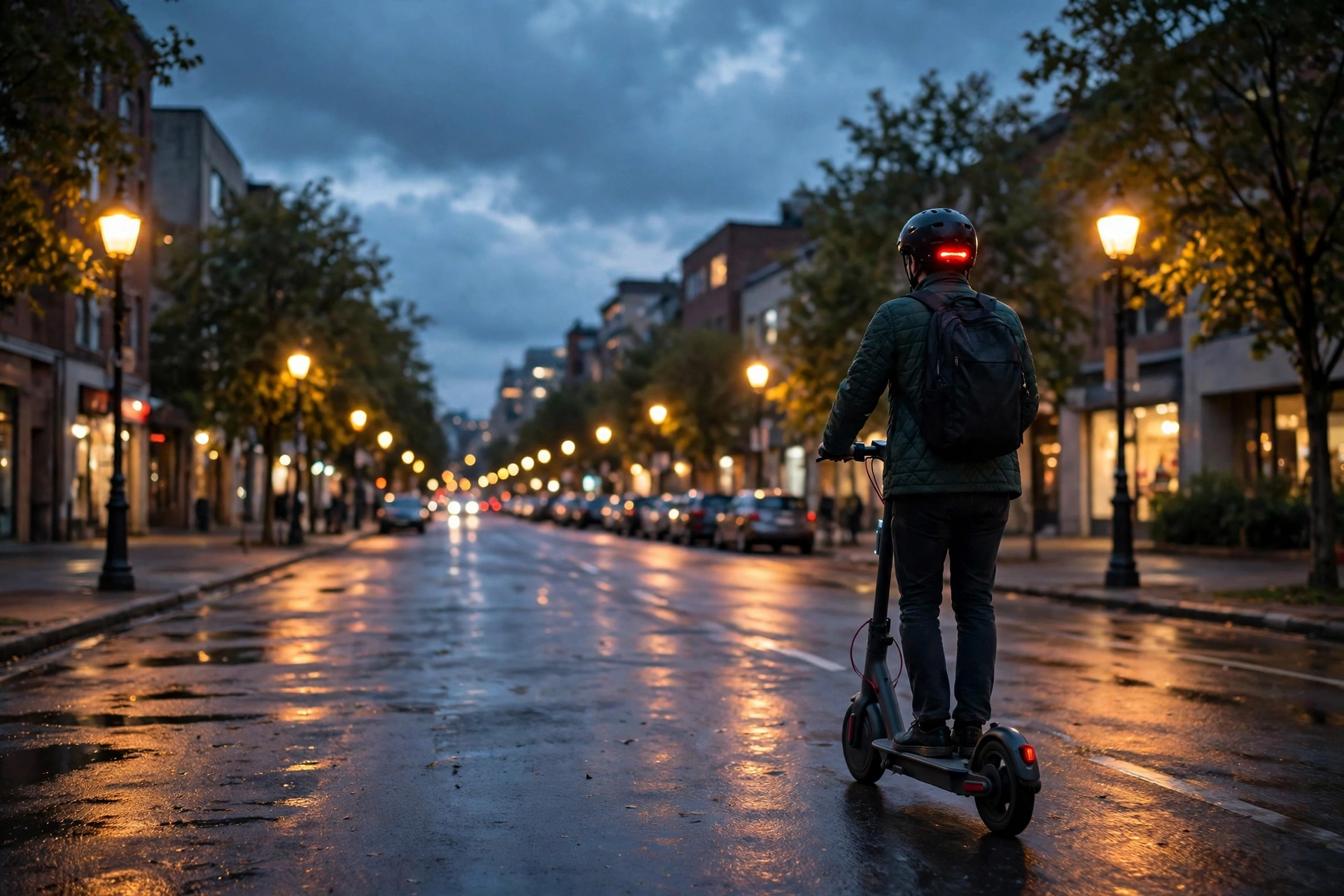
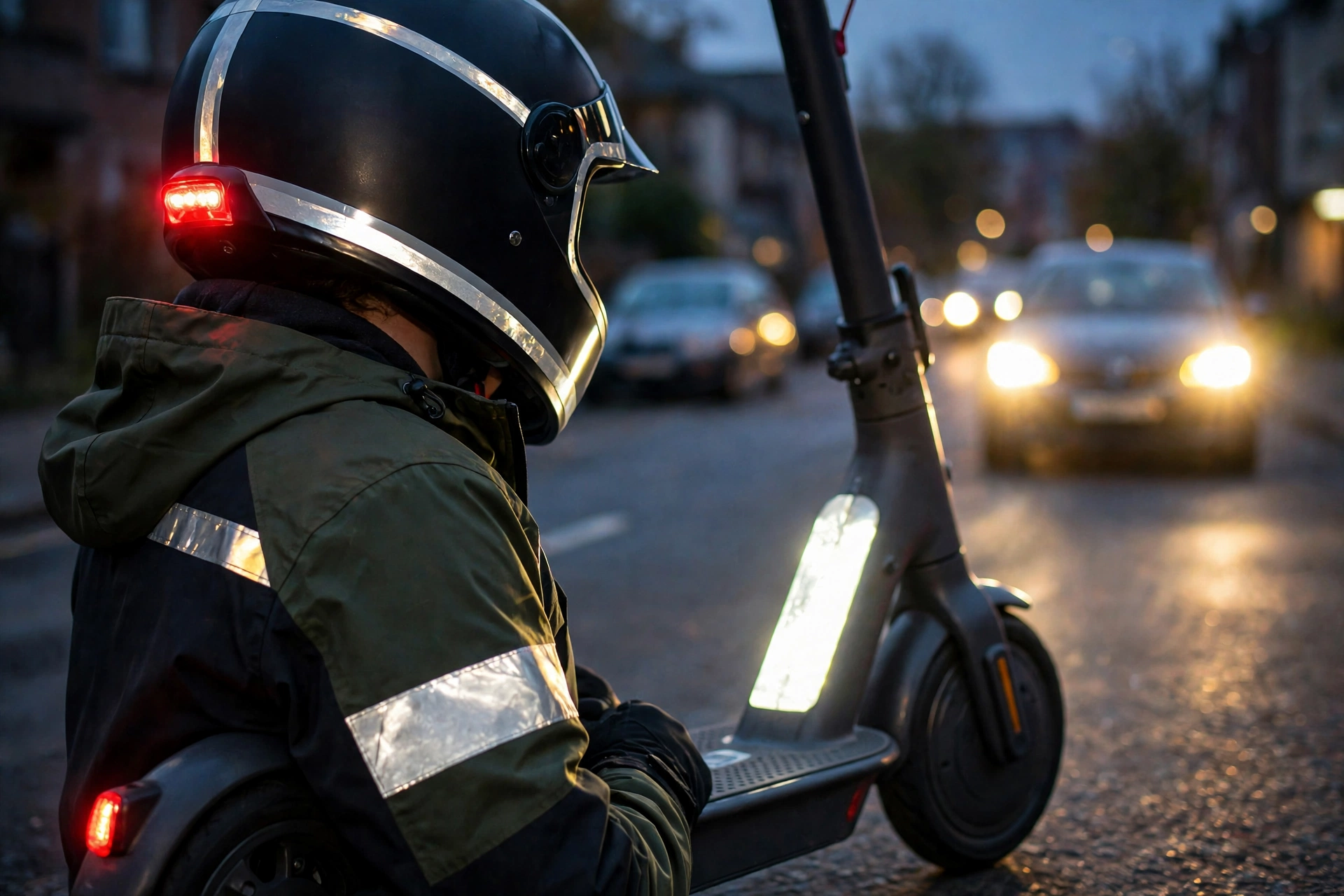
For night riding on an e-scooter, look for a helmet that makes you visible as well as protected: built-in front and rear lights, reflective panels or trim, and solid coverage — paired with the lights on your scooter itself. A helmet alone never makes you legal or safe after dark, but the right helmet closes the biggest visibility gap on a scooter: your head is the highest, most visible part of you in traffic.
This guide covers the helmet features that genuinely matter after dark, how they work together with your scooter’s lights, and the other checks worth doing before a night ride.
Why is night riding on an e-scooter riskier?
Most scooter crashes involve another vehicle, and darkness attacks the one thing that prevents them: being seen in time. E-scooters have a slim profile, small lights mounted low near the deck, and no bulk to catch a driver’s eye. A driver’s headlights pick up your legs and the scooter far later than they pick up a cyclist’s higher, wider outline — and your head, up at car-driver eye level, may be the most visible thing about you if it carries light or reflectivity.
Your own vision shrinks too. Potholes, wet leaves, curbs, and uneven pavement that are obvious at noon become surprises at night, especially at scooter speeds on small wheels. Visibility gear is therefore a two-way problem: you need to see the road and be seen on it, and your helmet setup plays a part in both.
What helmet features matter most after dark?
Start with built-in lighting. Helmets with an integrated rear light — ideally with a front light as well — put illumination at the highest point of your body, above car hoods and parked vehicles, right in a driver’s natural line of sight. A flashing or pulsing rear mode is easier for drivers to notice in general terms, while a steady front light helps you be judged as an approaching vehicle rather than a streetlight reflection.
Next, reflective coverage. Reflective panels, piping, or even a fully reflective shell finish bounce headlight beams back toward drivers and work even if a battery dies. The more of the helmet’s surface that reflects — especially at the back and sides — the earlier you register. Finally, do not trade away the basics for electronics: the helmet still needs proper certification, a snug fit, and the coverage your speed calls for. Extra tech on a poorly fitting helmet is the wrong bargain.
Are built-in helmet lights enough on their own?
No. Helmet lights are an addition to your scooter’s lights, never a replacement for them. In general terms, road rules typically require a white front light and a red rear light or reflector on the device itself, and those rules do not care that your helmet also glows. Keep both systems working: scooter lights satisfy the law and mark the machine; helmet lights mark you, even when you turn your head or step off the deck.
There is one more subtle benefit to the combination. If you and the scooter are separated in a fall — it happens — a lit helmet keeps you visible lying in the road while drivers approach. That is a grim scenario, but it is exactly the kind of margin that visibility gear exists for.
How do helmets and lights work together with rider position?
Light output only helps if it points the right way. Before a night ride, check that your helmet sits level — a helmet tipped back aims its rear light at the sky and its front light at the ground. Charge helmet lights like you charge the scooter; a dead light at midnight is just extra weight, and rechargeable models with a clear battery indicator make this easy to manage.
Think about dusk specifically, too. The most dangerous riding light is often not full darkness but the hour around sunset, when the sun sits low in drivers’ eyes, shadows stretch across the road, and many drivers have not yet switched on their own headlights — which means your reflective gear has nothing to bounce back. A helmet light that you switch on early, before it feels dark to you, covers exactly this gap. Some lit helmets also add turn-signal functions controlled from a handlebar remote; used consistently, they tell drivers behind you what you are about to do, which at night is half the battle.
It also helps to understand how helmets protect you in the falls that darkness makes more likely. Angled impacts are the norm in real crashes, and rotational liner systems such as the one described in our MIPS helmet guide are designed to reduce the twisting motion transferred to the head. At night, when your reaction time is cut, that engineering margin matters more, not less.
What else should night riders check before heading out?
- Scooter lights: front white and rear red lights working, and reflectors clean — mud and road grime dim them fast.
- Clothing: a reflective vest, jacket, or ankle bands add a large, moving reflective surface that drivers read as a person.
- Route: choose lit streets over dark shortcuts; a slightly longer ride on lit roads is the safer ride in general terms.
- Speed: slow down. Your headlight shows less road than your brakes need at full speed, especially on wet pavement.
- Visor and eyes: a clear visor or clear glasses keep wind, dust, and insects out of your eyes without the dimming of tinted lenses.
Put together, these steps turn a night scooter ride from a gamble into a manageable, visible trip — with the helmet doing double duty as protection and as your highest, brightest signal.
Frequently Asked Questions
Q: Is a helmet with lights legal as my only light source?
A: In general terms, no. Rules usually require lights mounted on the scooter or bicycle itself. Treat helmet lights as a valuable visibility bonus on top of a working front and rear scooter light, not a substitute.
Q: Are reflective helmets or light-up helmets better for night riding?
A: Each does a different job. Reflectives only work when headlights hit them and need no charging; built-in lights shine on their own and mark you at intersections and from the side. The best night helmets combine both, and that combination is what to shop for.
Q: What color helmet is most visible at night?
A: Shell color matters less after dark than reflectivity and lighting — a white or bright helmet helps at dusk, but at full night a dark helmet with strong reflective panels and lights will outshine a plain bright one. Prioritize lights and reflective coverage over color.

Olivia
Writer at Helmet Today, covering helmet reviews, fit and riding safety.