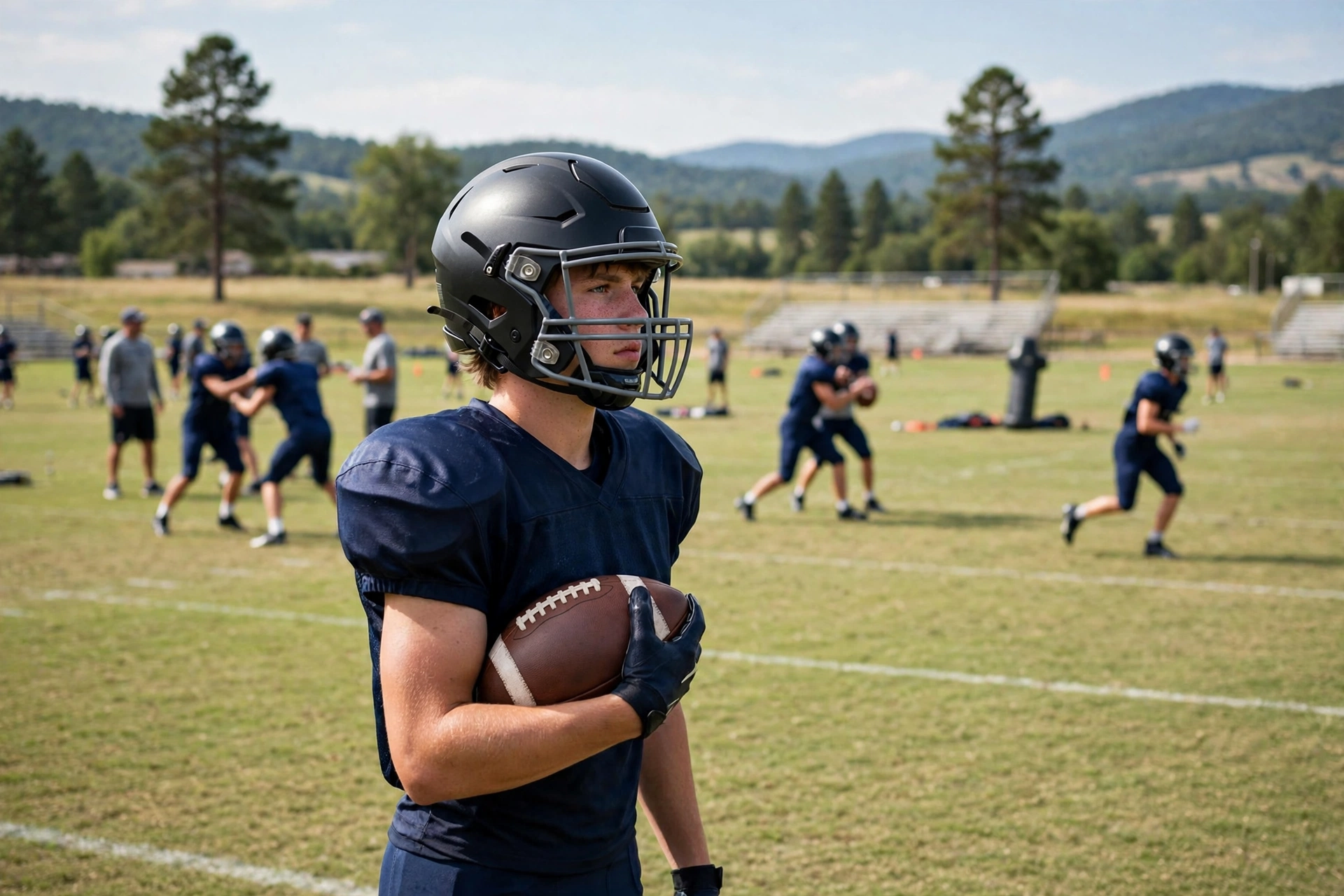
A football helmet for youth players is a youth-sized American football helmet made to protect a young player’s head from impacts, tackles, and falls on the field. It has a hard outer shell, an inner liner that absorbs impacts, a face mask, and a secure chin strap system, and it is sized and fitted to a child’s smaller head. Young players are still learning how to tackle and block safely, and falls and collisions are part of the game, so head protection is one of the most important pieces of kit. In general terms, a properly fitted youth football helmet is essential for any child playing organised tackle football.
What Is a Youth Football Helmet?
A youth football helmet is a smaller, lighter version of an adult football helmet, built with the same basic parts: a hard polycarbonate shell, a foam or air-filled liner, a metal face mask, and a chin strap that holds the helmet firmly in place. Many youth helmets use adjustable liners or a set of sizing pads, so the fit can be tuned to the child’s head and adjusted as the child grows. The face mask protects the face and mouth during tackles and blocks.
Youth helmets are designed with a child’s head and neck in mind, so they are lighter than adult helmets and proportioned for a smaller head. This matters because a helmet that is too heavy can tire a young player’s neck and may shift during play. In general terms, a youth football helmet should feel snug and stable, like a natural part of the kit, rather than something loose or heavy that the child notices on every play.
Why Do Youth Players Need a Football Helmet?
Youth players need a football helmet because tackle football involves repeated contact: tackles, blocks, and falls to the ground are part of every game and practice. Even at youth level, a player’s head can strike another player, the ground, or a knee during a tackle, and a helmet spreads the force of those impacts. The face mask also protects the face, teeth, and jaw from direct contact.
Young players are still developing their technique, so they may not always tackle with the correct form, which makes good head protection even more important. If you want to understand one of the safety technologies used in modern helmets, reading about what MIPS is for helmets is a good place to start, though not every youth football helmet uses that system. No helmet can prevent every injury, and safe tackling technique matters just as much, but a good helmet reduces the force that reaches the head.

How Should a Youth Football Helmet Fit?
A youth football helmet should fit snugly all round the head, with the liner in contact with the head all the way round and no gaps or pressure points. The helmet should sit level, covering the forehead, and the face mask should sit about a finger’s width from the face. When the player shakes the head, the helmet should move with the head rather than sliding around on its own.
The chin strap is a key part of the fit: it should be fastened snugly, with all four straps attached, so the helmet stays in place during contact. A helmet that is too loose can shift during a tackle, while one that is too tight can cause headaches and discomfort. It is worth having the fit checked by a coach or an experienced fitter, and re-checking it as the child grows, since a helmet that fitted last season may be too small this season.
What Features Matter in a Youth Football Helmet?
The most important features of a youth football helmet are a good fit, a sturdy shell, and a liner that absorbs impacts well. An adjustable liner or sizing pads help the helmet fit a growing child, and a secure chin strap system keeps it in place during contact. Vents help keep the head cool in warm weather, which matters because a hot, uncomfortable helmet is more likely to be worn loosely.
The face mask is another key choice. Different mask styles suit different positions, with linemen often using masks with more bars and skill players using lighter masks with better vision. Many youth leagues have rules about which masks are allowed, so it is worth checking before buying. In general terms, the best youth helmet is the one that fits well, suits the child’s position, meets the league’s rules, and is comfortable enough to be worn properly for the whole game.
How Do You Care for a Youth Football Helmet?
A youth football helmet should be cleaned and checked regularly. After each game or practice, the inside can be wiped with a damp cloth to remove sweat, and the helmet should be left to air dry away from direct heat. The shell and face mask can be wiped clean, and any mud or dirt should be removed before the helmet is stored. Letting it dry fully helps prevent odours and keeps the liner in good condition.
Regular checks are important too. Look for cracks in the shell, bent or loose face mask bars, worn chin straps, and padding that has gone flat or loose. Screws and clips should be tight, and the chin strap buckles should work smoothly. If any part is worn or damaged, it should be repaired or the helmet replaced, since a damaged helmet may not protect as well as it should.
When Should a Youth Football Helmet Be Replaced?
A youth football helmet should be replaced after a hard impact, even if it looks fine from the outside. The liner inside can compress or crack in a heavy knock, and that damage may not be visible under the shell. A helmet that has already absorbed a hard blow may not protect as well the next time, so retiring it after a serious impact is generally the sensible choice.
Growth is another common reason to replace a youth helmet. Children grow quickly, and a helmet that fitted well last season may be too tight this season, which can make it uncomfortable and less protective. Age and wear also count: repeated use, sweat, and knocks wear down the liner and straps over time. In general terms, if the helmet no longer fits snugly, shows damage, or has taken a hard hit, it is time for a new one.
Does my child need a football helmet for flag football?
Flag football usually does not require a helmet, since it is a non-contact version of the game, but the league rules are the best guide. Some parents still choose soft headgear for extra peace of mind, though a hard tackle helmet is not normally used for flag football.
Can my child wear an adult football helmet?
No, an adult helmet is not a good fit for a child. Adult helmets are heavier and shaped for larger heads, so they will not sit correctly on a young player, and a youth-sized helmet is the right choice.
How often should a youth football helmet be rechecked?
The fit and condition should be checked at the start of each season and regularly during it. Children grow quickly, so a helmet that fitted at the start of the season may need adjusting or replacing before it ends.

Olivia
Writer at Helmet Today, covering helmet reviews, fit and riding safety.