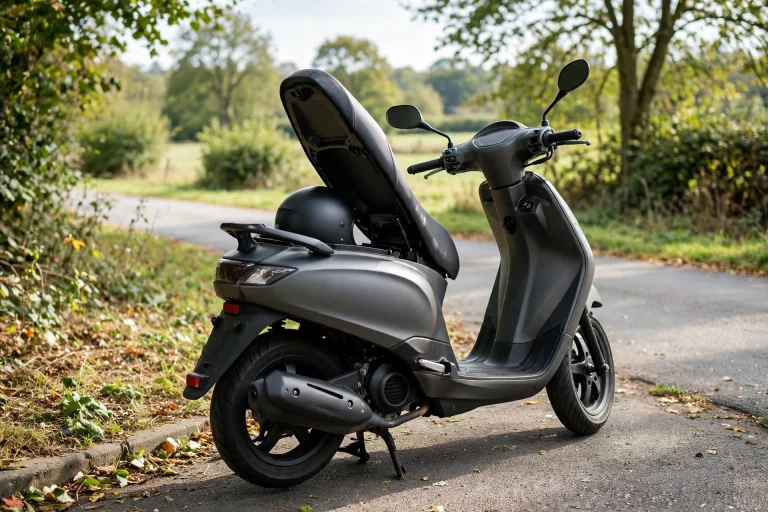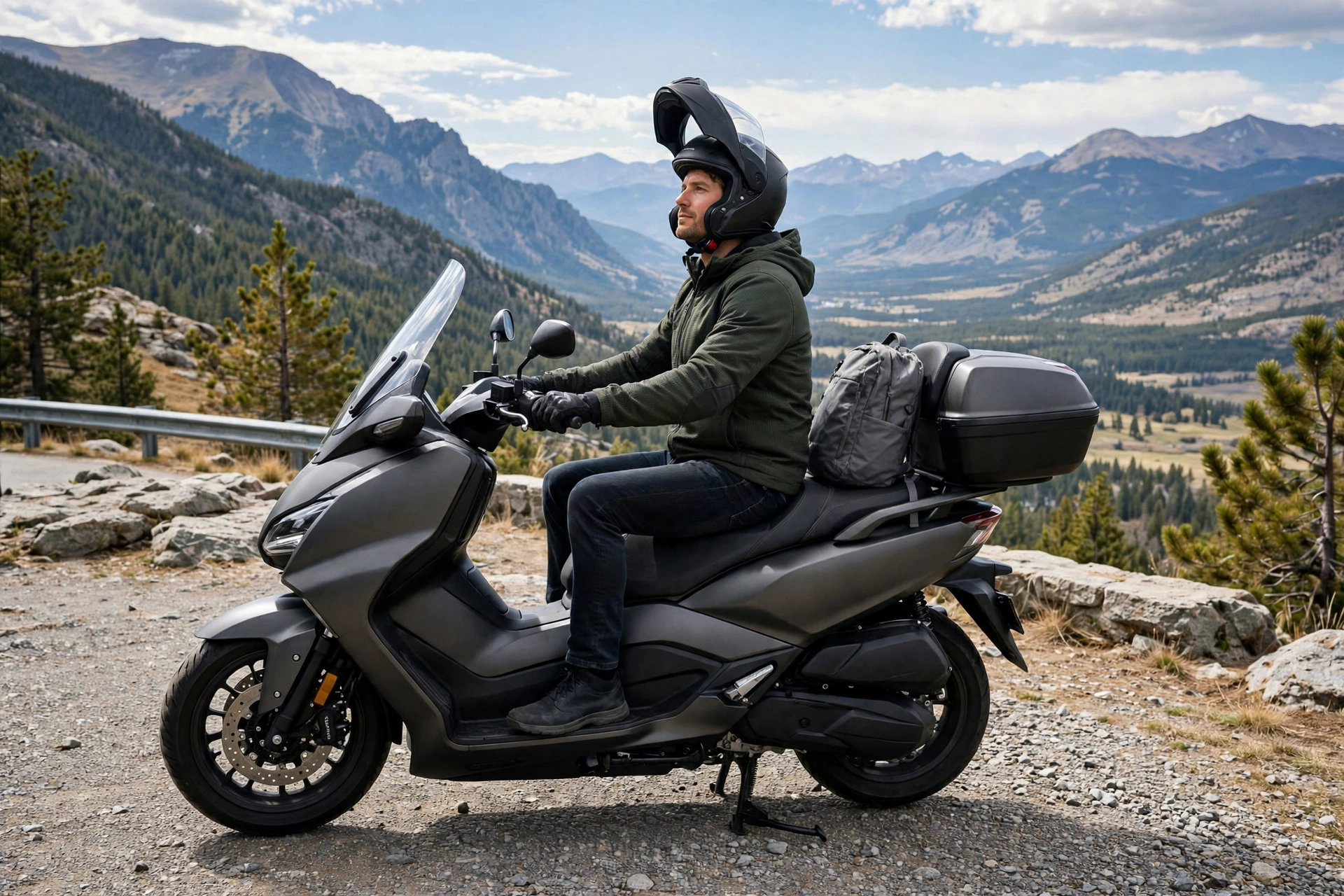
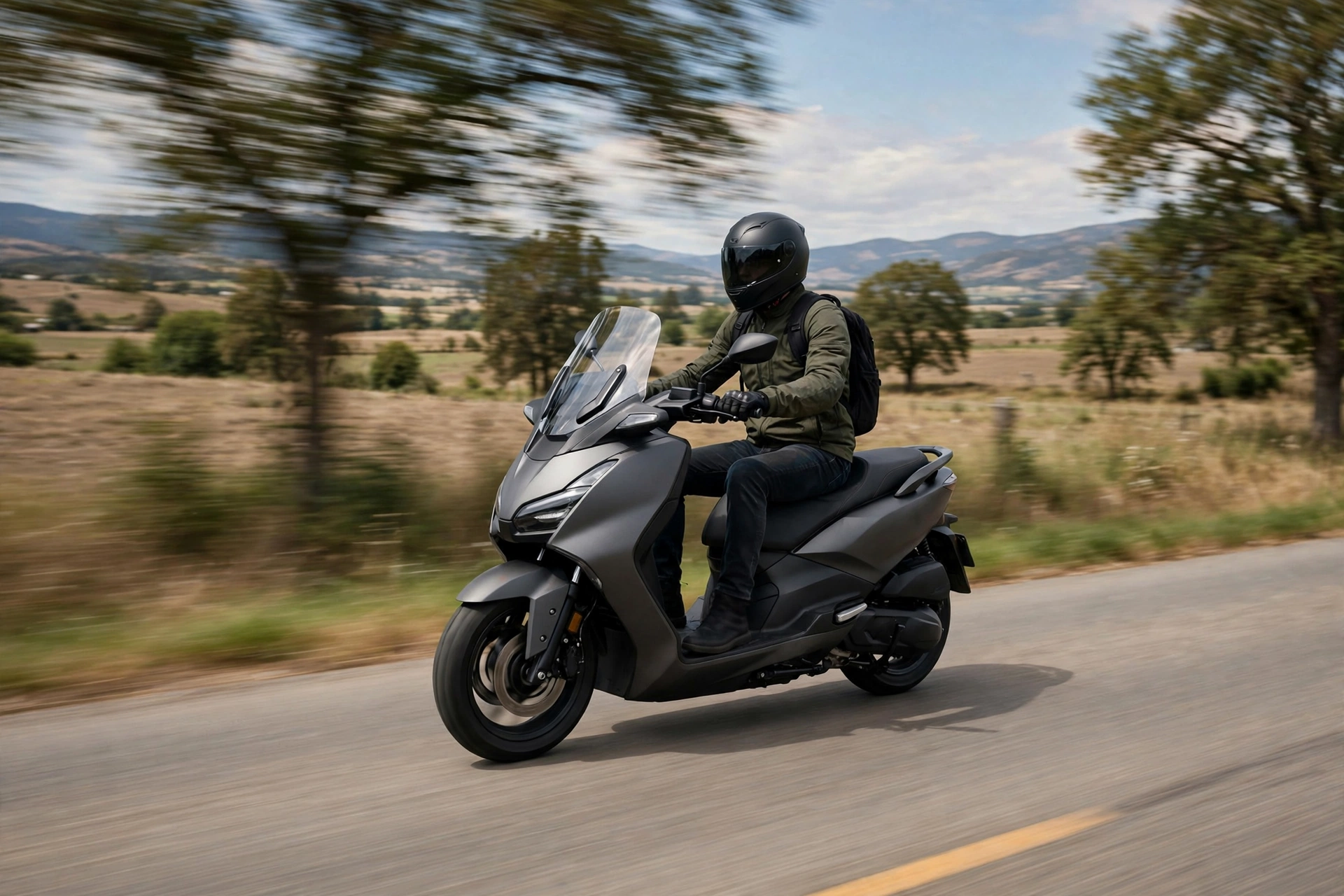
For a maxi scooter, both styles can be the right answer: a full face helmet gives you the simplest, strongest one-piece structure and usually the quietest ride at highway speed, while a modular helmet adds flip-up convenience for fuel stops, tolls and conversation. In general terms, a closed modular is close to a full face in structure, but chin-bar strength varies by model — so the choice comes down to how and where you ride.
Maxi scooters are not big mopeds. They cruise at genuine highway speeds, tour for hours, and mix with fast traffic, which puts them firmly in motorcycle helmet territory.
Why Do Maxi Scooters Call for Motorcycle-Grade Helmets?
Speed is the whole story. A maxi scooter will hold freeway pace comfortably, commute across a whole metro area, and tour two-up with luggage. A fall at those speeds is a motorcycle fall, with motorcycle energies involved, and the helmet needs to be certified and built accordingly — a DOT or ECE motorcycle helmet, not a bicycle or light scooter helmet.
Sustained speed changes what else matters. Wind noise at highway pace is fatiguing over an hour in a way it never is across town. Aerodynamic stability matters, because buffeting tires your neck. Weather protection matters, because a maxi scooter gets used in rain and cold that a small scooter would simply skip. Helmet choice for a maxi is closer to choosing touring motorcycle gear than to choosing city runabout gear.
Coverage matters too. A meaningful share of real-world motorcycle impacts involve the chin and face area, which is why open face helmets, however pleasant in town, leave maxi riders under-protected for the riding they actually do. The realistic shortlist is a full face or a good modular.
Where Does a Full Face Helmet Have the Edge?
The fixed chin bar is the full face helmet’s core advantage. Because the chin bar is part of the shell’s structure rather than a hinged addition, it is, in general terms, the strongest and stiffest arrangement, and the helmet is one continuous piece with no latch mechanism to maintain or to fail. If maximum chin protection is the priority, this is the benchmark.
Full face helmets also usually win on quietness and weight. With fewer seams, gaps and moving parts, they tend to produce less wind roar at speed, and gram for gram they are often a little lighter than modular equivalents with their steel latches and hinge hardware. On long touring days, quieter and lighter adds up to noticeably less fatigue.
The trade-offs are convenience and air. A full face stays on at the fuel pump, the toll booth and the coffee stop; you cannot flip it up to talk, eat or cool down. Some riders feel closed-in, and glasses can be fiddly to fit. Modern vents and drop-down sun visors soften these drawbacks, but the fundamental character does not change: it is a helmet you put on and leave on.
What Does a Modular Helmet Make Easier Day to Day?
Convenience, genuinely. Flip the chin bar up and you can talk to a passenger or a toll attendant, take a drink, fill the tank, walk into a shop, or get cooling air at a long traffic light without removing the helmet and finding somewhere to put it. For riders who commute, tour with frequent stops, wear glasses, or ride in groups, this is a quality-of-life difference they feel every single day.
Some modulars go further and are dual-homologated: certified to be ridden legally with the chin bar locked in the raised position as well as closed, in general terms under the ECE system. That lets you legally cruise slowly through town in open mode and close the helmet for the highway. Not every modular has this approval, though — many are certified closed only, and riding those with the bar raised means riding outside their approval.
Modulars also tend to come well equipped for touring life: drop-down sun visors, speaker pockets and intercom readiness, and flip-up fronts that make fitting glasses easy. If your maxi scooter is transport, transport-plus-travel, and social riding rolled into one, the modular matches that mixed use very well.
Is a Modular Chin Bar as Strong as a Fixed One?
Honest answer: it varies by model, and it is the one place the full face keeps a structural advantage. A modular’s chin bar depends on its latch. Good latches on quality helmets are metal, lock positively, and perform strongly in testing — and a well-made modular worn closed is broadly comparable to a full face in real-world structure. But the mechanism introduces a variable a fixed bar does not have: wear, dirt in the latch, or a bar that was not fully latched before the ride.
Both types, when certified to the same motorcycle standard, have passed the same baseline impact tests for the standard’s requirements. Where protection thinking has moved on for both styles is rotational impact: angled crashes twist the head, and modern helmets increasingly add systems such as MIPS to reduce rotational forces reaching the brain. Whichever style you choose, a model with rotational protection, from a reputable maker, worn closed and properly latched, is the meaningful safety spec.
Practical care narrows the gap further. Keep the latch clean and check it engages with a positive click every time you close it. Replace a modular helmet after any impact, just as you would a full face, and be extra wary of a chin bar that has taken a hit — that is the one component you cannot inspect from the outside with confidence.
Which Should You Choose for Your Kind of Riding?
Choose the full face if your maxi riding is mostly distance and speed: long highway commutes, touring, winter riding, or if you simply value the quietest, lightest, structurally simplest option and rarely need your face uncovered during a ride. Riders who do not stop often get little for the modular’s compromises.
Choose the modular if your riding is stop-and-go and social: urban commuting with errands, fuel-and-coffee touring, riding with a passenger you need to talk to, or wearing glasses full-time. Look specifically for dual homologation if you want the legal open-face cruising mode, and for a metal latch and a good reputation for chin-bar testing.
Either way, fit decides more than style does. Try both types in your measured size, wear each for fifteen minutes, check the noise and the neck feel as best you can, and confirm the helmet is certified to a current motorcycle standard. A well-fitted modular and a well-fitted full face are both serious protection; the best one is the one that matches your day and that you will wear, closed, on every highway mile.
Frequently Asked Questions
Q: Can I ride with a modular helmet’s chin bar raised?
A: Only if that specific model is dual-homologated — certified for riding with the bar up as well as down. Many modulars are approved closed only. Check the helmet’s certification details before treating the raised position as a riding mode rather than a stopped-at-the-pump convenience.
Q: Is a modular helmet safe enough for highway touring on a maxi scooter?
A: A quality, certified modular worn closed and properly latched is a legitimate highway helmet, used by many touring riders. The fixed full face keeps an edge in chin-bar structural simplicity, so riders who prioritize maximum protection above convenience often choose it — but a good modular is not a compromise to apologize for.
Q: Which is quieter for long rides?
A: In general terms, full face helmets tend to be a bit quieter, because they have no hinge or latch seams near the ears. Individual models vary a lot, though, and earplugs are worth considering for regular highway use with either style.

Olivia
Writer at Helmet Today, covering helmet reviews, fit and riding safety.