
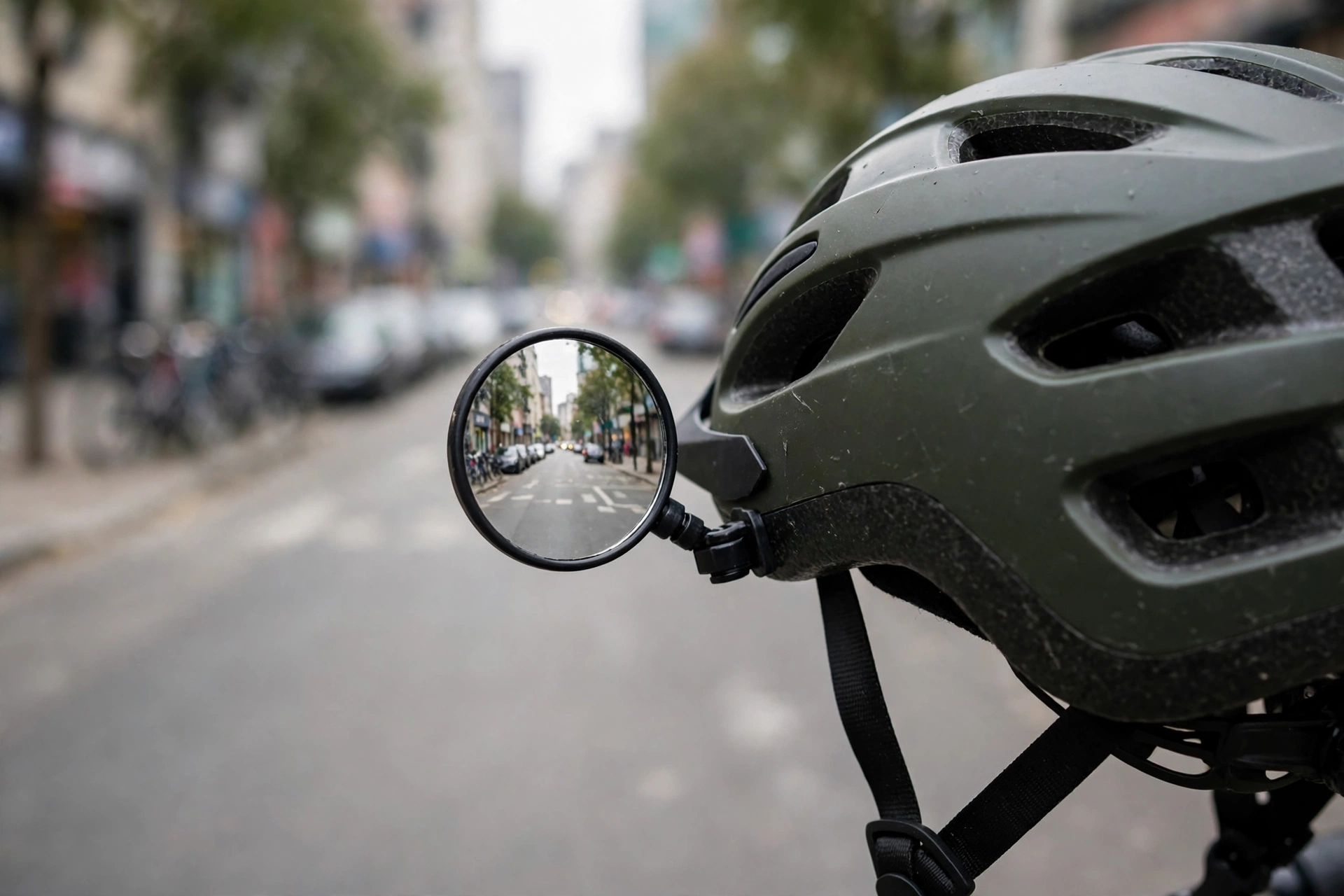
A helmet with a built-in rear-view mirror is a helmet that has a small mirror fitted to the side or front of the shell, positioned so the rider can see behind without turning the head. It gives the rider a quick view of traffic coming up from behind, which helps with awareness on the road. The mirror is part of the helmet itself rather than an add-on, so it is always in the same place and there is nothing extra to fit or adjust each time. Rear-view mirrors are most often found on cycling and commuting helmets, where knowing what is behind matters most.
How Does a Built-In Rear-View Mirror Work?
The mirror is a small, flat or slightly curved reflective surface mounted on a short arm or fixed directly to the side of the helmet shell. It is angled so that when the rider glances to one side, the mirror shows the road behind. The rider does not need to turn the head fully, just move the eyes toward the mirror, which takes only a moment and keeps the road ahead in view.
Because the mirror is small, it shows only a narrow view, so the rider needs to learn where to look and how to read it. In general terms, a quick glance in the mirror is enough to tell whether a vehicle is behind and how close it is, but it does not replace a proper look over the shoulder before turning or changing lanes. The mirror is a helper for awareness, not a full replacement for looking behind.
Why Would a Rider Want a Mirror on a Helmet?
A rider would want a mirror on a helmet because knowing what is behind is important on busy roads. A cyclist sharing the road with cars, buses, and lorries needs to know when a vehicle is approaching from behind, especially before moving out to pass a parked car or turning across traffic. A mirror makes that check quick and easy, without the rider having to twist around and take the eyes off the road ahead.
The mirror is also useful on quieter roads, where a fast vehicle can come up from behind with little warning. For commuters, tourers, and anyone who rides in traffic every day, that extra awareness can make riding feel calmer and more controlled. In general terms, a mirror does not make the road safer on its own, but it gives the rider more information, and more information helps the rider make better decisions.
Is a Helmet Mirror Better Than a Handlebar Mirror?
A helmet mirror and a handlebar mirror each have their own strengths. A handlebar mirror is fixed to the bike, so it stays steady and gives a stable view, and it is usually larger, which means a wider view of the road behind. It is easy to glance at because it sits in front of the rider, close to the hands.
A helmet mirror moves with the head, which means the rider can aim it by turning the head slightly, and it is always in the same place relative to the eyes. It also works on any bike, since it is part of the helmet rather than the bike. In general terms, neither is clearly better for everyone: some riders prefer the steady view of a handlebar mirror, while others like the freedom of a helmet mirror. If you want to understand one of the safety technologies used in modern helmets, reading about what MIPS is for helmets is a good place to start, though a mirror itself is an awareness aid rather than a safety system.
What Are the Limits of a Helmet Rear-View Mirror?
A helmet rear-view mirror has several limits worth knowing. The mirror is small, so the view is narrow, and it can be hard to judge how far away a vehicle is, especially at speed. Vibration from the road can also make the image shake, which makes it harder to read on rough surfaces.
The mirror can also be knocked out of position by a bump, a fall, or brushing against something, and it may need adjusting before it is useful again. In rain, the mirror can become covered in droplets, and at night the lights of vehicles behind can glare in it. In general terms, the mirror is a useful extra, but it should be used together with shoulder checks and good road positioning, not as a replacement for them.
How Do You Use a Helmet Mirror Properly?
Using a helmet mirror properly starts with setting it up before the ride. The mirror should be adjusted so that, with the helmet on and the head in its normal riding position, a glance to the side shows the road behind. It helps to check this while standing still, then to test it on a quiet road before relying on it in traffic.
During a ride, the mirror should be checked with quick glances, not long stares, so the eyes stay mostly on the road ahead. Before turning, changing lanes, or moving out around an obstacle, the rider should still look over the shoulder to check the blind spot that the mirror cannot show. In general terms, the mirror is best used as a regular awareness check, with the shoulder check kept for the moments when a move is about to be made.
Can a Rear-View Mirror Be Added to Any Helmet?
In general terms, a rear-view mirror can be added to many helmets, but it depends on the shape of the shell and the type of mount. Clip-on and stick-on mirrors are available, and some fit a wide range of helmets, while others are made for a particular model. A built-in mirror is usually neater and more secure, because it is designed for that helmet from the start.
An add-on mirror may stick out further from the shell, which makes it more likely to catch on things or to be knocked off. It may also vibrate more than a built-in one. If you are choosing between a helmet with a built-in mirror and adding a mirror to a helmet you already own, it is worth weighing the neater fit of the built-in option against the cost of buying a new helmet. Either way, the mirror should be checked regularly to make sure it is secure and correctly aimed.
Does a helmet mirror replace looking over my shoulder?
No. A helmet mirror shows only a narrow view and has blind spots, so it cannot show everything behind you. Always look over your shoulder before turning or changing lanes, and use the mirror as an extra awareness check.
Can a helmet mirror dazzle me at night?
It can, because the headlights of vehicles behind may reflect in the mirror. Aiming the mirror slightly downward or to one side can reduce the glare, and some riders fold the mirror away or turn it aside when riding at night.
Is a helmet with a rear-view mirror legal to use?
In general terms, yes, a helmet mirror is a simple accessory and does not change the helmet itself. Rules for helmets and road use vary by place, so it is worth checking local rules if you are unsure, but a small mirror is not normally a problem.

Olivia
Writer at Helmet Today, covering helmet reviews, fit and riding safety.