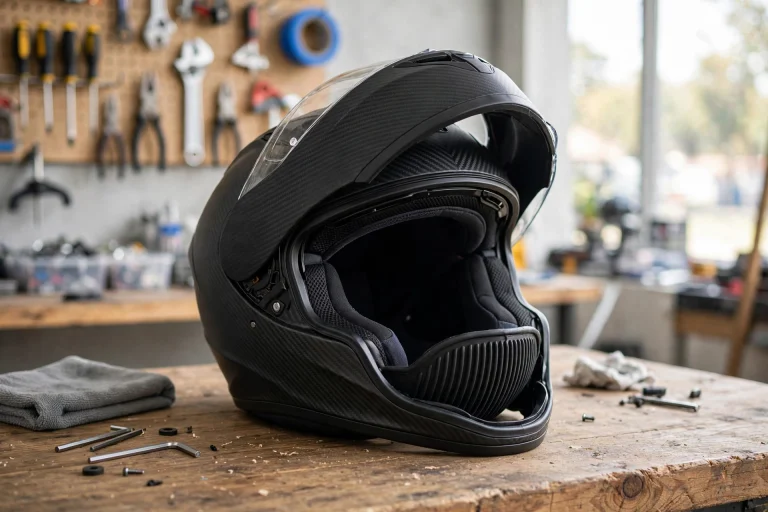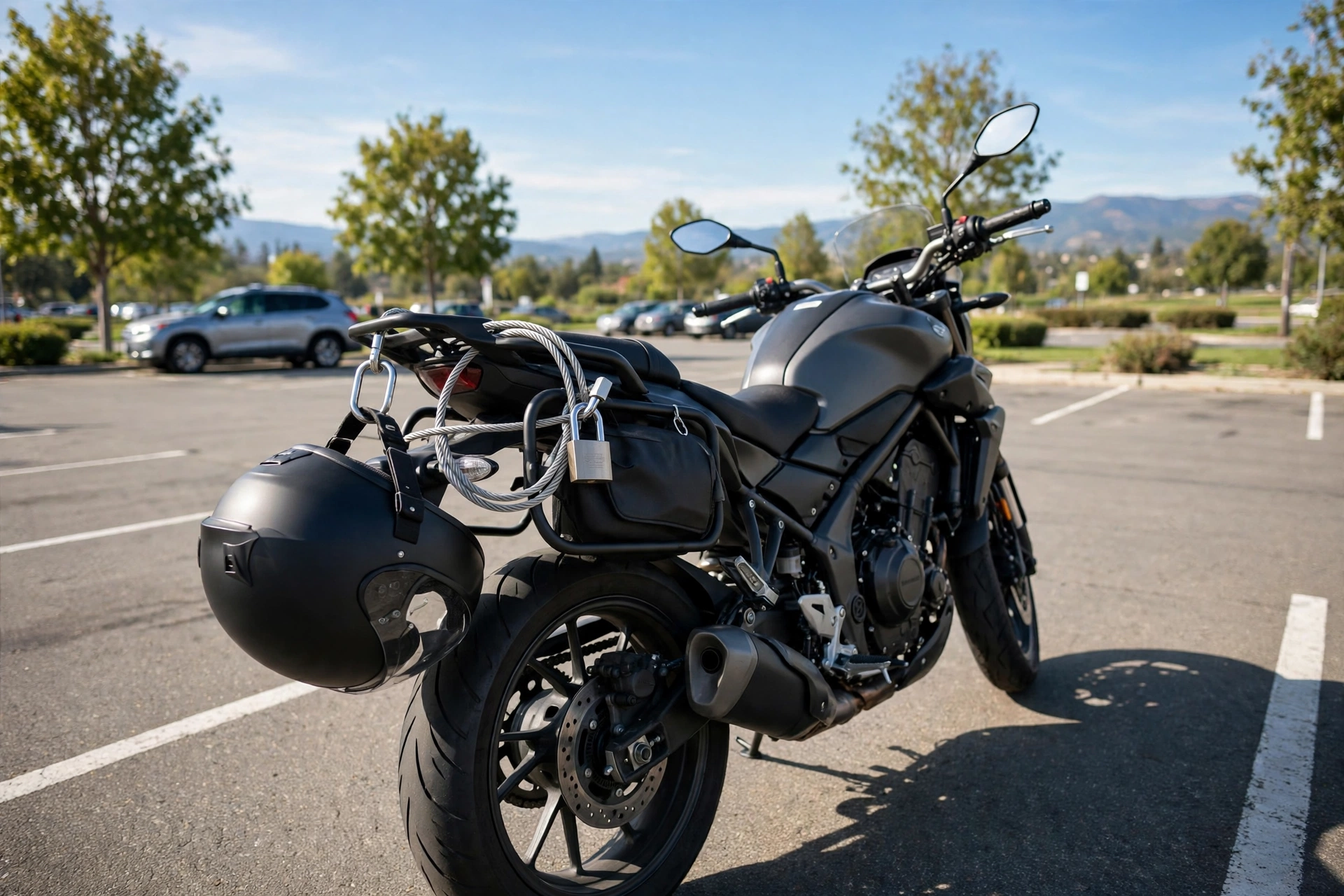
A helmet lock cable is a strong steel cable that threads through a helmet and locks it to a bike, a rack, or a fixed object, so the helmet is much harder for a casual thief to walk away with. It is a simple, cheap piece of security kit, and it is popular with riders who do not want to carry their helmet everywhere they go.
A helmet is an easy target for theft, because it is light, valuable, and often left on a bike while the rider is away. A lock cable does not make a helmet impossible to steal, but it turns a quick grab into a job that needs tools and time, and that is often enough to put off a casual thief.
How does a helmet lock cable work?
A helmet lock cable is a length of braided steel cable, usually coated in plastic or vinyl to protect the helmet and the bike from scratches. At each end there is a loop, or a lock, and the cable is threaded through the helmet, often through the chin bar of a full-face helmet or through the strap of an open-face helmet.
The cable is then passed around a fixed part of the bike, such as the frame or a rack, and the two ends are locked together with a padlock or a built-in combination lock. Once it is locked, the helmet cannot be lifted off the bike without cutting the cable or breaking the lock.
Some cables have a lock built into one end, while others are just a plain cable that you use with your own padlock. In general terms, a built-in lock is simpler to use, while a separate padlock lets you choose a stronger lock if you want more security.
What types of helmet lock cable are there?
The most common type is a straight cable with a loop at each end. These come in different lengths, and a longer cable is more flexible, because it can reach around a rack or a rail as well as the bike. A shorter cable is easier to carry, but it limits where you can lock the helmet.
Coiled cables are another option. These wind up into a small coil when they are not in use, so they take up less space in a bag or a pocket. They stretch out when you need them, although they are usually thinner than straight cables, which can make them easier to cut.
There are also retractable lock cables, which wind into a small case and pull out when needed. These are neat and easy to carry, but they tend to be shorter and thinner than other cables, so they suit short stops in low-risk places rather than long stays in busy areas.
How do you use a helmet lock cable?
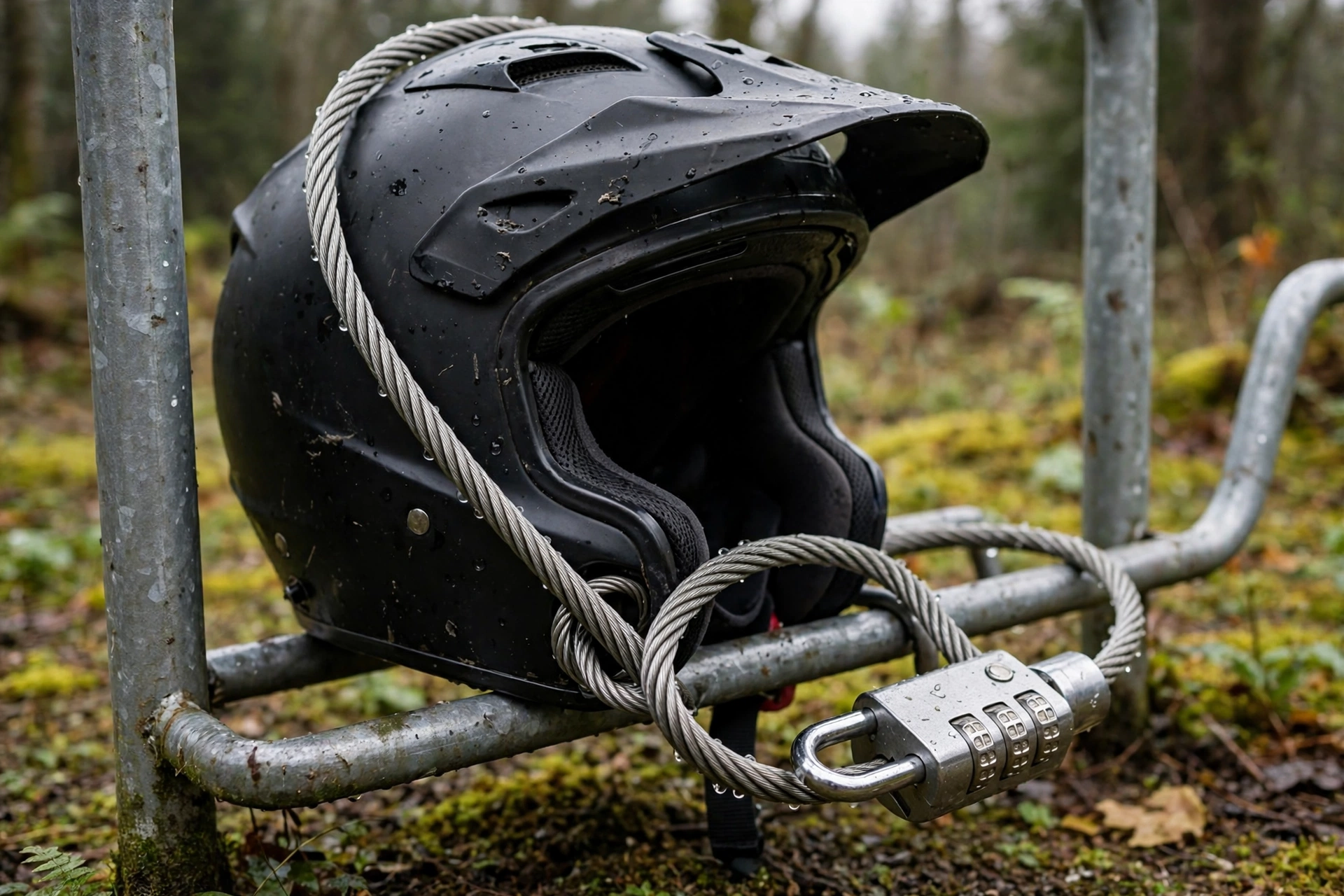
Start by choosing a solid anchor point, such as the bike frame, a fixed rack, or a railing that cannot be lifted or unscrewed. Avoid thin or flimsy objects that a thief could break or cut through easily.
Thread the cable through the helmet in a way that cannot be slipped off. For a full-face helmet, pass it through the chin bar, because the chin bar is a solid part of the shell. For an open-face helmet, pass it through the chin strap or the D-rings, although this is less secure than a chin bar.
Loop the cable around the anchor point, bring the two ends together, and lock them. Pull the cable snug so the helmet sits close to the bike and cannot be swung around. Check that the helmet is stable and not resting on the ground, where it could be kicked or run over.
How secure is a helmet lock cable?
In general terms, a helmet lock cable is a deterrent, not a guarantee. A thick steel cable will resist a quick cut from small tools, but a determined thief with bolt cutters can get through most cables given enough time. The aim is to make the theft slow and awkward, not impossible.
Thicker cables are harder to cut than thinner ones, so look for a cable with a decent diameter and a strong lock. A cable that is coated in plastic is also harder to grip with cutting tools, although the coating itself does not add much strength.
Where you lock the helmet matters as much as the cable itself. A helmet locked in a busy, well-lit place is safer than one locked in a quiet, hidden spot, because a thief is less likely to spend time cutting a cable where people can see them.
What should you look for when buying one?
Length is the first thing to check. The cable needs to be long enough to reach from the helmet to a solid anchor point on your bike or nearby, with a little slack to spare. Measure the distance on your usual parking spot before you buy, if you can.
Thickness is next. A thicker cable is harder to cut, but it is also heavier and bulkier to carry. For most riders, a medium-thickness cable is a good balance: strong enough to deter a casual thief, but light enough to carry every day.
The lock matters too. A combination lock means you do not need to carry a key, but a key lock is often stronger for the same size. If you use a separate padlock, choose one with a shrouded shackle, which is harder to cut or force open.
Are there alternatives to a helmet lock cable?
Some helmets have a built-in lock loop, which is a small metal loop on the helmet that a padlock can pass through. This works in a similar way to a cable, but without the extra length, so it suits riders who lock the helmet close to the bike.
Some bikes have a helmet lock fitted under the seat or on the frame. This is a small hook or latch that holds the helmet strap in place when the seat is locked down. It is neat and secure, but it is not available on every bike, and it may not fit every helmet strap.
The simplest alternative is to carry the helmet with you. That is the most secure option of all, because the helmet is never left alone. If your helmet has a MIPS liner, carrying it by the chin strap is fine, although it is best to hold it by the shell to avoid stretching the strap over time.
Can a helmet lock cable be cut?
Yes, most cables can be cut with the right tools, given enough time. A lock cable is a deterrent for casual theft, not a guarantee against a determined thief, so use it for short stops in busy places and carry the helmet in higher-risk spots.
Where is the best place to lock a helmet?
Lock it to a solid, fixed part of the bike or a rack in a busy, well-lit place. Avoid leaving it on the ground or hanging where it can be kicked, and avoid quiet, hidden spots where a thief can work unseen.
Will a lock cable scratch my helmet?
It can, if the cable is bare steel. Choose a cable with a plastic or vinyl coating, and pass it through the chin bar rather than across the painted shell, to keep scratches to a minimum.

Olivia
Writer at Helmet Today, covering helmet reviews, fit and riding safety.