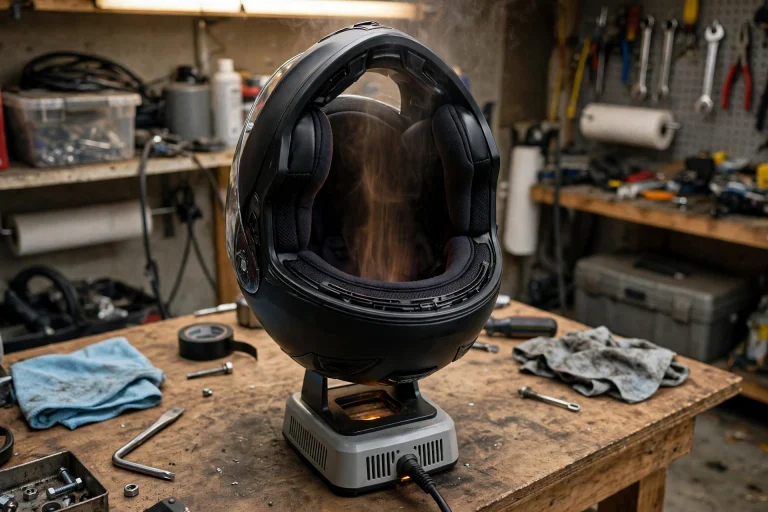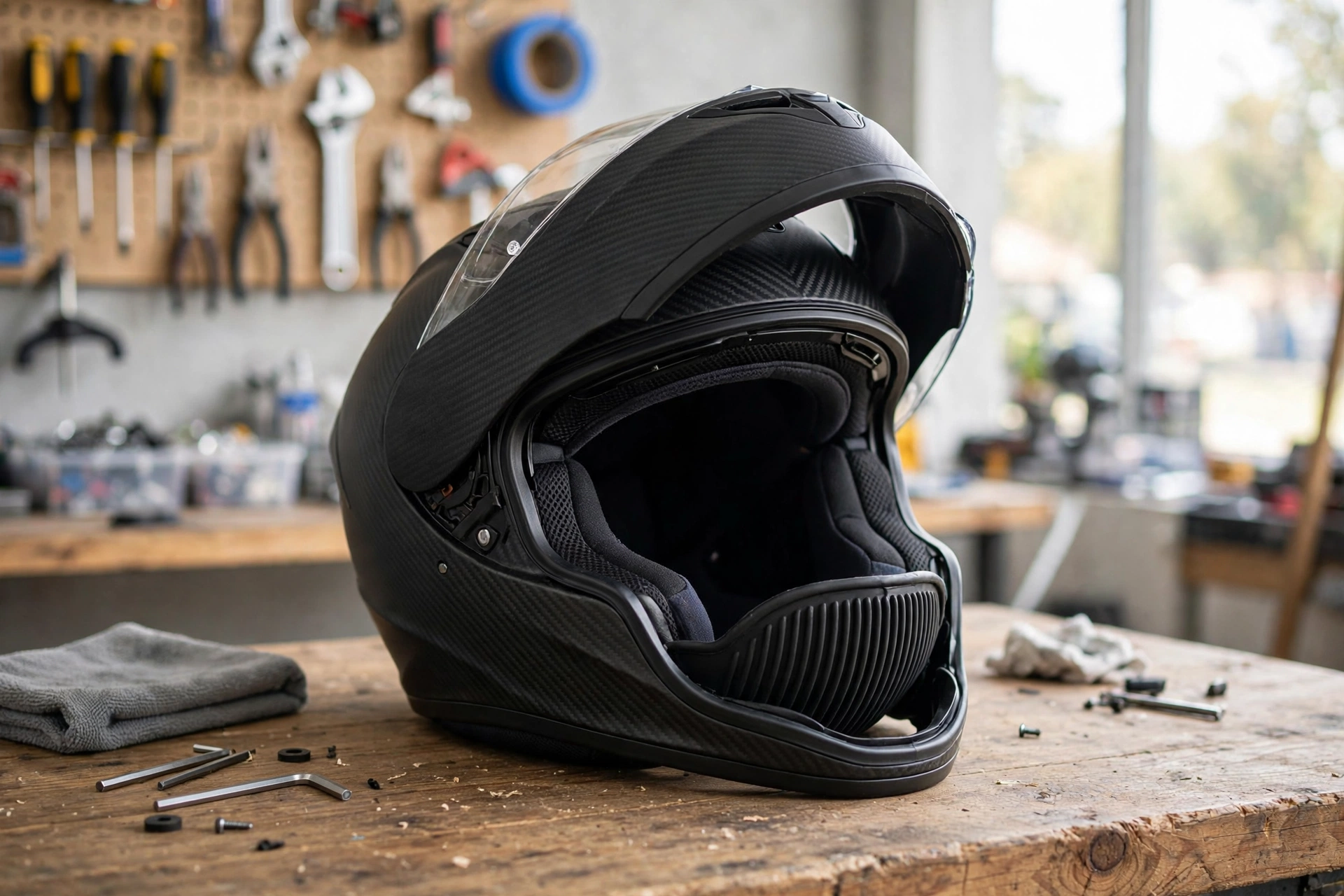
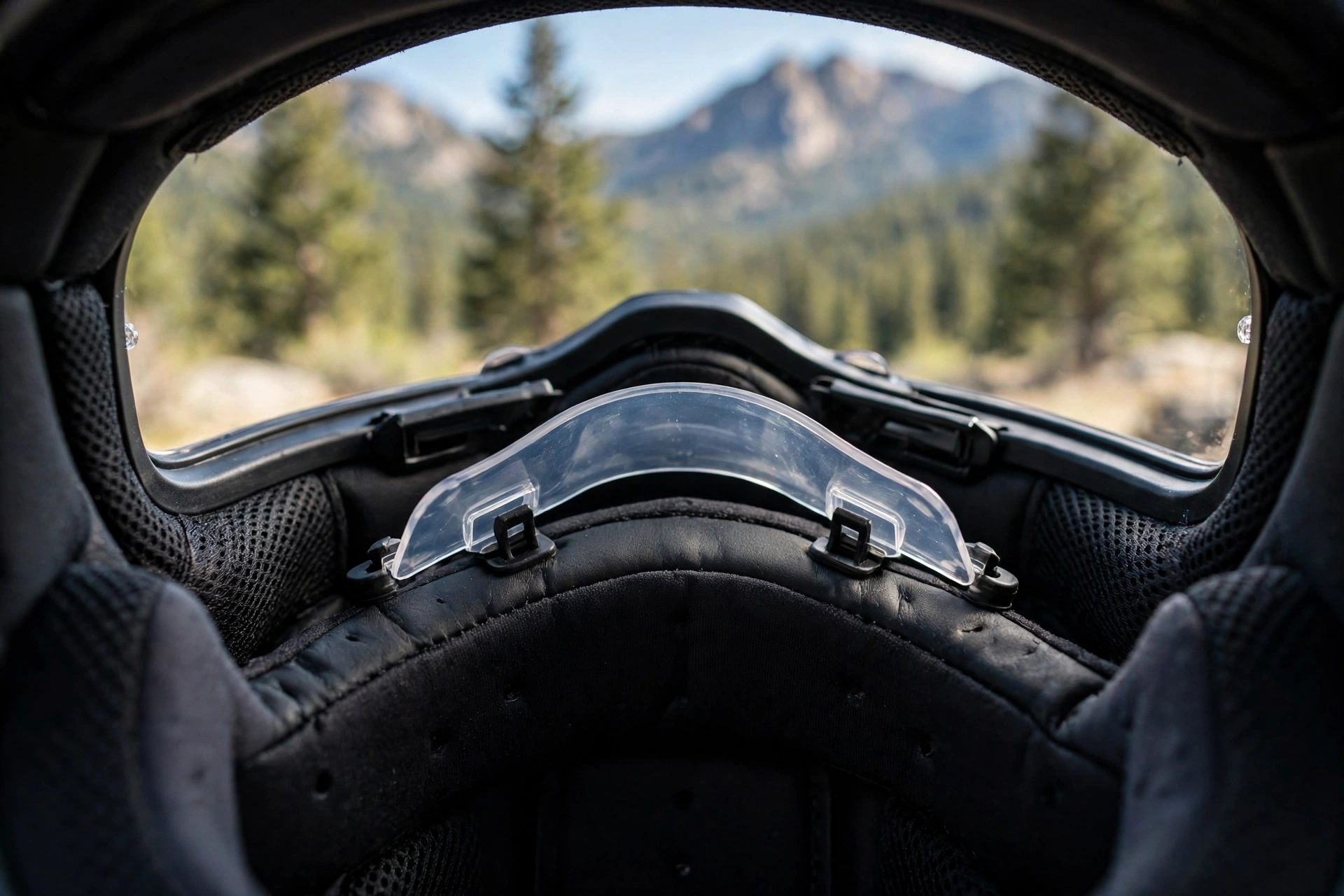
A helmet visor breath deflector is a small shield fitted inside a helmet that directs the warm, moist air from your breath away from the visor, so the visor stays clear instead of fogging up. It sits near your nose and mouth, and it works by catching your breath before it reaches the inside of the visor and turns into mist.
Breath deflectors are a simple piece of kit, and they are common on motorcycle helmets, snowmobile helmets, and cold-weather helmets of all kinds. They do not need power or maintenance, and they are often built into the helmet from the start, although they can also be bought separately and fitted afterwards.
How does a breath deflector work?
When you breathe out, warm air leaves your nose and mouth and rises straight towards the visor. In cold weather, the visor is much colder than your breath, so the moisture in that air condenses into tiny droplets on the inside of the visor, and your view clouds over.
A breath deflector sits between your face and the visor and blocks that rising stream of air. It channels your breath downwards, towards the chin vents and the bottom of the helmet, instead of letting it flow up to the visor. The visor stays closer to the temperature of the air outside, and the moisture never reaches it.
The deflector does not seal your nose and mouth off completely. It leaves gaps at the sides and below, so air can still move through the helmet and you can breathe normally. In general terms, a good deflector cuts down fogging a lot without making the helmet feel stuffy.
What types of breath deflector are there?
The most common type is a flexible rubber or foam flap that is built into the chin curtain or the front of the helmet liner. It presses gently against the bridge of your nose and extends down over your mouth, forming a small pocket that catches your breath.
Some helmets use a rigid plastic deflector that clips into place in front of the mouth area. These are easier to remove and clean, and they hold their shape better than a soft flap, although they can feel less comfortable if they press too hard on the nose.
There are also stick-on deflectors that you fit to the inside of the helmet yourself. These are usually made from flexible foam or rubber, and they attach with adhesive strips or clips. They are a useful option if your helmet did not come with a deflector and you ride in cold or damp weather.
How do you fit a breath deflector?
If your helmet came with a deflector, it is usually already in place, and all you need to do is check that it sits correctly. It should rest gently on the bridge of your nose without pressing hard, and it should cover your mouth without touching your lips.
To fit an aftermarket deflector, start by cleaning the inside of the helmet where the deflector will sit, so the adhesive or clips hold properly. Position the deflector so it lines up with your nose and mouth, and press it firmly into place.
Put the helmet on and check the fit. The deflector should not push the helmet up or press on your glasses, if you wear them. Breathe out through your nose and see whether the air is being directed downwards. If the deflector feels uncomfortable, try adjusting its position before you ride.
Does a breath deflector stop visor fogging completely?
In general terms, a breath deflector reduces fogging a lot, but it does not always stop it completely on its own. In very cold weather, or when you are stopped at traffic lights with no airflow through the helmet, some moisture can still reach the visor and cause light fogging.
For the best results, use a breath deflector together with good helmet ventilation. Opening the top vents lets fresh air flow through the helmet and carry moisture away, while the deflector keeps your breath off the visor. The two work well as a pair.
A fog insert is another useful partner for a breath deflector. The deflector keeps most of your breath away from the visor, and the insert deals with whatever moisture still gets through. Many winter riders use both, and together they keep the view clear in the worst conditions.
How do you clean a breath deflector?
Breath deflectors get dirty quickly, because they sit right in front of your nose and mouth. Moisture, skin oils, and dust build up on them, and a dirty deflector can start to smell if it is not cleaned regularly.
Most soft deflectors can be wiped with a damp cloth and mild soap, then left to air-dry. If the deflector is removable, take it out of the helmet and wash it by hand in lukewarm water. Let it dry fully before you put it back, because a damp deflector can hold smells.
Rigid deflectors can usually be wiped in the same way, or removed and rinsed under lukewarm water. Avoid harsh cleaners or solvents, which can damage the material. If the deflector is cracked, torn, or has lost its shape, replace it, because a damaged deflector will not direct your breath properly.
When should you use a breath deflector?
Breath deflectors are most useful in cold weather, when the gap between the temperature of your breath and the temperature of the visor is widest. They are also useful in rain and damp weather, and for riders who wear glasses, because fogging affects glasses as well as the visor.
Some riders leave the deflector in place all year, while others only fit it in winter. In warm weather, a deflector can make the helmet feel slightly warmer around the face, because it reduces airflow, so some riders remove it in summer.
If your helmet has a MIPS liner, a breath deflector will not interfere with it. The deflector sits at the front of the helmet near the chin, while the liner sits against the inside of the shell, so the two work independently and can be used together.
Will a breath deflector make my helmet feel stuffy?
It can feel slightly warmer around the face, because it redirects airflow, but most riders adjust quickly. If it feels too stuffy, open the helmet vents a little, or try a smaller or softer deflector that leaves more room for air to move.
Can I wear glasses with a breath deflector?
Yes, in general terms, although the deflector should not press your glasses into your nose. Check the fit with your glasses on, and adjust the deflector or choose a softer type if it pushes the frames out of place.
Do breath deflectors work on open-face helmets?
They are less common on open-face helmets, because the open design lets breath escape easily. They are most useful on full-face helmets, where the closed shell traps warm, moist air around the visor.

Olivia
Writer at Helmet Today, covering helmet reviews, fit and riding safety.