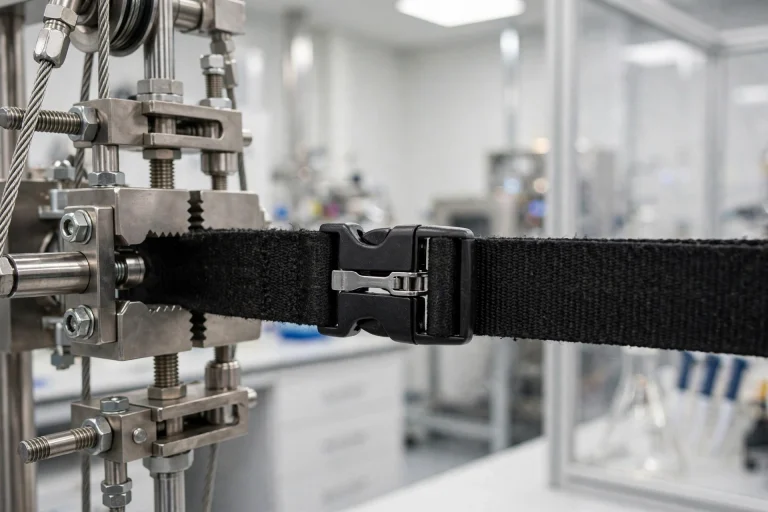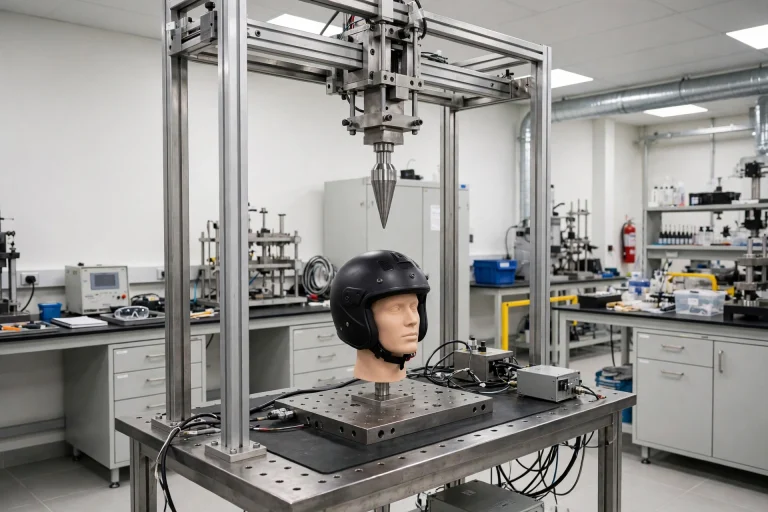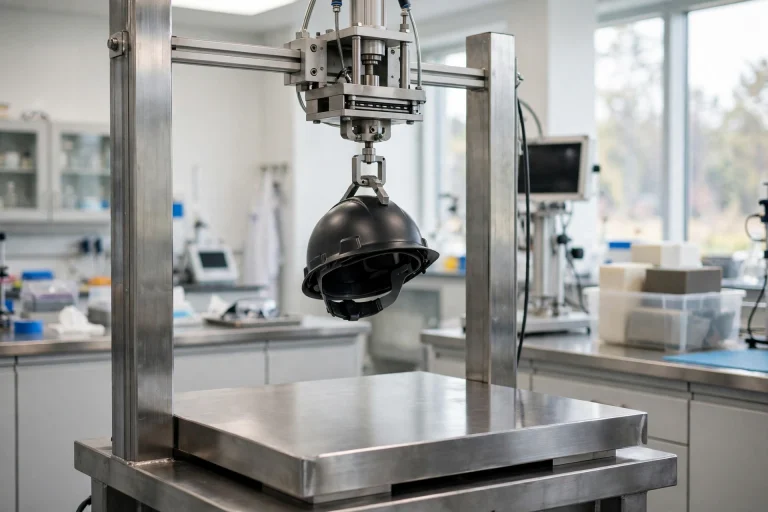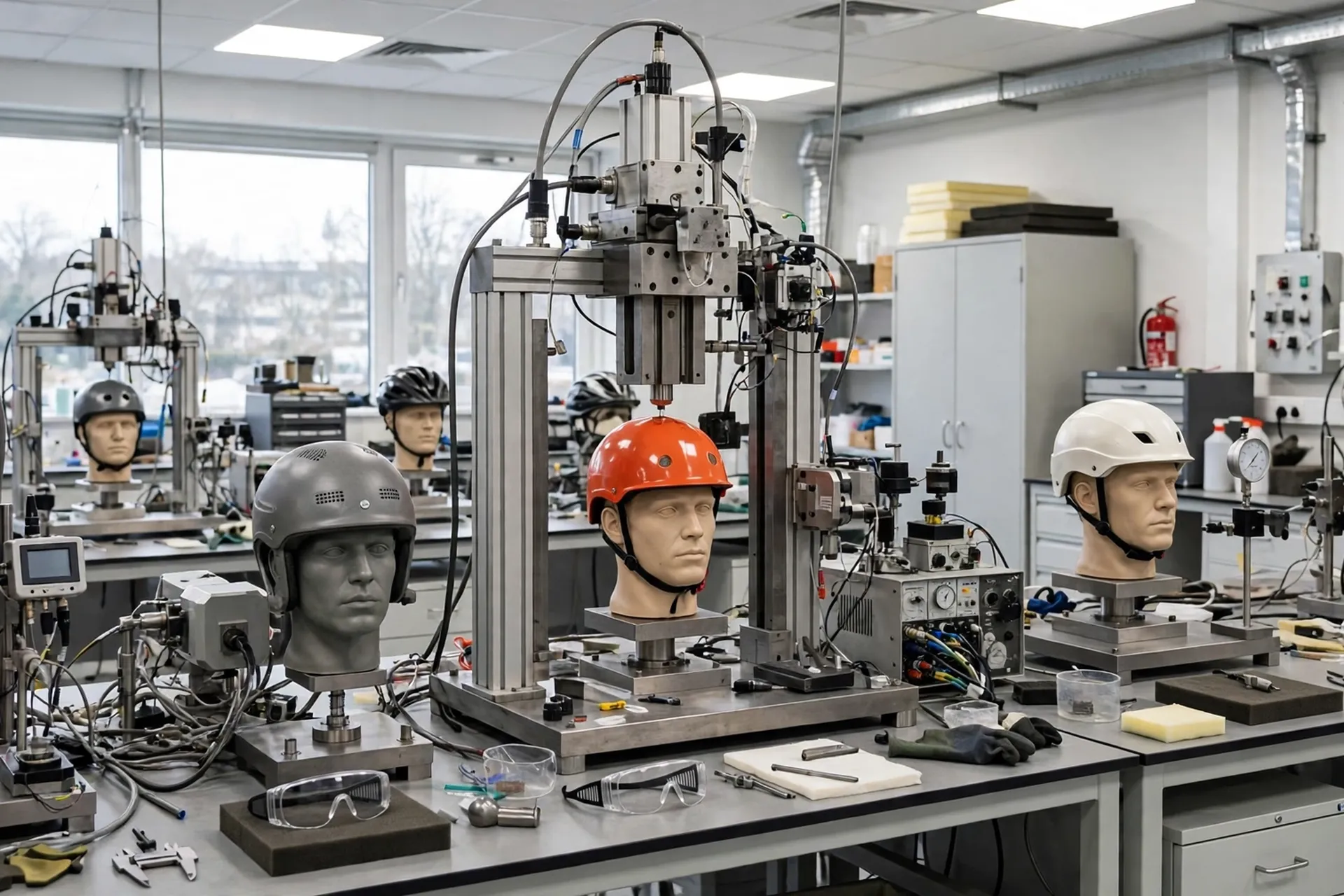
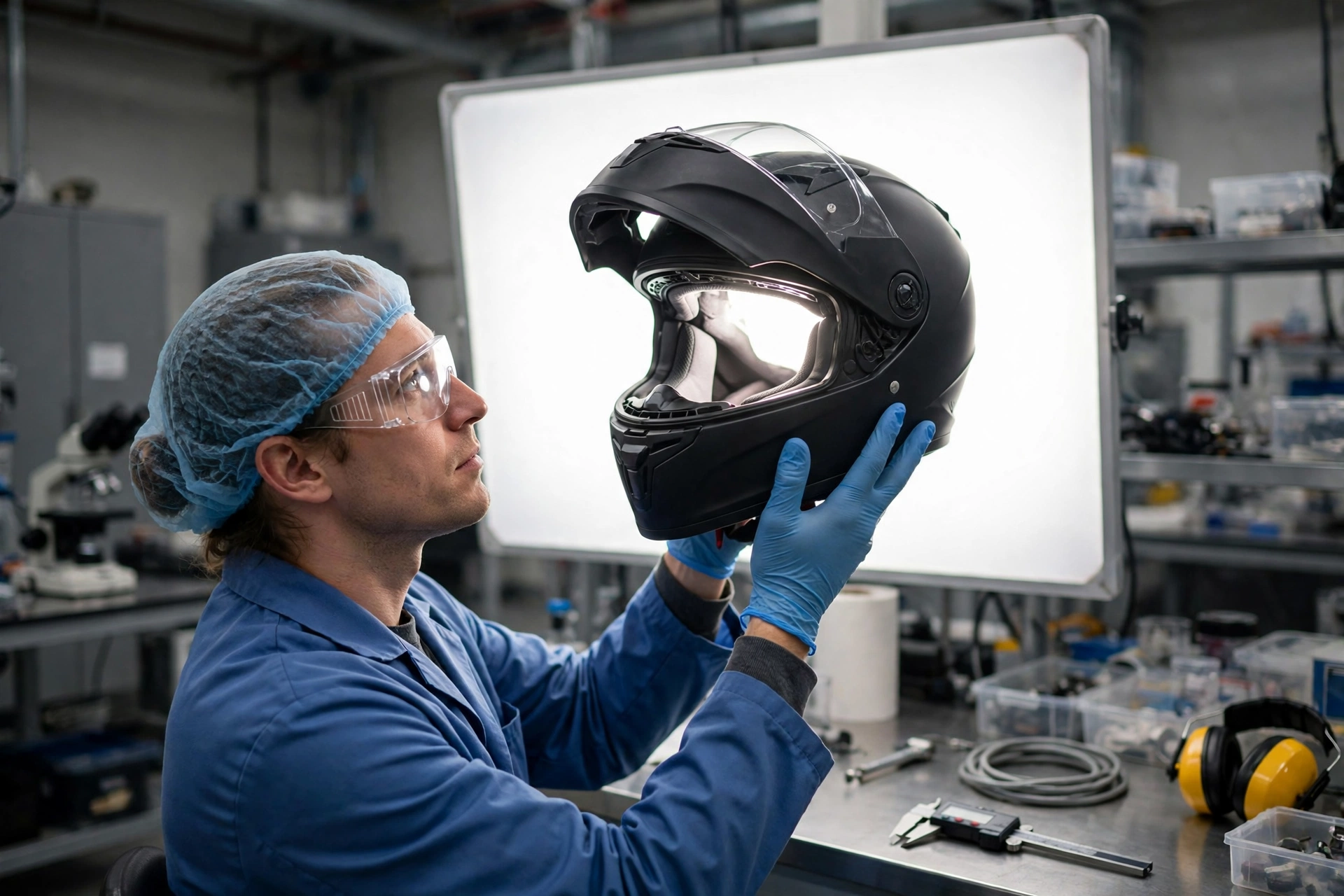
Helmets are tested in a lab by fitting them onto a model head and putting them through a series of controlled checks, including drop tests, sharp-object tests, strap tests, and checks in hot, cold, and wet conditions. Each test copies one kind of danger a rider might face in a real crash, and a helmet has to pass the full set before it can be certified for sale. The lab records every result, so the maker and the certification body can see exactly how the helmet behaved.
Lab testing exists because a helmet that looks strong is not always strong. Two helmets can look almost the same on a shelf and behave very differently in a crash, and only a controlled test can tell them apart. By testing every model in the same way, labs give riders a fair way to compare helmets, and they give makers a clear target to design towards.
What is the first step in lab testing a helmet?
Testing starts with choosing the helmets to be tested. The lab does not test a single helmet and call the job done; it takes several helmets of the same model, usually in more than one size, so the results reflect the whole range. These helmets come from the production line, not from a special batch made just for testing, so the results show what an ordinary buyer would actually get.
Before any test begins, each helmet is measured and inspected. The lab checks the weight, the fit of the liner, the condition of the straps, and the general build quality. A helmet that is already damaged or badly made is noted before testing starts, because a fault found later could be blamed on the test when it was really there from the beginning.
How does a lab test a helmet against impacts?
The impact test is the best-known lab check. A helmet is fitted onto a headform, which is a solid model head with sensors inside it, and the whole thing is dropped onto a hard surface. The surface may be flat, rounded, or shaped like a kerb, because different shapes copy different kinds of fall. The sensors record how much of the blow reaches the headform, and the lab compares the result with the limit set by the standard.
What other tests do labs run on helmets?
Beyond the impact test, labs run a penetration test, in which a pointed object is dropped onto the shell to see whether it can pierce through. This checks whether the shell can stop sharp objects such as stones or branches, which is a different danger from a broad blow. A helmet that passes the impact test can still fail the penetration test, so both checks are needed.
How do labs measure what happens inside the helmet?
The key tool inside a lab is the instrumented headform. It looks like a plain model head, but inside it are sensors that record the shock of each blow. When a helmet is dropped onto a test surface, the sensors measure how quickly the headform slows down, and how much force reaches it. The lab turns those readings into a result that can be compared with the standard.
Modern labs also use high-speed cameras to film the impact in slow motion. The footage shows how the shell bends, how the liner crushes, and whether the helmet stays in place or shifts on the headform. This is useful because it shows the maker exactly where the helmet is working well and where it is not, in a way that a single number cannot.
Some labs measure rotation as well as straight-line force, because many real crashes involve a glancing blow that twists the head. A liner system such as MIPS is designed to reduce that twisting motion, and labs that test for rotation can show whether such a system is doing its job. In general terms, the more the lab can measure, the clearer the picture of how the helmet protects the head.
Who runs helmet testing labs?
Some labs are run by independent certification bodies, which test helmets on behalf of a standard and decide whether a model can carry the certification mark. These labs have no link to the helmet maker, so their results are trusted as independent proof. A helmet that carries a certification mark has been through one of these labs, or through a lab whose results the certification body accepts.
Other labs are run by the helmet makers themselves. Large brands often have their own test facilities, where they test new designs long before they send them for certification. These in-house labs let a maker try out ideas quickly, and they can run extra tests beyond what the standard requires, such as testing at higher speeds or in harsher conditions.
There are also university and government labs, which carry out research into helmet safety and sometimes test helmets for the public. Their work helps to improve the standards themselves, because they can show where the current tests are too easy, or where a new kind of danger is not being covered. Together, these different kinds of lab keep helmet testing honest and up to date.
How can you tell if a helmet has been lab tested?
The simplest sign is the certification label. Most helmets carry a label on the inside, or a sticker on the shell, naming the standard they meet. That label is the maker saying the helmet was tested in a lab and passed, and a certification body usually checks the claim before the label can be used. If a helmet has no label, there is no proof it was ever tested.
You can also look for the name of the standard in the product description or on the box. A serious maker will name the standard clearly and say which tests were included, rather than using vague words such as safe or protective. If the description avoids naming a standard, or if the label looks homemade, it is worth choosing a different helmet.
Finally, remember that lab testing is only the start of helmet safety. A helmet that passed its tests still needs to fit well, be fastened correctly, and be replaced after a crash or when it is worn out. The lab proves the design works, but the rider has to make sure the helmet is worn properly every time.
Are all helmets tested in the same lab?
No, different labs test helmets for different standards and different makers. Some labs are independent certification bodies, some belong to the makers themselves, and some are research labs, but all of them follow the same test methods set out in the standard they are testing against.
Does a lab test destroy the helmet?
Yes, in general terms the helmets used in lab testing are damaged or destroyed by the tests, especially the impact and penetration checks. Test helmets are taken from production and set aside for testing, so they are never sold to riders.
Can a helmet fail a lab test after it is on sale?
Yes, if a later check finds that a model no longer meets the standard, it can be recalled or have its certification withdrawn. That is why labs sometimes test helmets bought from shops, to make sure production helmets still match the ones that passed the original tests.

Olivia
Writer at Helmet Today, covering helmet reviews, fit and riding safety.