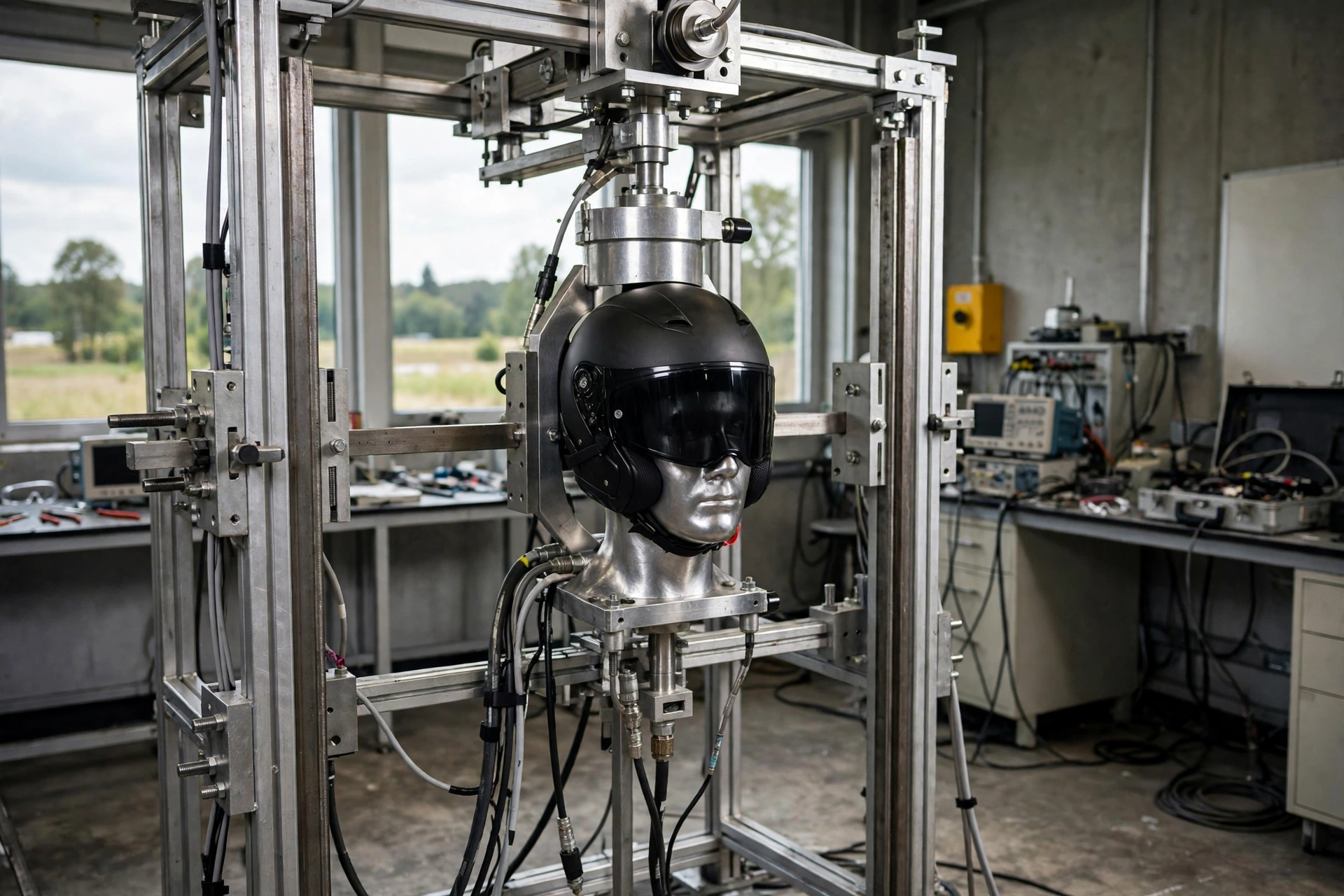
Motorcycle helmet crash testing works by fitting a helmet to an instrumented artificial head, called a headform, and dropping it in a controlled way onto steel anvils while sensors measure how much force reaches the headform. The helmet passes or fails depending on whether the measured forces stay within the limits set by the standard being tested. It is a simple idea executed with great precision, and understanding it helps you read helmet safety claims with clearer eyes.
No test can reproduce every real accident. What standardized testing does is give every helmet the same exam — same drops, same surfaces, same pass marks — so that a certified helmet has proven it can manage a defined level of impact energy in a repeatable way.
What Happens During a Helmet Crash Test?
The process begins with conditioning. In general terms, test helmets may be exposed to heat, cold, moisture, or solvents before testing, because a helmet has to protect on a freezing morning and a sweltering afternoon alike, not just at comfortable room temperature. Several samples of the same model are used so the results do not rest on a single lucky helmet.
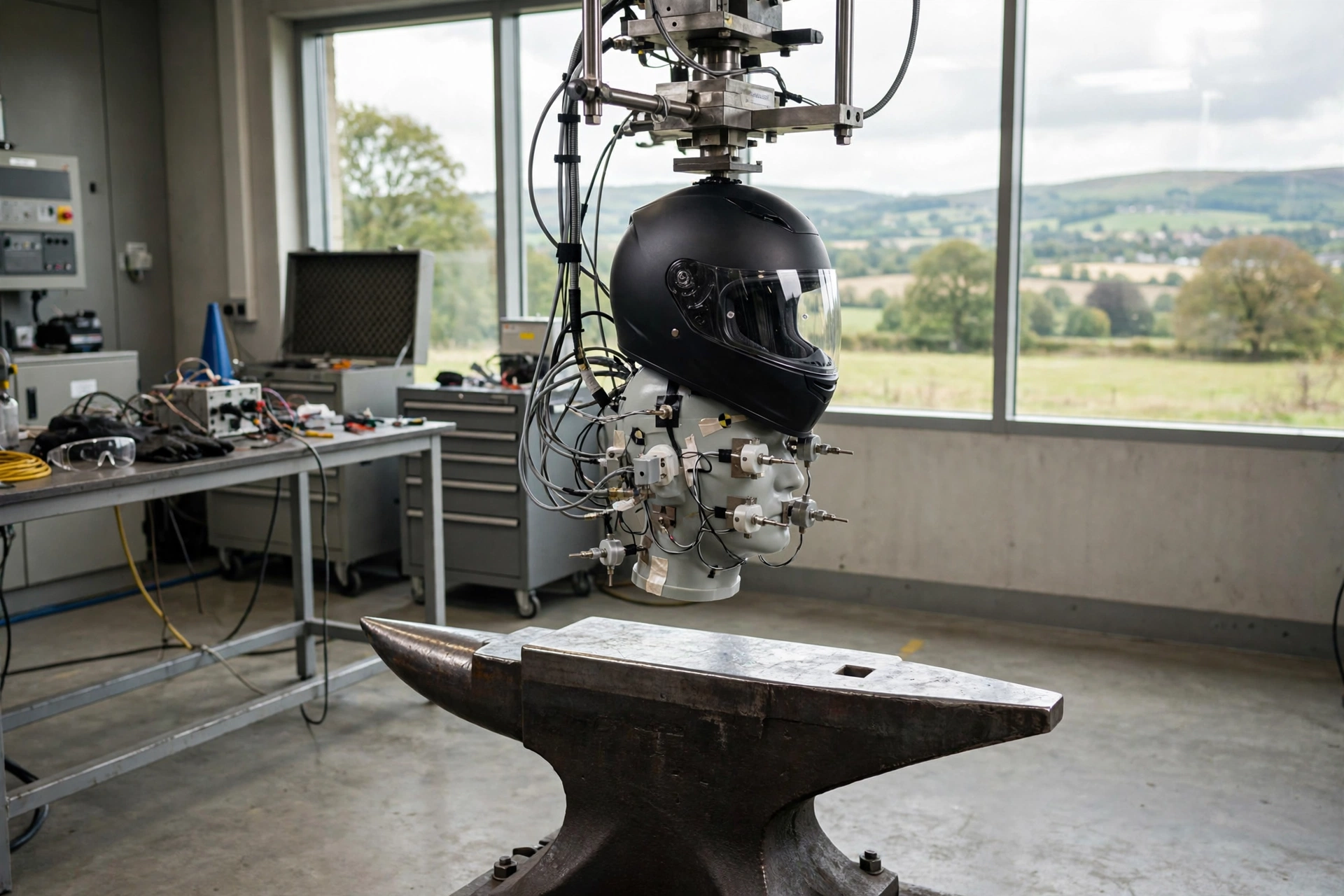
Each helmet is then fitted to a headform matched to its size, with the chin strap fastened as a rider would wear it. The headform is raised to a set height and dropped — sometimes guided along rails, sometimes in free fall — so the helmet strikes the anvil at a controlled speed. Different points around the helmet are tested: front, sides, rear, and crown, because crashes do not politely land on one spot.
Sensors inside the headform record the impact, and technicians also check things like whether the helmet stayed on, whether the strap and buckle held, and — for helmets with visors or flip fronts — whether those mechanisms behaved as they should. The whole sequence is repeated across samples and impact points before a model earns its certification.
What Are Headforms, Anvils, and Sensors?
The headform is a rigid model of a human head, built in standardized sizes and weighted to represent a real head’s mass. Because it never changes shape or complains, it gives testers the same “head” in every drop, which is what makes results comparable between helmets and between laboratories.
Anvils are the surfaces the helmet strikes, and their shape matters enormously. A flat anvil spreads the impact, representing a fall onto flat pavement. A rounded or edged anvil — sometimes shaped to suggest a curb or road furniture — concentrates force on a smaller area, which is a sterner test of the shell and foam. Test programs choose anvils to represent the kinds of objects riders actually hit.
Inside the headform, an accelerometer measures how sharply the headform slows down during the impact — in plain language, how violent the stop is. That measurement is the heart of the test: the foam in a good helmet crushes progressively and stretches the stop over a longer time and distance, lowering the peak force the head experiences.
What Do the Test Results Actually Measure?
The headline measurement is peak acceleration: the maximum force recorded during the impact, expressed in units of gravity. Standards set a ceiling that the helmet must keep the headform under. Lower peaks mean the helmet absorbed and spread the energy more effectively, which is why foam quality and thickness matter so much.
Some measurements also consider how long the force lasts, not just how high it spikes, because the brain’s tolerance depends on both. Testers additionally verify coverage — that the protective structure extends low enough around the head — and retention, meaning the strap system keeps the helmet in place during the tumble of an impact.
What the results do not give you is a prediction. A pass means the helmet met a defined standard in a defined test; it is not a promise about any individual crash, where speed, angle, surface, and the rider’s body all vary. This is why standards are best understood as a floor that every legal helmet must reach, rather than a ranking of real-world outcomes.
How Do Different Standards Test Differently?
The main standards — the US DOT standard, the European ECE standard, and voluntary programs such as Snell — all use the same basic headform-and-drop approach, but they differ in details: drop energies, anvil choices, impact points, how many samples are tested, and how compliance is checked after approval. Some rely more on manufacturer self-certification with later spot checks; others require testing before sale.
These differences explain why a helmet can be legal in one market and not sold in another, and why enthusiasts argue about standards. In practice, a helmet certified to a current major standard has passed a serious examination. Some helmets carry multiple certifications for different markets, and independent rating programs test beyond the legal minimums to compare models against each other.
Newer versions of standards have also broadened what is tested. Where older tests focused on impacts to a few points, newer programs test more locations around the shell and at different impact energies, reflecting better knowledge of how riders actually hit the ground.
Why Is Rotational Testing Becoming More Common?
Most real crashes involve an angled impact: the helmet hits the ground while moving forward, grips, and twists. That twisting motion — rotational acceleration — is now understood to be an important part of how head injuries happen, and traditional drop tests onto flat anvils were not designed to measure it.
Newer test methods address this with oblique impacts, where the headform strikes an angled, moving, or abrasive surface so the rotational forces can be measured. Recent standard updates have begun including this kind of testing, and helmet designers have responded with low-friction liner systems intended to let the helmet slide slightly and reduce the twist passed to the head. If you want to see how one such system works, our article on what MIPS is and how it works explains the idea in detail.
For riders, the practical lesson is that standards keep evolving as the science improves. A helmet certified to the latest version of a standard has been examined against a more complete picture of crash forces than one built only to an older edition — another reason to buy current models from reputable brands and to replace helmets as they age.
Frequently Asked Questions
Q: Do testers crash actual motorcycles to test helmets?
A: No. Certification testing is done on laboratory drop rigs using headforms, because lab tests can be repeated exactly and measured precisely. That repeatability is the point — every helmet faces the same exam.
Q: Does passing a crash test mean a helmet will prevent injury?
A: No test can promise that. Passing means the helmet managed a defined impact within the standard’s limits. Real crashes vary widely, which is why fit, condition, and replacing a helmet after any significant impact matter so much.
Q: Why are several helmets of the same model tested?
A: Because manufacturing varies slightly and a single sample could be unusually strong or weak. Testing multiple samples and sizes gives confidence that helmets sold to the public, not just one hand-picked example, meet the standard.

Olivia
Writer at Helmet Today, covering helmet reviews, fit and riding safety.