To choose a ski helmet size correctly, measure the circumference of your head in centimeters, match that measurement to the size chart of the exact brand and model you are buying, and confirm it with an in-person fit test: snug and even all around, no wobble when you shake your head, and no single painful pressure point. Letter sizes alone — S, M, L — are not comparable between brands.
Sizing is where most ski helmet mistakes happen. Two helmets labeled “medium” can differ by several centimeters, and a helmet that shifts on your head protects far less in a fall. This guide walks through measuring, reading size charts, the fit checks that matter, what to do between sizes, and why sizing up for a hat is a bad trade.
How Do You Measure Your Head for a Ski Helmet?
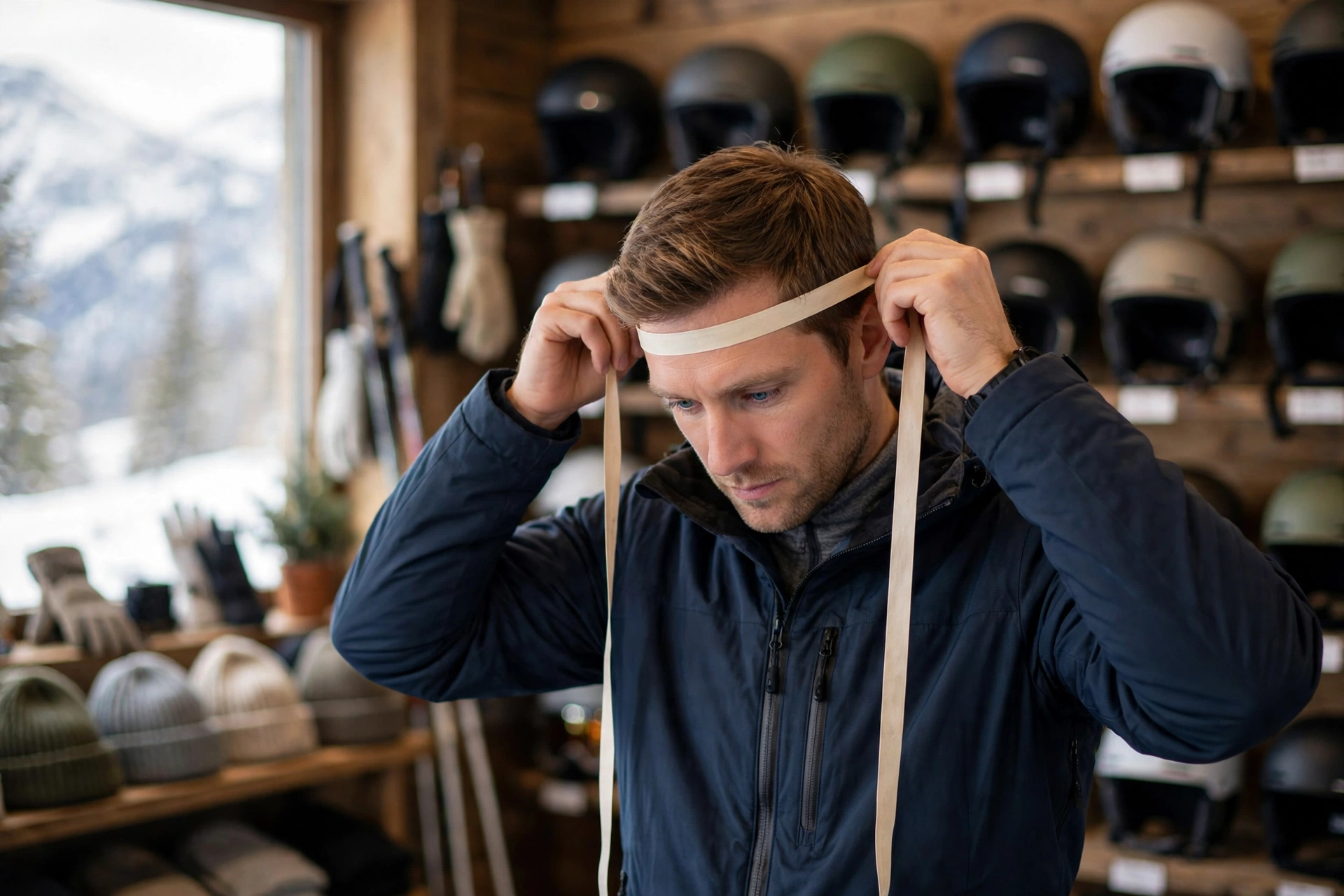
Use a soft tailor’s tape measure. Wrap it around your head at its widest point, passing about an inch above your eyebrows and ears and around the prominent bump at the back of your skull. Keep the tape level and snug but not tight enough to compress your skin, and read the result in centimeters — nearly all ski helmet charts are published in centimeters, even in the US.
Measure two or three times and use the largest consistent number. Measure with your hair as you will wear it on the mountain; a thick hairstyle or plans to wear a thin liner change the result slightly. If you have no soft tape, loop a piece of string or a phone charging cable around your head, mark the overlap, and measure that length flat against a ruler.
Write the number down and shop with it. A single centimeter can move you across a size boundary, and your measurement is the only reliable starting point.
How Do Ski Helmet Size Charts Work?
Every brand draws its size ranges differently. One maker’s medium might span roughly 55 to 59 cm while another’s covers 56 to 60 — treat those numbers as illustrations of the variation, not as a universal chart, and always read the chart for the specific model. Some brands offer two sizes with wide adjustment ranges; others offer four sizes for a closer shell match. Where your measurement falls inside a range matters: a helmet in which you sit mid-range, with the adjustment dial near the middle of its travel, generally fits better than one you barely squeeze into.
Head shape matters alongside circumference. Helmets tend toward rounder or more oval internal shapes, and a mismatch shows up as forehead pressure with loose cheeks, or temple pressure with a gap at the front. If helmets in your measured size consistently hurt in one spot within minutes, you likely need a different brand’s shape, not a different size.
Size decided, check the safety basics: the helmet should carry a recognized ski helmet certification, in general terms ASTM F2040 in North America or CE EN 1077 in Europe. Many models also offer rotational-impact protection; our guide to what MIPS is and how it reduces rotational forces explains that technology if you are comparing feature lists.
How Should a Ski Helmet Feel When the Fit Is Right?
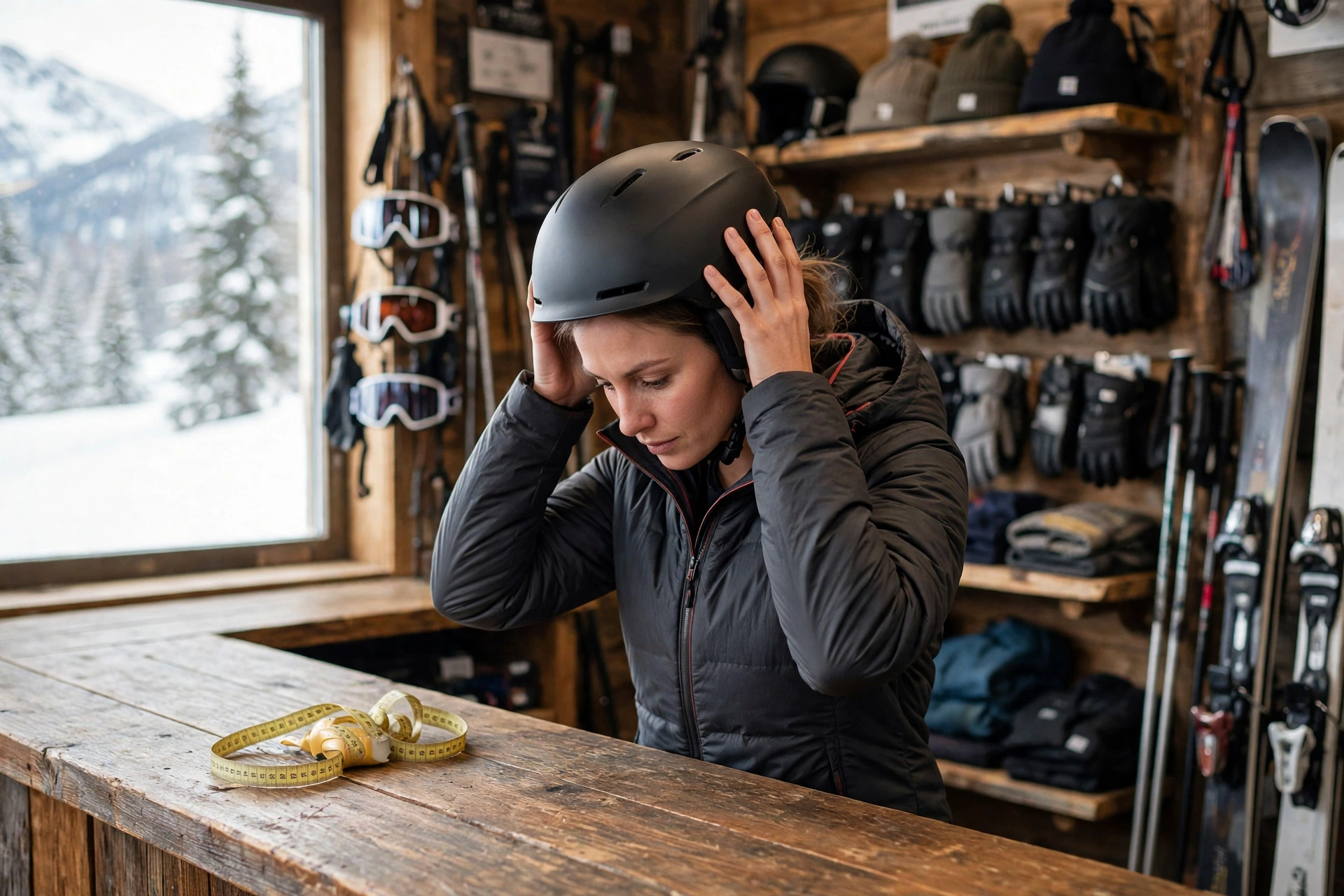
It should feel snug and even, like a firm handshake around your whole head — secure, but with no single point digging in. Wear it for at least ten to fifteen minutes before deciding; pressure points that are invisible in the first minute announce themselves clearly by minute ten.
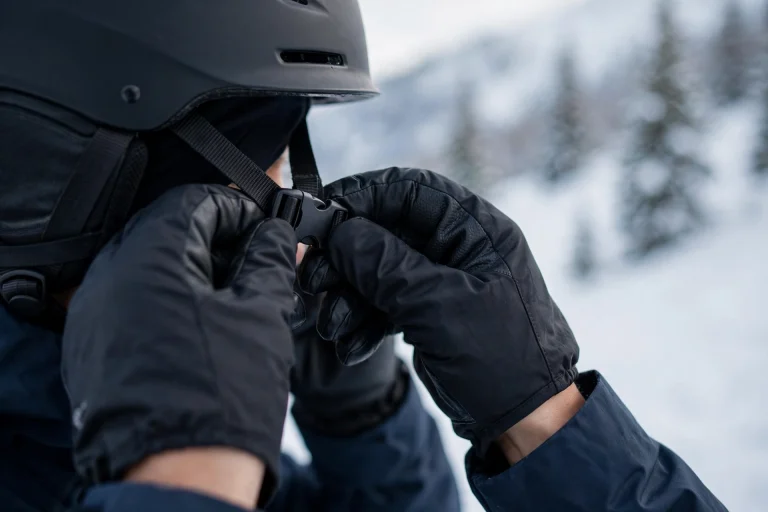
Run the movement tests. Shake your head side to side and nod: the helmet should move with your head, and your forehead skin should move with the helmet rather than sliding underneath it. Try to roll the helmet forward and backward with both hands — it should resist firmly. Then fasten the chin strap: the side straps should form a V just below each ear, and you should be able to fit roughly one or two fingers under the chin strap.
Always complete the test with your goggles on. The top of the goggle frame should meet the helmet’s brim with little or no gap, the goggle strap should sit comfortably around the shell, and the combination should not push the helmet back or lift it. A helmet that fits alone but fights your goggles will annoy you all season.
What Should You Do If You Are Between Sizes?
Try both sizes, in the same session if you can. Start with the smaller one: ski helmet comfort padding compresses slightly over the first days of use — often called packing out — so a firm, even snugness when new usually settles into a comfortable fit, while a helmet that starts loose only gets looser. Wear each candidate for a full fifteen minutes before judging.
Move up a size only if the smaller one causes a genuine hot spot, headache, or numbness that does not fade. In the larger size, use the rear fit dial and any supplied thicker pads honestly — the helmet must pass the shake test on adjustment alone, not on hope. Never pad out a too-large helmet with a thick beanie or extra foam the manufacturer did not supply; improvised filling changes how the helmet sits and can compromise how it works in a fall.
If neither size in a model works, change models. With the number of brands and internal shapes available, a between-sizes head almost always finds a clean fit somewhere — circumference is one dimension, and shape is the other.
Should You Size Up to Fit a Hat Under Your Helmet?
No. A thick hat or beanie under a ski helmet lifts it out of position, creates gaps, and interferes with how the helmet is designed to sit and absorb impact. Ski helmets are insulated and cover your ears; in general terms, most skiers find a helmet alone warm enough on all but the coldest days.
If you run cold, the correct solution is a thin, close-fitting balaclava or dedicated helmet liner — these add warmth with minimal effect on fit. Fit your helmet while wearing that liner if you plan to use one regularly, and re-check the shake test with it on. For genuinely bitter days, a balaclava worn under the helmet plus a neck gaiter pulled up outside it covers nearly everything without disturbing the fit.
The same goes for kids: resist buying growing room. Buy the size that fits now, use the adjustment range as they grow, and replace it when outgrown — a season in a too-big helmet is a season of reduced protection.
Frequently Asked Questions
Q: Is ski helmet sizing the same as bike helmet sizing?
A: The measuring method is identical, but the charts are not. Each brand and helmet type sets its own ranges, so re-measure and check the ski helmet’s own chart rather than assuming your bike helmet size transfers.
Q: How can I tell if my ski helmet is too big?
A: It rocks or shifts when you shake your head, slides down toward your eyes or back off your forehead, leaves a gap at the temples, or only stays put with the chin strap painfully tight. Any of those means size down or try another model.
Q: Do ski helmets loosen up over time?
A: Yes, slightly. Comfort foam compresses with use — the “packing out” effect — which is why a new helmet should feel firmly snug rather than comfortably loose. If a well-used helmet has become sloppy, adjustment pads may help, but a helmet that no longer fits should be replaced.

Olivia
Writer at Helmet Today, covering helmet reviews, fit and riding safety.