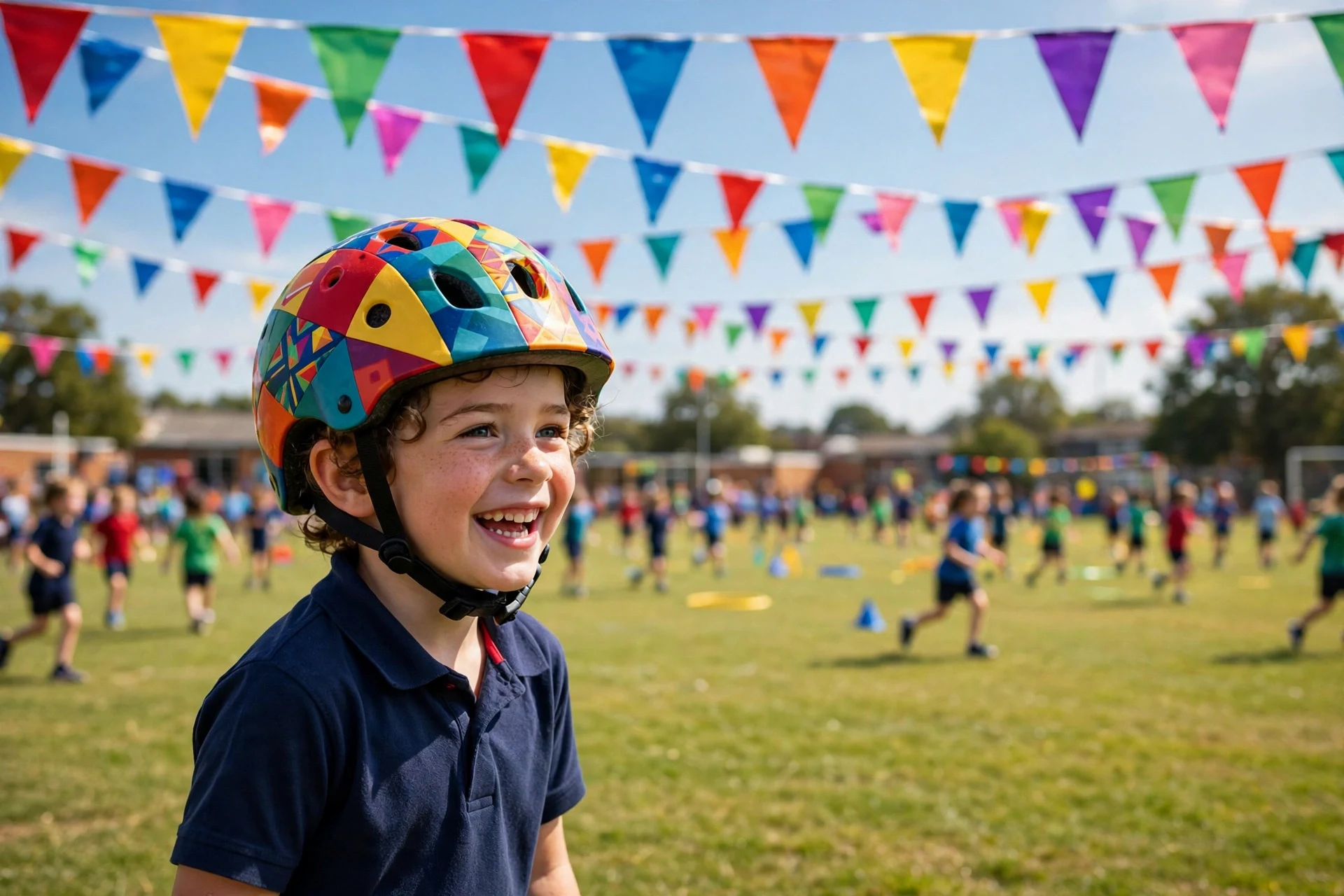
A kids helmet for school sports day is a light protective helmet worn by a child taking part in school sports day activities where there is a risk of knocks to the head. It gives head protection during races, games, and team events, while staying comfortable enough to wear for a whole morning outdoors. School sports day is usually a fun, busy event with running, jumping, and team games, and a helmet is a simple way to add protection where falls or collisions are possible. A helmet that fits well lets a child enjoy the day without being held back.
What Does a Helmet Do on School Sports Day?
A helmet on school sports day protects the head during the kinds of knocks that can happen in a busy field full of children. In running races, a child can trip and fall onto hard ground, and in team games, children can bump into each other or into equipment. The helmet’s shell and inner padding work together to spread out and soften the force of these impacts. In general terms, no helmet can remove all risk, but a helmet reduces the chance that an ordinary fall turns into a serious head injury.
For younger children, the protection matters even more, because they are still learning to run, balance, and change direction at speed, and they may not yet judge distances well in a crowded game. A light helmet that stays in place through running and jumping is the right choice, and it should not distract the child from the activity itself. The aim is protection that the child barely notices once the event starts.
When Does a Child Need a Helmet on Sports Day?
A child needs a helmet on sports day when the activity involves a real risk of falling or being hit on the head. That can include cycling races, scooter events, obstacle courses, and team games where children move fast in close quarters. For simple running races on grass, a helmet is often not needed, but for any event with wheels, climbing, or hard equipment, it is a sensible precaution. The school or the event organiser will usually say when a helmet is expected, and it is worth following that guidance.
If you want to understand one of the safety technologies used in modern helmets, reading about what MIPS is for helmets is a good place to start, though not every kids sports helmet uses that system. The key point is to match the helmet to the activity: a helmet made for cycling suits a cycling race, while a helmet made for skating suits a skating event. A helmet built for the wrong activity may not protect the head in the way the event needs.
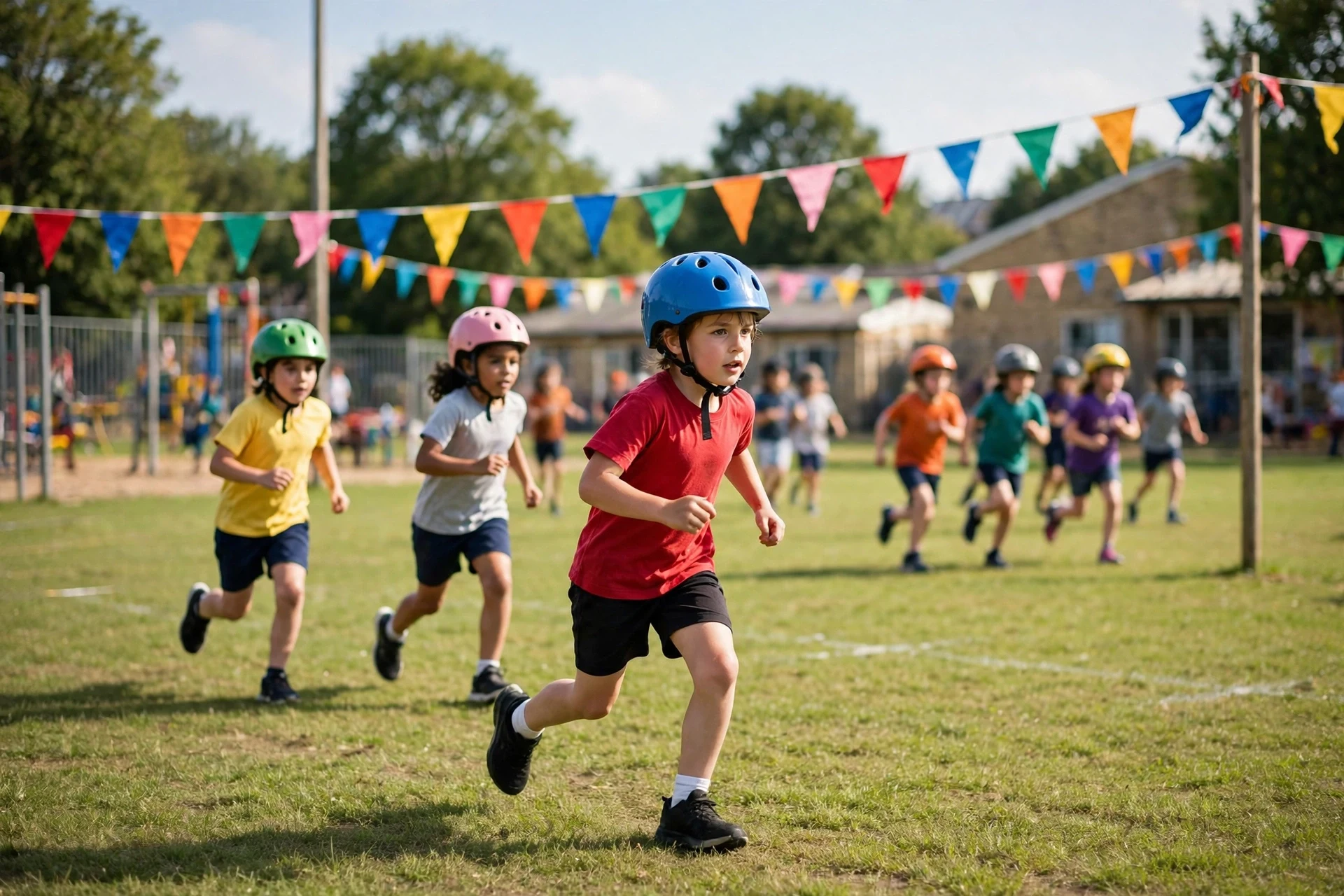
How Should a Kids Sports Day Helmet Fit?
A kids sports day helmet should fit snugly all round the head, with no pressure points and no wobbling when the child shakes their head from side to side. It should sit level, covering the forehead, and the back should sit low enough to protect the back of the head. If the helmet can be rocked forwards or backwards easily, it is probably too loose, and it may shift during a race, which is when it is needed most.
The chin strap should be fastened snugly before the event starts, and it is worth checking the fit with the child moving about, since running and jumping can shift a helmet that felt fine while standing still. Many kids helmets can be adjusted in size, which helps as the child grows, but a helmet that is bought too big in the hope it will last longer is a poor choice, because a loose helmet protects less well. In general terms, it is better to use a helmet that fits now.
What Features Matter for a School Sports Day Helmet?
For a school sports day helmet, the most important features are light weight, a comfortable fit, and good ventilation. Children wear the helmet for a whole morning outdoors, often in warm weather, so a heavy helmet or one with no airflow will soon feel uncomfortable. Vents that let heat out make a real difference, and a helmet that stays comfortable is more likely to stay on for the whole event.
Adjustability is worth having, since kids grow quickly and a helmet with adjustable sizing can be fine-tuned as the head grows. The fastenings should be easy to use, so the helmet can be put on and taken off quickly between events, and the chin strap should be simple to tighten. A bright colour is a good idea on a busy field, because it makes the child easier to spot, and a colour the child likes can also help, because a helmet a child is happy to wear is a helmet that actually gets worn.
How Do You Look After a Kids Sports Helmet?
Looking after a kids sports helmet starts with letting it dry out after the event. Sports helmets get sweaty, and the padding can hold moisture, so leaving the helmet in an open bag or on a shelf to air dry helps keep it fresh and stops the padding from breaking down early. Wiping the shell with a damp cloth removes dirt and grass, and the padding can usually be wiped or rinsed if the maker allows it.
It is also worth checking the helmet regularly, looking for cracks in the shell, worn padding, or a chin strap that no longer holds tight. Small problems caught early can often be fixed, but a helmet with a cracked shell or a strap that will not stay fastened should not be used. Keeping the helmet in a bag that protects it from knocks when it is not being worn, and out of strong sun, is a simple habit that helps it last longer.
When Should a Kids Sports Helmet Be Replaced?
A kids sports helmet should be replaced after a hard impact, even if it looks fine from the outside. The padding inside a helmet can compress or crack in a heavy knock, and that damage may not be visible under the shell. A helmet that has already absorbed a hard blow may not protect as well the next time, so it is generally sensible to retire it after a serious impact and use a new one.
Growth is the other common reason to replace a kids helmet. A helmet that has become too tight, or that can no longer be adjusted to fit snugly, is no longer doing its job properly, and it may also be uncomfortable enough that the child resists wearing it. Wear and tear matters too: straps that no longer hold, padding that has gone thin, or a shell that feels brittle after many seasons are all signs that the helmet has reached the end of its useful life.
Does my child need a helmet for every sports day event?
Not necessarily. A helmet is sensible for events with wheels, climbing, or hard equipment, but simple running races on grass may not need one. Follow the school’s guidance and match the helmet to the activity.
Can my child use a bike helmet for sports day?
Yes, in general terms a bike helmet can work for cycling or scooter events on sports day, since it is made for those kinds of falls. For other events, use a helmet made for that activity instead.
How do I know if my child’s sports day helmet fits?
It should sit level, feel snug all round without pressing anywhere, and stay put when your child shakes their head and runs about. The chin strap should be snug, and the helmet should not rock forwards or backwards easily.

Olivia
Writer at Helmet Today, covering helmet reviews, fit and riding safety.