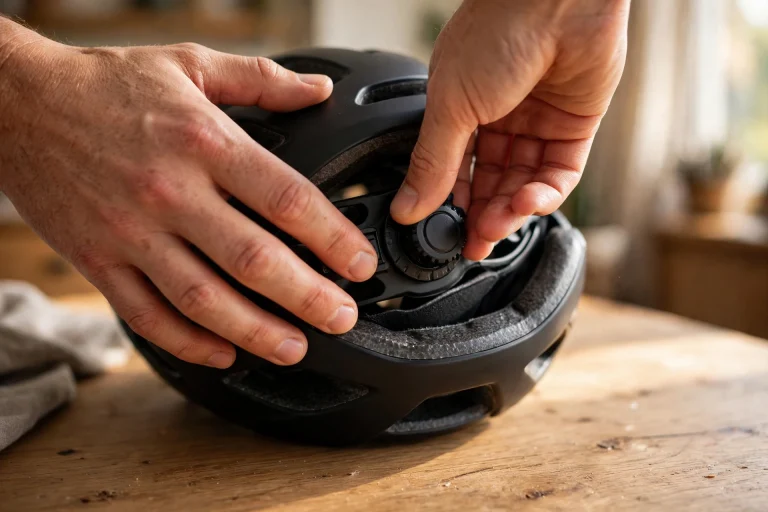
Riders with a wide head need a helmet that is wide enough at the sides, not just large enough in circumference. In general terms, a round or wide-fit helmet, in the right size, with the retention system adjusted evenly, will sit level and snug without pressing painfully at the temples, while a long, narrow helmet will squeeze the sides even when the size chart says it should fit. Head width is one of the most overlooked parts of helmet fit. Two people can have the same head circumference and need completely different helmets, because one head is long and narrow and the other is short and wide.
What Does a Wide Head Mean for Helmet Fit?
A wide head is broader across the temples and sides than it is long from front to back. When you measure the circumference, the number may look average, but the width across the sides is greater than the helmet expects. That means a helmet built for a narrow or average head will press hard at the temples while leaving a gap at the forehead or the back, and it will feel tight even though the size is technically right.
This is why the size chart alone is not enough. A helmet that squeezes your temples will give you a headache on a long ride, and you may be tempted to size up to escape the pressure. Sizing up does relieve the squeeze, but it often creates a new problem: the helmet becomes too long front to back, so it rocks and slides. The real fix is a helmet whose shape matches your head, not simply a bigger one.
How Do I Know If I Have a Wide Head?
You can get a rough idea by measuring your head in two directions. Measure the circumference with a soft tape just above your eyebrows and ears, then measure the width across the widest part of your head, above the ears, and the length from the middle of your forehead to the back of your head. If the width is close to the length, your head is on the rounder, wider side; if the length is clearly greater, your head is more oval.
The simplest test, though, is trying helmets on. If helmets in your measured size always press at the temples but feel loose at the front and back, you probably have a wide head. If you want to understand one of the safety technologies used in modern helmets, reading about what MIPS is for helmets is a useful starting point, but shape comes first: a liner system cannot fix a helmet that presses in the wrong places.

Which Helmet Shapes Suit a Wide Head?
Round-fit helmets suit wide heads best, because their shells are broader across the sides and shorter front to back. Some brands describe their fit as round, intermediate, or long oval, and riders with wide heads should look for the round end of that range. A round-fit helmet spreads the pressure evenly around the head instead of concentrating it at the temples.
It is worth trying several brands, because each maker shapes its helmets slightly differently, and one brand’s round fit may suit you better than another’s. Try the helmet on, fasten the straps, and wear it for a few minutes in the shop. It should feel snug all round without a sharp pressure point at the sides, and it should sit level just above your eyebrows. In general terms, comfort in the shop is a good guide to comfort on a long ride.
Should I Size Up If My Helmet Squeezes My Temples?
Sizing up can relieve temple pressure, but it is often the wrong fix. A larger helmet gives more room at the sides, but it also gives more room front to back, so the helmet may start to rock, slide forward over your eyes, or sit too high. You end up trading a pressure problem for a looseness problem, and neither is safe.
A better approach is to stay in your measured size but switch to a rounder model, or to try a helmet with adjustable fit pads that can be thinned at the sides. Some helmets let you remove or swap the side pads, which takes pressure off the temples without changing the overall size. If no helmet in your size fits comfortably, then sizing up with thicker pads at the front and back can work, but test it carefully before you commit.
How Do I Adjust a Helmet for a Wide Head?
Start with the fit pads. If the helmet presses at the temples, try thinner pads at the sides, or remove them altogether if the design allows it, and keep thicker pads at the forehead and back so the helmet stays stable. Then adjust the retention dial until the cradle feels even all round, rather than tight at the sides and loose elsewhere.
Check the straps as well. The side straps should form a neat V just below each ear, and the chin strap should sit snugly without pulling the helmet to one side. Wear the helmet for ten minutes or so at home before a long ride, because pressure that feels minor at first can become a headache after an hour. In general terms, a good fit for a wide head feels even and firm all round, with no single spot doing all the squeezing.
Can a Wide Head Ever Fit a Standard Helmet?
Yes, many riders with wide heads fit standard helmets perfectly well, because most helmets are made in an intermediate shape that suits a broad range of heads. The problem only arises when your head is clearly wider than average, or when a particular model runs narrow. Trying on a range of models is the best way to find out, and you may find that one brand’s standard fit suits you while another’s does not.
It is also worth remembering that helmets break in slightly: the pads compress a little with use, so a helmet that feels firm at the temples on day one may feel better after a few rides. That break-in is small, though, and it will not fix a helmet that genuinely hurts. If a helmet gives you a headache within minutes, it is the wrong shape, and no amount of breaking in will make it right.
What helmet shape is best for a wide head?
A round-fit helmet is usually best, because it is broader across the sides. Look for models described as round fit, and try several brands to find the shape that spreads pressure evenly.
Is temple pressure a sign my helmet is too small?
Not always. Temple pressure often means the helmet is the wrong shape rather than the wrong size. Try a rounder model in the same size before sizing up.
Can I widen a helmet that squeezes my head?
In general terms, no, you should not try to stretch or bend a helmet shell. Use thinner side pads or a rounder model instead, because forcing the shell can damage the helmet and weaken its protection.

Olivia
Writer at Helmet Today, covering helmet reviews, fit and riding safety.