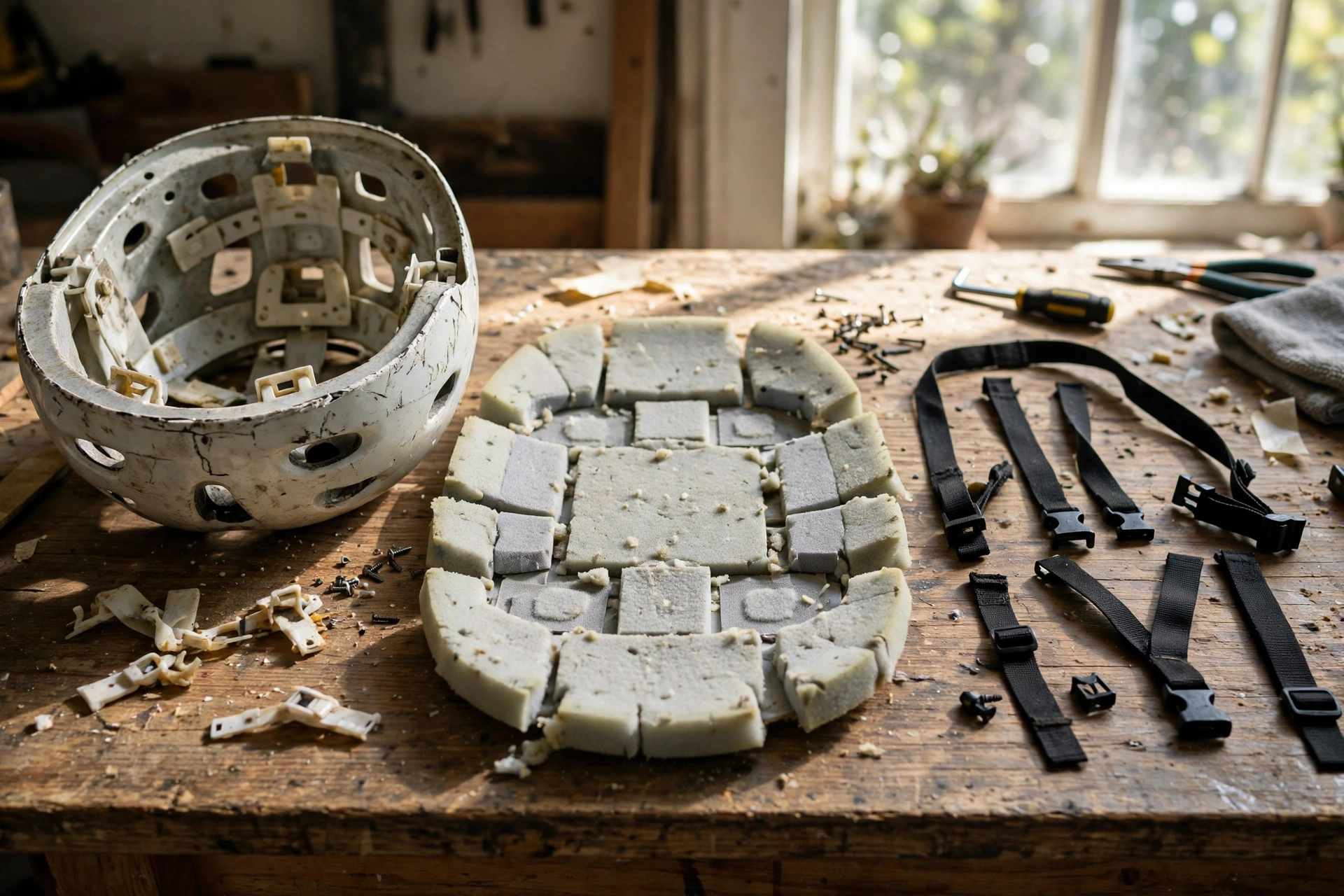
You can recycle a helmet at home in general terms by taking it apart and sorting its parts, because a whole helmet cannot go in the household recycling bin. A helmet is made from several materials fixed together: a hard plastic shell, a foam liner, straps, buckles, and pads. Recycling centres cannot process that mix as one item, so the job at home is to separate the parts and put each one where it belongs. It takes a little time and a few basic tools, but it keeps the materials out of landfill and lets the parts that can be recycled be recycled properly.
Can you recycle a helmet at home?
You cannot recycle a whole helmet at home in the way you recycle a bottle or a cardboard box, because no home recycling system is set up to take a mixed-material helmet. Your household recycling bin is for clean, single-material items such as paper, glass, and certain plastics. A helmet combines hard plastic, foam, fabric, and metal, and the sorting machines at a recycling plant cannot separate those materials when they are glued and riveted together. Putting a whole helmet in the bin usually means it is pulled out and sent to landfill anyway.
What you can do at home is the first step of recycling: taking the helmet apart. By separating the shell from the foam, cutting away the straps, and removing the buckles and pads, you turn one mixed item into several simpler ones. Some of those parts may be accepted by your local recycling centre, and others may be reusable in other ways. The key is to check your local rules first, because what one area accepts, another may not. A quick check with your local council or recycling centre will tell you which plastics they take and where to bring them.
What parts of a helmet can be separated?
A typical helmet has five main parts, and most of them can be separated with basic tools. The outer shell is the hard plastic skin you see from the outside. Under it sits the foam liner, usually made from expanded polystyrene, which absorbs the force of an impact. The comfort pads sit against your head and are held in place with hook-and-loop fasteners or small clips. The straps run under your chin and are fixed to the shell with rivets or screws, and the buckle and adjustment dial are small plastic or metal parts that can be unscrewed or cut away.
The shell and the foam are usually glued together, so they need the most effort to separate. A flat screwdriver or a blunt knife can be worked gently between the shell and the foam to break the glue, but take care not to cut yourself on the edge of the shell. The pads usually pull off easily, and the straps can be cut with strong scissors once you have removed the buckle. The vents, visor, and any clips usually unscrew or snap off.
How do you take a helmet apart safely?
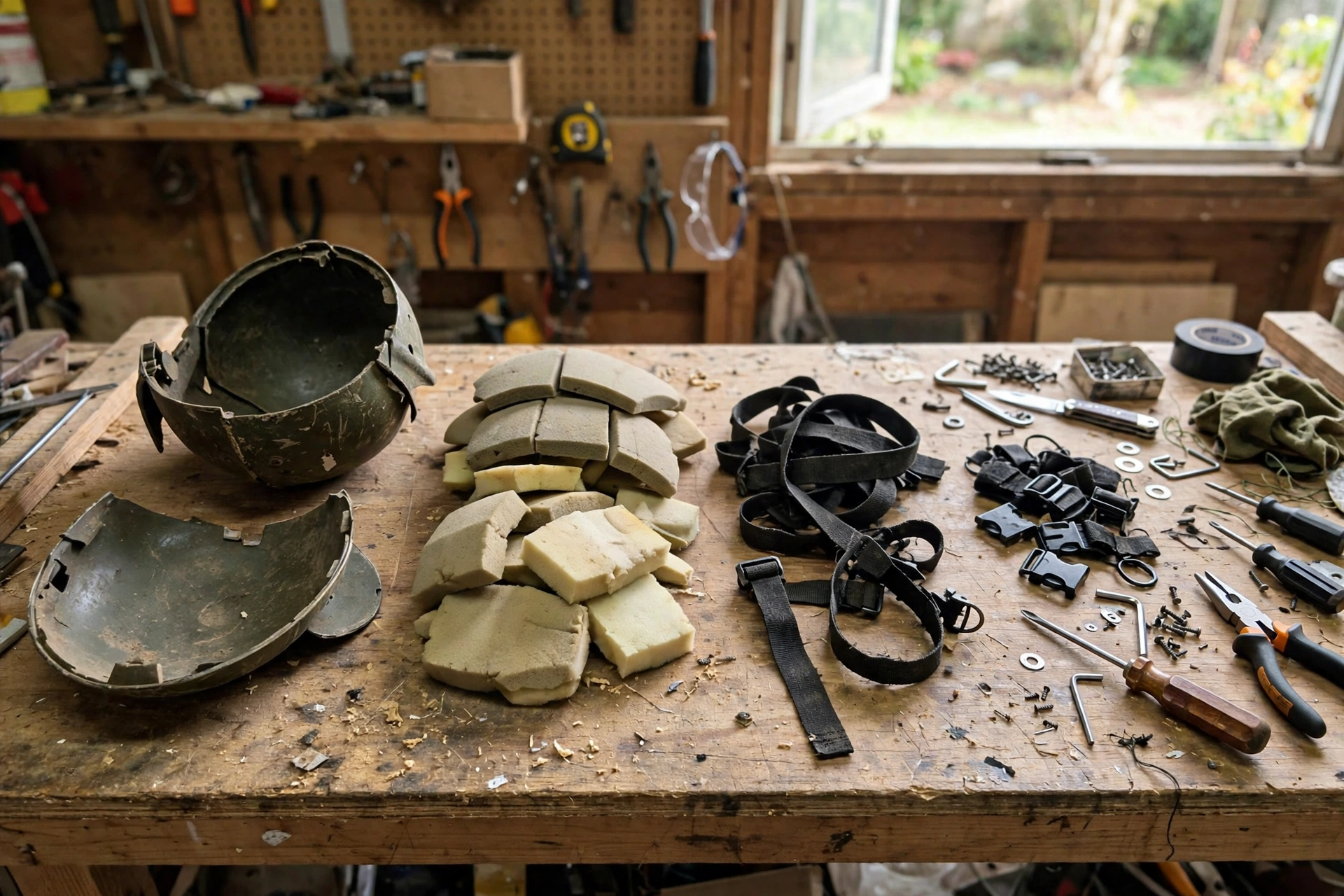
Start by working on a stable surface, such as a workbench or a table covered with an old towel, and wear gloves to protect your hands from sharp plastic edges. Remove the visor, pads, and any clip-on parts first, because these usually come off without tools. The pads can be pulled out by hand, and the visor screws can be undone with a screwdriver. Put small screws and clips in a jar so they do not get lost.
Next, cut the straps close to where they join the shell, and remove the buckle and adjustment dial. A pair of strong scissors or a craft knife will do this, but always cut away from your body and keep your fingers clear of the blade. Once the straps are off, work on the shell. Use a flat screwdriver to ease the edge of the shell away from the foam, working slowly around the helmet rather than forcing one spot. The glue will crack and let go in sections.
What can you do with the shell and foam?
The hard plastic shell is the part most likely to be recyclable. Many shells are made from polycarbonate or ABS plastic, and some recycling centres accept these plastics if they are clean and separated from the foam. Check the recycling symbol and number moulded inside the shell, then ask your local centre whether they take that type of plastic. If they do, the shell can go in with other hard plastics. If they do not, the shell may still be useful as a plant pot, a storage bowl, or a scoop in the garden, rather than going to landfill.
The foam liner is harder to recycle. Expanded polystyrene is light and bulky, and many local recycling programmes do not accept it because it is costly to transport and hard to process. Some specialist recyclers do take it, and some areas have drop-off points for polystyrene packaging, so it is worth asking. If no recycler will take it, the foam can be broken into small pieces and used as drainage material in plant pots or as protective packing for fragile items. This is reuse rather than recycling, but it still keeps the foam out of the bin for a while longer.
What should you never put in the recycling bin?
Never put a whole helmet in your household recycling bin, because it will almost certainly be rejected at the sorting plant and sent to landfill. The same goes for the foam liner on its own in most areas, because expanded polystyrene is not accepted in kerbside recycling in many places. Putting the wrong items in the bin can also contaminate a whole load of recycling, which may then be sent to landfill instead of being recycled. When in doubt, leave it out and check with your local centre.
Never put helmet parts in the compost bin, and never burn them. The foam and the plastic shell are not biodegradable, and burning them releases harmful fumes. Do not pour any glue or cleaning fluid you used down the drain either; wipe tools clean with a cloth and put the cloth in the general waste. Keep small screws and clips out of the recycling bin unless your centre accepts small metal items, because tiny pieces can jam sorting machines. A slip layer such as MIPS sits between the shell and foam, so separate it with the liner.
How can you reuse an old helmet instead?
Before you recycle an old helmet, think about whether it can be reused. A helmet that is too old for riding may still be useful as a display piece, a planter, or a prop for a school or club. Some cycling clubs keep old helmets to show new riders how a helmet is built and what the foam looks like inside. A helmet that has been cut in half makes a clear teaching aid, because the layers are easy to see.
Can I put an old helmet in my recycling bin?
No, in general terms, a whole helmet should not go in the household recycling bin. It is made from mixed materials that sorting plants cannot separate, so it is usually pulled out and sent to landfill.
What tools do I need to take a helmet apart?
A screwdriver, strong scissors, gloves, and a flat surface are usually enough. Remove the pads and visor first, cut the straps, then ease the shell away from the foam with a flat screwdriver.
Is the foam liner recyclable?
Expanded polystyrene foam is hard to recycle, and many local programmes do not accept it. Ask your local recycling centre or a specialist recycler, and reuse the foam as packing or plant pot drainage if no recycler will take it.

Olivia
Writer at Helmet Today, covering helmet reviews, fit and riding safety.