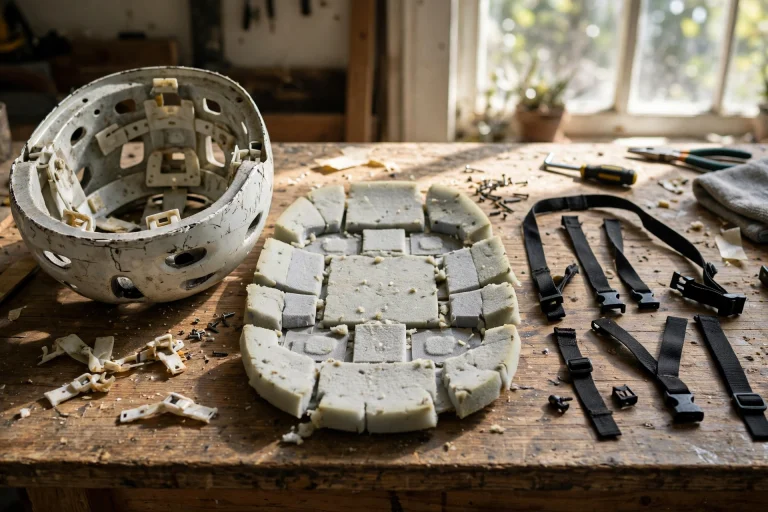
You can recycle an old helmet at a local recycling centre, through a helmet maker’s take-back scheme, or at some bike and sports shops, but not in your household recycling bin. A whole helmet is a mix of hard plastic, foam, fabric, and metal, and kerbside recycling cannot handle that mix. The right place depends on where you live and what kind of helmet it is, so the first step is always to check what your local services accept. In most areas, one of the options below will take your old helmet, and the materials can then be sorted and dealt with properly.
Can you put a helmet in your household recycling bin?
In general terms, no, you should not put a whole helmet in your household recycling bin. Kerbside recycling is set up for clean items made from a single material, such as a plastic bottle, a tin can, or a cardboard box. A helmet is the opposite of that: a hard shell glued to a foam liner, with straps, buckles, and pads fixed on. The sorting machines at a recycling plant cannot pull those materials apart, so the helmet is usually picked out by hand and sent to landfill, even if the plastic shell on its own could have been recycled.
Some areas do accept hard plastics at the kerbside, but a helmet still causes problems because of the foam and the straps. The foam can break into small pieces that contaminate other recycling, and the straps can tangle in the sorting machinery. For that reason, most councils ask residents not to put helmets in the household bin. If you are unsure, check your council’s recycling guide online or look for the list of items they accept. When in doubt, keep the helmet out of the bin and take it to a recycling centre instead.
Where do local recycling centres accept helmets?
Your local household waste recycling centre, sometimes called a tip or a dump, is usually the best first place to ask. Many centres have a section for hard plastics, and some have a section for mixed materials or for items that need special handling. The staff there can tell you whether they take helmets whole or whether you need to take the helmet apart first. They can also tell you where the foam liner should go, because some centres have a separate container for polystyrene.
Before you go, it helps to call ahead or check the centre’s website. Recycling centres change what they accept from time to time, and a centre in one town may take helmets while the next town’s centre does not. If you are making a special trip, a quick call saves time and fuel. Take the helmet with you and ask the staff where each part should go. They deal with unusual items every day and will usually be happy to help.

Do helmet makers run take-back schemes?
Some helmet makers do run take-back schemes, although they are not yet common everywhere. A take-back scheme usually works like this: when you buy a new helmet, the maker or the shop takes your old one back and sends it to a recycler that can break it down properly. Some makers run the scheme all year round, while others run it for a limited time or only in certain countries. The best way to find out is to check the maker’s website or ask at the shop where you bought the helmet.
Take-back schemes are good because the maker knows exactly what materials are in the helmet and can send it to a recycler that handles those materials. The maker may also use the returned helmets to learn how their products wear out, which helps them design better helmets in the future. Makers are also thinking about the whole life of a helmet, and a slip layer such as MIPS is one example of that wider change.
Can bike shops and sports shops help?
Bike shops and sports shops are a useful place to ask, because they handle old helmets every day. When a customer buys a new helmet, the shop often offers to take the old one away, and some shops collect old helmets in a bin for recycling. A shop that sells a lot of helmets may have an arrangement with a recycler or with the helmet maker, and they may be able to add your old helmet to their next collection.
Even if the shop does not have a formal scheme, the staff will often know where helmets can be recycled locally. They hear the same question from other customers and may have a list of local options. Ask when you are buying a new helmet, or call ahead if you are making a special trip. Some shops run trade-in events, where you can bring an old helmet and get a small discount on a new one, although this is not common everywhere and the discount is usually modest.
What about charity and community reuse?
Community groups can be a good home for a helmet that is still safe. Cycling clubs, schools, and youth groups often need spare helmets for new riders, and a helmet you no longer use may be exactly what they need. Before you donate, check the helmet carefully: look for cracks, check that the straps and buckle work, and make sure the foam liner is not crumbling. If the helmet is damaged or has been in a crash, do not donate it.
Some community projects collect old helmets to use in training or as teaching aids. A helmet that is too old to wear can still show a new rider how the foam and shell work together, and a cut-open helmet makes the layers easy to see. Ask local clubs or schools whether they want old helmets for this purpose. It is a better use than landfill, and it helps new riders understand why a helmet matters.
How do you prepare a helmet for recycling?
Preparing a helmet for recycling is simple, and it makes the recycler’s job much easier. Start by cleaning the helmet: remove the pads and wash them if you plan to reuse them, and wipe the shell clean with a damp cloth. Remove any stickers or labels that peel off easily, and take off the visor if it unscrews. The cleaner the helmet, the easier it is to sort and process.
Next, find out whether the place you are taking it to wants the helmet whole or taken apart. A take-back scheme may want it whole, because the recycler has the tools to break it down. A recycling centre may prefer it taken apart, with the shell, foam, and straps separated. If you are taking it apart at home, work on a stable surface, wear gloves, and use a screwdriver and strong scissors. Keep the parts in separate bags so they can be sorted quickly when you arrive.
Can I recycle a helmet at the kerbside?
No, in general terms, a whole helmet should not go in your household recycling bin. It is made from mixed materials that kerbside sorting cannot separate, so take it to a recycling centre or a take-back scheme instead.
Do all recycling centres accept helmets?
No, not all of them do. Rules vary by area, so call ahead or check the centre’s website before you go. The staff can tell you whether they take helmets whole or taken apart.
What should I do with a helmet that has been in a crash?
Do not donate or reuse a crashed helmet. Take it to a recycling centre or a maker’s take-back scheme, or take it apart at home and recycle the parts that your local services accept.

Olivia
Writer at Helmet Today, covering helmet reviews, fit and riding safety.