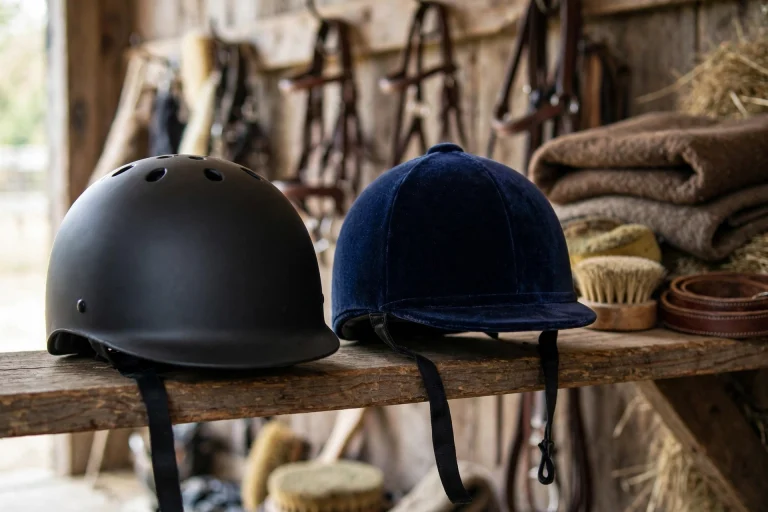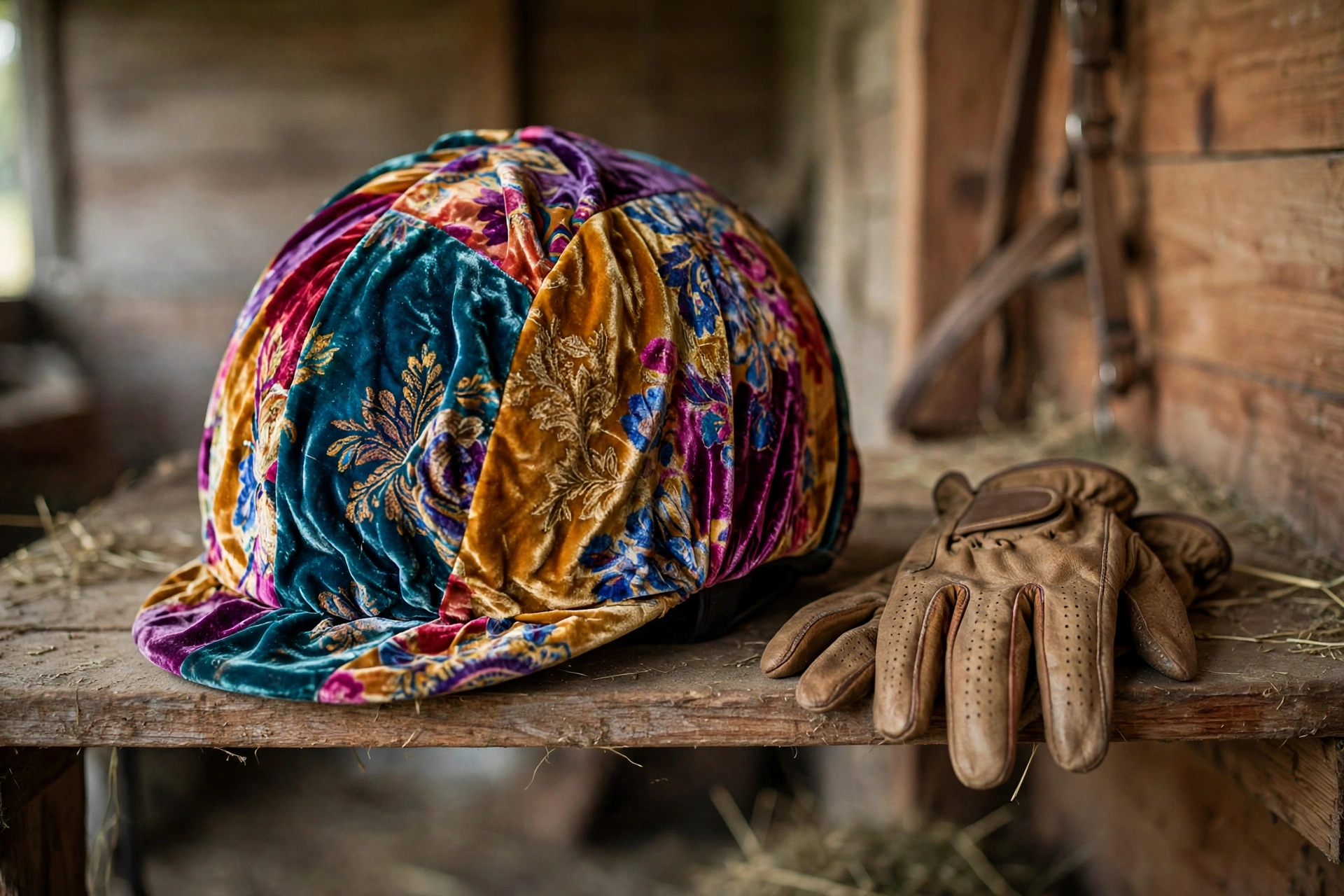
Riding helmet covers and silks are fabric covers that slip over a helmet — most often a peakless skull cap — to add colour, team or racing identity, a smart traditional finish, and a layer of protection against scuffs, sun, and weather. They change how a helmet looks, not how it protects: the certified helmet underneath does all the safety work, and the cover simply dresses it.
This guide explains the difference between covers and silks, when riders use them, and how to fit one without upsetting the helmet underneath.
What Is the Difference Between a Helmet Cover and a Silk?
The words overlap, and riders use them loosely. In general terms, “silk” is the traditional British term for the coloured cover worn over a jockey skull cap — originally silk, now usually nylon, lycra, or satin-effect fabric — most familiar from racing colours and eventing cross country. “Helmet cover” is the broader term, covering everything from those silks to insulated winter covers, waterproof covers, and hi-viz covers for road work.
Most covers share the same construction: a shaped fabric cap that stretches or ties over the shell, often with a small button or pommel at the crown, and — on covers made for skull caps — a soft, flexible peak or a short brim sewn in. Because a skull cap has no peak of its own, the cover supplies the finished look, which is why silks and skull caps are almost always seen together.
Covers are also made for peaked helmets: velvet covers give schooling helmets a traditional show finish, and plain stretch covers protect a good helmet’s shell during everyday use. If it fits over a helmet and comes off again, it is a cover, whatever the shop calls it.
Why Do Riders Wear Covers and Silks?
Identity is the oldest reason. Racing silks carry the owner’s colours so a horse can be followed in a field; eventers match their silk to their cross-country colours; pony club and team riders match each other. A cheap fabric cover turns a standard black skull cap into part of a coordinated outfit, and swapping covers is far cheaper than owning several helmets.
Protection of the helmet itself is the everyday reason. Covers take the scuffs, scratches, stable-yard dust, and sun exposure that would otherwise age the shell’s finish, and a grubby cover can be washed or replaced for little money while the helmet underneath stays presentable for years. Velvet show helmets in particular are often just good helmets kept smart under a cover.
Function is the third reason. Covers come with ear flaps and fleece lining for winter, in hi-viz with reflective trim for hacking on roads, and in waterproof fabrics for wet weather.

Do Helmet Covers Affect Safety or Competition Rules?
A correctly fitted fabric cover does not change the helmet’s protective performance — it is a thin layer over the shell, and it does not interfere with the foam, the harness, or the fit. What officials care about is the helmet underneath: it must be certified to an accepted standard, correctly fitted, with the harness fastened. In general terms, competition rules govern the helmet, and covers and silks are treated as dress — permitted, and in racing and eventing, expected.
Two cautions keep that true. First, never wear anything under the cover that changes the fit — no padding, no folded material, nothing trapped between cover and shell that lifts or shifts the helmet. Second, if a cover has a peak, it must be the soft, flexible kind supplied for the purpose; rigid peaks are not acceptable on a skull cap in most disciplines, because a stiff peak can lever the helmet in a fall.
This is also the moment to remember what the cover cannot hide: damage. If a helmet has taken a fall or a hard knock, a fresh silk does not restore it. Inspect the helmet itself regularly — shell, foam, and harness — and replace it when its condition or age says so, whatever the cover looks like.
How Do You Fit a Cover Correctly?
Start with the helmet on its own, fitted properly. Pull the cover over the shell evenly, working it down so the fabric sits smooth with no bunching, and line up any peak so it sits straight and level with the helmet’s brim line. Ties, elastic, or hook-and-loop fastenings go under the back edge or around the harness as designed — follow the maker’s arrangement rather than improvising knots near the straps.
Then re-check the whole setup on your head: helmet level, harness fastened, shake test. The cover should not creep, twist, or flap at speed; a cover that rotates on the shell is the wrong size for that helmet. Covers are sold in helmet sizes and shapes for a reason — a skull cap cover will not sit right on a peaked helmet, and vice versa.
Fit matters in the details, too: make sure the cover does not cover the certification label permanently — you may need to show it to an official — and that none of the fabric fouls the harness buckles or the rotational liner’s ability to move where a helmet has one. If you are unsure how that liner works, this overview of what MIPS is for helmets explains why nothing should jam the layers inside a helmet.
How Do You Care for Covers and Silks?
Covers are the washable part of the partnership, which is the point. Most fabric covers can be hand-washed or machine-washed gently with mild detergent and air-dried; check the label, especially for velvet and satin finishes, which mark easily. Wash them before they get grim — sweat and arena dust ground into a cover transfer straight onto the shell and harness underneath.
Inspect covers as you wash them. Torn elastic, worn ties, and thinning fabric mean the cover will slip or bunch at exactly the wrong moment, and since covers are inexpensive, replacement beats repair. Keep a spare: riders who compete carry a clean silk in the lorry so a muddy cross-country round does not mean a grubby cover for the next phase.
Store covers off the helmet if the helmet is being stored long-term, so any residual damp in the fabric is not held against the shell, and keep both somewhere cool and dry. Treated this way, a good helmet outlives several covers.
Frequently Asked Questions
Q: Can I wear a silk over any riding helmet?
A: Silks are designed for peakless skull caps, and that is where they fit best. Covers for peaked helmets exist too — buy the type made for your helmet’s shape and size. A cover that twists, bunches, or will not sit smooth is the wrong type, whatever the colour.
Q: Does a helmet cover make the helmet safer?
A: No — and it does not make it less safe either, provided it is a proper fabric cover fitted smoothly. All the protection comes from the certified helmet underneath. A cover’s safety contribution is indirect: it protects the shell’s finish from sun and scuffs, and hi-viz versions make you easier to see on the road.
Q: Do I need a cover for competing?
A: It depends on the discipline. Racing and eventing cross country are traditionally ridden in a skull cap with a silk, and teams often require matching colours. Dressage and show jumping are usually ridden in a peaked helmet with no cover needed. Check your discipline’s dress rules — the helmet’s certification is always required; the cover is dress.

Olivia
Writer at Helmet Today, covering helmet reviews, fit and riding safety.