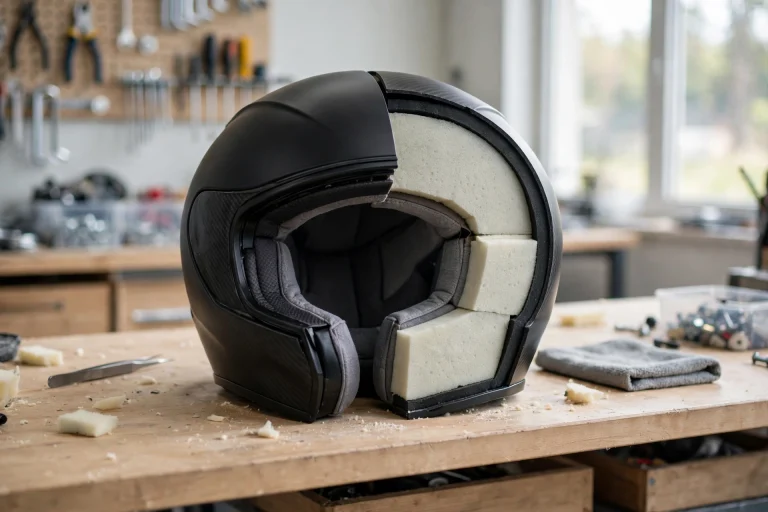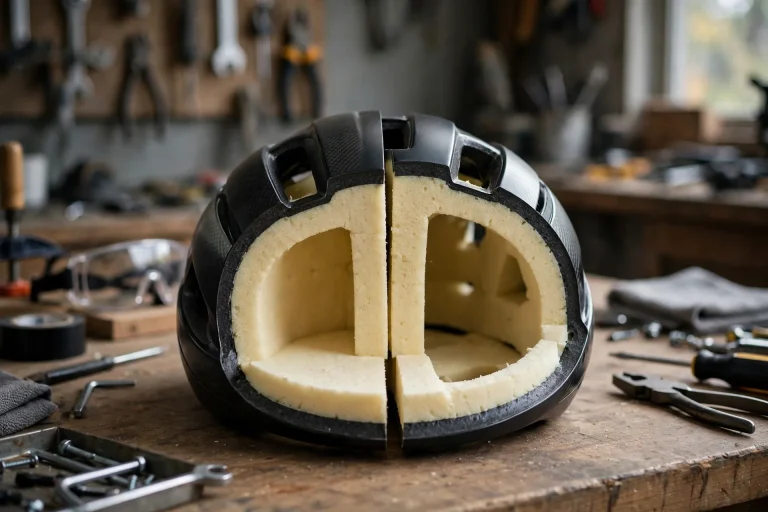
Rotational force in a helmet crash is the twisting force that turns your head suddenly when you hit the ground at an angle, and it can strain the brain even when the straight-line impact is cushioned by the helmet. Most real crashes are not straight on: the head usually strikes the ground at an angle, and that angled hit makes the head spin as well as stop. That spin, or rotation, is what rotational force describes, and it is one of the main ways a crash can injure the brain.
In general terms, a helmet deals well with a direct, straight-line impact, because its foam liner crushes and slows your head down. Rotational force is harder to deal with, because it comes from the angle of the hit rather than the speed alone. That is why helmet makers have spent years working on ways to reduce the twisting forces that reach the head, and why it matters when you choose a helmet.
What is rotational force?
Rotational force is the force that makes something spin. In a helmet crash, it happens when the head hits a surface at an angle, so part of the impact pushes the head sideways as well as slowing it down. Imagine dropping a ball straight down onto the floor, and then throwing it at the floor at an angle: the straight drop stops the ball, while the angled throw makes it spin and skid. Your head behaves in a similar way.
When your head spins suddenly, your brain, which floats inside the skull in a layer of fluid, can twist and stretch. That twisting can strain the delicate tissues of the brain, even if the skull itself is not damaged. In general terms, rotational force is a key part of why angled impacts can be serious, even when the helmet’s foam has done its job.
How does rotation happen in a real crash?
Rotation happens in a real crash because most falls are angled. A cyclist who falls off a bike usually hits the ground at an angle, not straight down, and a rider thrown from a horse lands in a tumble rather than a neat drop. The ground catches the helmet and slows it, while the head and body keep moving, and the difference between the two creates a twist.
The surface matters too. A rough surface can grip the helmet and increase the twist, while a smooth surface lets the helmet slide and reduces it. The speed of the fall, the angle of the impact, and the shape of the helmet all affect how much rotation happens, which is why two crashes that look similar can have very different results.

Why is rotational force a problem for the brain?
Rotational force is a problem for the brain because the brain is soft and is not fixed firmly inside the skull. When the head twists suddenly, the brain can lag behind and then twist inside the skull, which stretches the nerve fibres that carry signals through the brain. That stretching can damage those fibres, even when there is no cut or bruise on the outside of the head.
In general terms, a straight-line impact mainly pushes the brain against the inside of the skull, while a rotational impact twists it. Both can cause injury, but twisting injuries are often harder to see and can affect memory, balance, and concentration. That is why reducing rotation has become a focus for helmet designers in recent years.
How do helmets reduce rotational force?
Helmets reduce rotational force in a few ways. A smooth outer shell helps the helmet slide along the ground instead of catching, which lowers the twist. A rounder helmet shape also helps, because it is less likely to snag on the surface. Some helmets add a special low-friction layer inside, which lets the helmet move slightly relative to the head during an angled impact, so less of the twist is passed on to the brain.
One well-known example of that idea is MIPS, a system that allows a small amount of movement between the helmet and the head. In general terms, these systems do not remove rotation entirely, but they can reduce how much of it reaches the brain, and they are now found in many bike, ski, and climbing helmets.
What should you look for when buying a helmet?
When you buy a helmet, look for one that fits well, meets a recognised safety standard, and suits the activity you do. A good fit matters most, because a helmet that is loose or sits too high will not protect you properly, whatever else it has inside. Check that the shell is smooth, the straps are strong, and the fit system holds the helmet steady when you shake your head.
Ask whether the helmet includes a system designed to reduce rotational forces, and consider it as one factor among others, alongside fit, comfort, ventilation, and weight. A helmet with such a system is not a substitute for a good fit or for riding carefully, but it can add an extra layer of protection in an angled crash.
Does a helmet remove all rotational force?
No, a helmet cannot remove all rotational force, because the twist comes from the angle and the speed of the crash, which the helmet cannot change. What a helmet can do is reduce the forces that reach your head, both straight-line and rotational, and lower the risk of a serious injury. In general terms, a good helmet makes a crash less harmful, but it does not make a crash harmless.
That is why the best protection is a combination of things: a well-fitting helmet, a sensible speed, and care about where and how you ride. Replace your helmet after a hard impact, check it regularly for damage, and wear it every time. The helmet is there for the crash you do not expect, and the one you cannot plan for.
Is rotational force the same as a direct impact?
No, a direct impact pushes the head straight back, while rotational force twists it. In general terms, most real crashes involve both, because the head usually hits the ground at an angle rather than straight on.
Do all helmets protect against rotation?
All helmets reduce some of the twisting force by letting the shell slide on the ground, but only some have a special layer or system designed to reduce it further. Check the helmet’s description, or ask the shop, if this matters to you.
Should I replace a helmet after an angled crash?
Yes, in general terms a helmet that has taken a hard impact, angled or straight, should be replaced. The foam liner may have crushed even if the shell looks fine, and it cannot absorb a second impact in the same way.

Olivia
Writer at Helmet Today, covering helmet reviews, fit and riding safety.