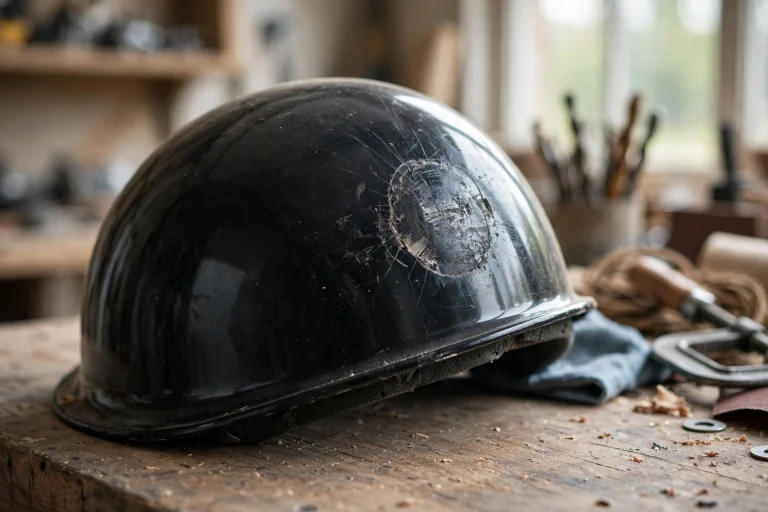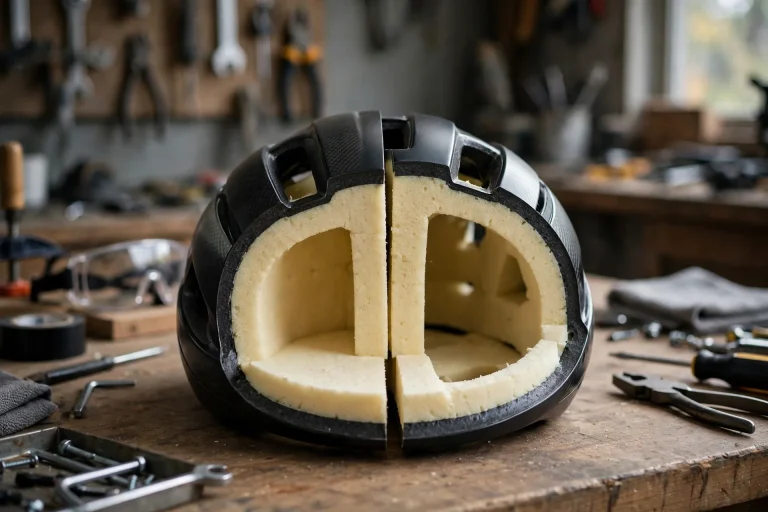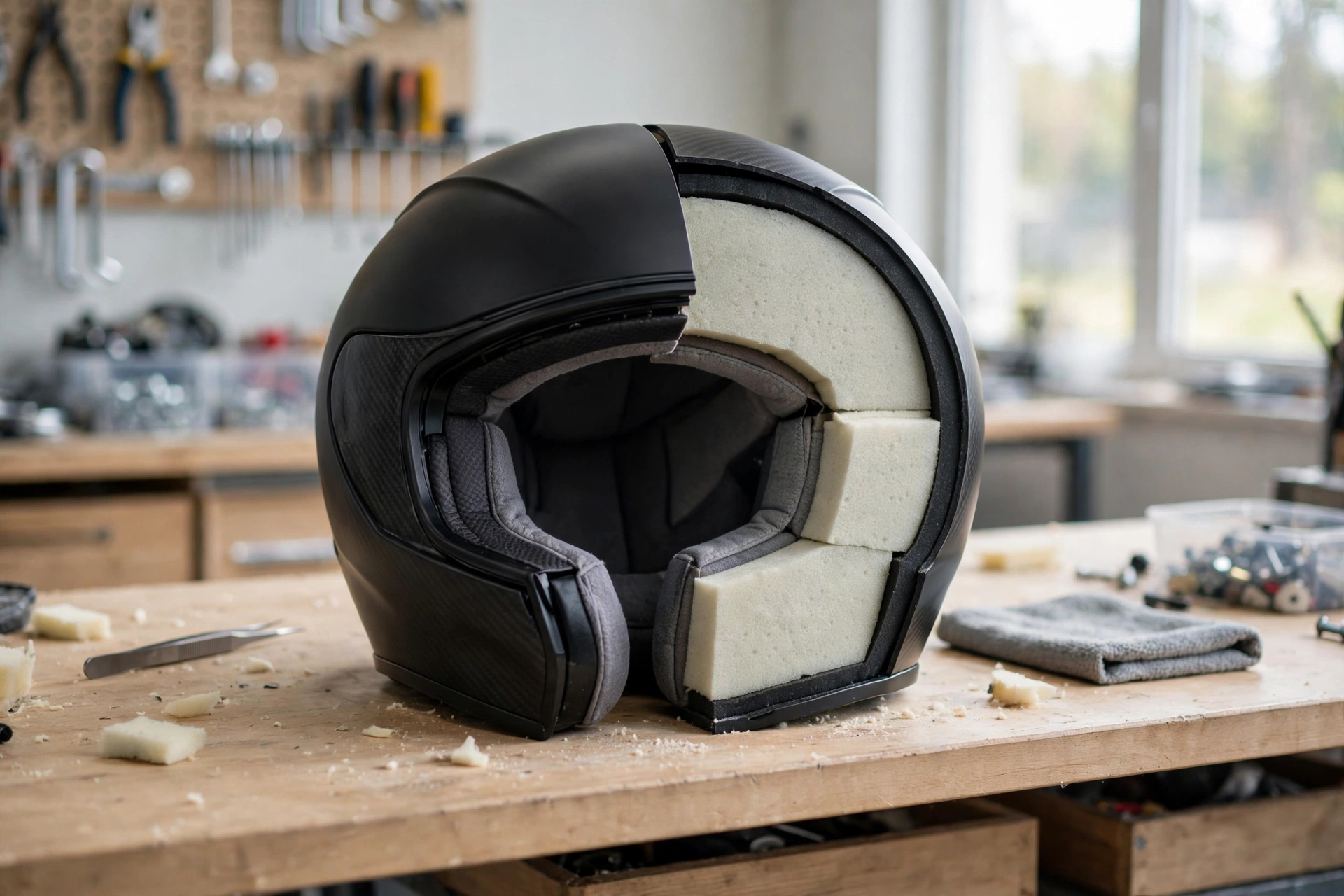
Inside a helmet during a crash, the hard outer shell spreads the force of the impact over a wider area, while the foam liner inside crushes slowly to slow your head down more gently. In a fraction of a second, the helmet takes the sharp, sudden energy of the impact and turns it into a longer, softer stop for your head. That is the whole job of a helmet, and it all happens in the layers between the outside world and your skull.
Most of this work is invisible. From the outside, a crash looks like a single violent moment, but inside the helmet a sequence of small jobs happens one after another. The shell meets the surface first, the liner absorbs the energy, and the comfort padding and fit system keep the helmet in place so those layers can do their work. Understanding what happens inside helps you see why a helmet that looks fine after a crash may still need replacing.
What does the shell do first in a crash?
The outer shell is the first part of the helmet to meet the impact, and its job is to spread the force out. When a helmet hits a hard surface, all of the energy is concentrated at one small point of contact. The stiff shell takes that focused force and shares it across a much wider area of the helmet, so the liner underneath is not hit by the full force in one spot.
The shell also protects the softer layers inside from being cut or pierced, and it helps the helmet slide along a surface instead of catching and snagging. In general terms, a smooth, hard shell is better at glancing off a surface, which can reduce the twisting forces that reach your head. The shell does not absorb much energy itself, but without it the liner would be overwhelmed in one place.
What happens to the foam liner during a crash?
Under the shell sits the foam liner, and this is the part that does most of the energy absorbing. When the impact reaches the liner, the foam crushes in a controlled way, collapsing cell by cell. As it crushes, it soaks up energy and slows your head down over a short distance instead of letting it stop all at once.
This crushing is permanent. The foam does not spring back to its original shape once it has been compressed in a crash, which is why a helmet that has taken a hard hit should be replaced even if the outside looks undamaged. The liner has already spent its ability to absorb energy, and it cannot do the same job a second time.
How does the helmet slow your head down?
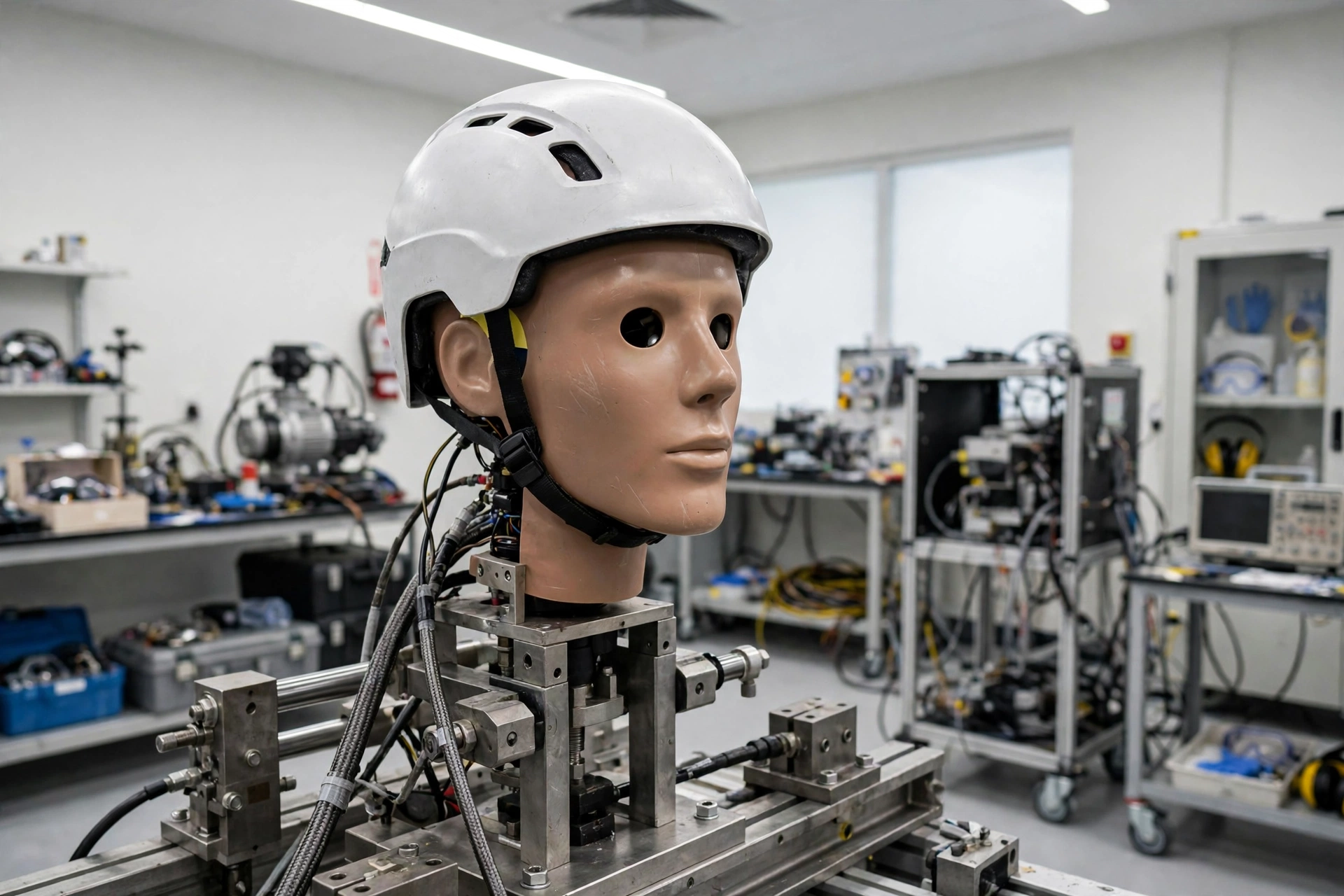
Your head is moving fast when it hits something, and stopping it suddenly is what causes injury. The helmet works by stretching that stop out over a longer distance and a slightly longer time. The foam liner gives your head a cushion to travel into, so instead of hitting a hard stop, it comes to rest more gradually.
Think of it like landing on a thick mattress instead of a bare floor. The mattress gives way under you and slows you down gently, while the floor stops you at once. The foam in a helmet works in the same way, on a smaller scale and in a fraction of a second. The longer and smoother the slowdown, the less force your brain has to deal with.
What about twisting forces in a crash?
Not every crash is a straight-on hit. Many impacts are glancing blows, where the helmet strikes a surface at an angle and starts to twist. That twisting can pass rotational force to the head, and the brain is sensitive to that kind of movement. In general terms, a helmet that can let the head move slightly inside the shell, or let the shell rotate a little on its own, can reduce the twisting force that reaches the brain.
Some helmets include a low-friction layer or a system designed for this purpose, such as MIPS, which allows a small amount of movement between the helmet and the head during an angled impact. The shell and liner still do the main work of spreading and absorbing the force, but this extra movement helps deal with the twist that a straight-on design cannot handle alone.
What happens to the helmet after the crash is over?
Once the impact is over, the helmet will usually show signs of the work it has done, but not always in obvious places. The shell may be scratched, cracked, or dented, and the liner may be compressed in the area of the impact. Sometimes the damage is hidden under the shell or inside the foam, where you cannot see it without taking the helmet apart.
The straps and buckles may also have been stressed, and the fit system can be bent or loosened. Even if the helmet looks almost as good as new, the liner may have crushed in the spot that took the hit. That is why safety advice is consistent: a helmet that has been in a crash should be replaced, because you cannot tell from the outside how much of its protection has been used up.
Why does a crashed helmet need replacing?
A helmet is designed to protect you once, in one serious impact. The foam liner crushes to absorb energy, and once crushed it stays crushed. Wearing the same helmet again after a crash means the liner in that spot is already compressed, so it has less room left to slow your head down in a second crash.
Replacing a crashed helmet is not about the shell looking damaged. It is about the hidden liner, which is the part that does most of the protecting. A new helmet gives you a fresh liner with its full cushioning intact, and that is the safest way to ride, work, or play again. If you are unsure whether an impact was hard enough to matter, it is better to replace the helmet than to risk it.
Can you see what happens inside a helmet during a crash?
Not usually. The shell hides the liner, so most of the crushing happens out of sight. Cuts or cracks in the shell and dents in the liner are the visible clues, but a lot of the damage can be hidden.
Does the foam liner bounce back after a crash?
No. The foam is designed to crush permanently as it absorbs energy. Once it has been compressed in a crash, it does not return to its original shape or thickness.
Is a helmet still safe after a small knock?
A light knock, such as dropping a helmet from a low height onto a soft surface, is not the same as a crash. In general terms, a hard impact that involves your head should be treated as a crash, and the helmet should be replaced.

Olivia
Writer at Helmet Today, covering helmet reviews, fit and riding safety.