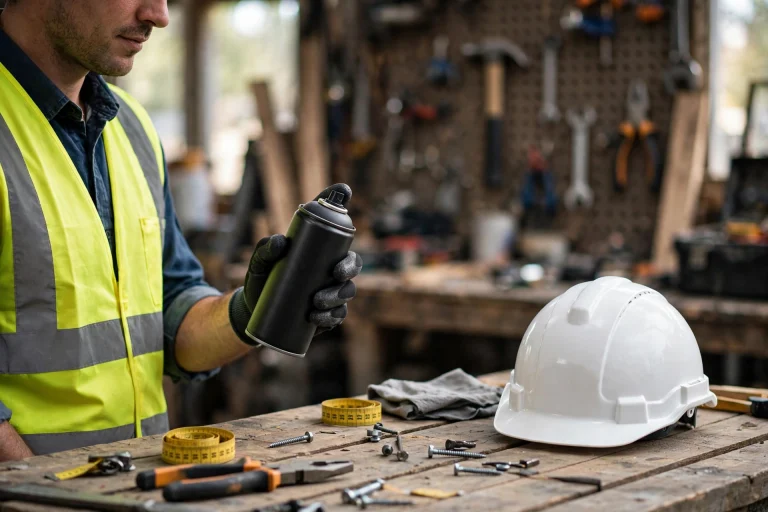
A bump cap is not enough protection whenever there is any risk of falling objects, swinging loads, electrical contact, or a serious fall — in short, on almost any construction site. Bump caps protect only against minor knocks when you bump your own head into a fixed object, and in general terms they are not safety helmets and are not tested to hard hat standards. If the hazard comes to you, rather than you walking into it, you need a hard hat.
Bump caps look reassuringly helmet-like, and they are genuinely useful in the narrow range of work they were made for. The danger is wearing one where the risk is bigger than the cap. This guide explains where the line sits and how to judge which side of it your work is on.
What Is a Bump Cap Actually Designed to Do?
A bump cap is a lightweight cap — often styled like a baseball cap — with a plastic shell or insert hidden inside it. Its job is to protect your scalp from cuts, scrapes and painful knocks when you walk into a low pipe, catch the edge of a shelf, or rise up under a machine or vehicle you are working beneath.
Notice the direction of the force in every one of those examples: it is your own head, moving at your own walking pace, meeting something stationary. That is a low-energy bump, and it is the only kind of impact a bump cap is built to soften. The thin shell spreads the contact enough to stop a sharp edge from cutting you, and that is all it is asked to do.
Bump caps are tested, where they are tested at all, to a much lighter standard than hard hats. They have no rated suspension system to absorb a heavy blow, no tested resistance to falling objects, and no electrical class. Confusing the two is easy because they sit in the same catalogues — but they are different tools for different risks.
When Do Falling Objects Rule Out a Bump Cap?
Anywhere something can fall on you. That includes construction sites at almost every stage, work below scaffolding or overhead trades, warehouses with high racking where items can be dislodged, and loading areas where loads move above head height. A falling tool or fitting arrives with far more energy than a bump cap can handle.
A hard hat is built for exactly this: a rigid shell to resist penetration and a suspension that holds the shell away from your head so the force is absorbed and spread. A bump cap’s insert sits close against the head with nothing behind it to manage that energy, so the blow passes through almost undiminished.
The practical rule is simple. If you can look up and see work, storage, or loads above you, a bump cap is the wrong headwear — no matter how light the task in your hands feels.

When Do Other Hazards Rule Out a Bump Cap?
Falling objects are not the only disqualifier. Work around swinging or suspended loads, moving plant, or vehicles that could strike you at head height can deliver side blows a bump cap is not rated for. Work where you yourself could fall — from height, or even a hard fall at ground level onto concrete or steel — puts forces through your head that demand a real helmet.
Electrical hazards rule a bump cap out completely. Bump caps carry no electrical class rating, and their inserts and fittings are not tested insulation. Anywhere there is a realistic chance of contacting live conductors, you need a hard hat of the correct class.
Weather and visibility matter too, in a quieter way. A bump cap offers no meaningful protection from sun or rain, and although hi-vis versions exist, a bump cap is less visible than a full hard hat — a real consideration around moving vehicles. None of these make a bump cap bad equipment; they simply mark out the jobs it was never meant for.
Who Decides Whether a Bump Cap Is Allowed?
In general terms, your employer does, through its risk assessment and site rules — and on most construction and industrial sites, the answer will be hard hats only, often because insurers, clients or site rules require rated head protection for everyone inside the gate. Individual workers do not get to downgrade their own head protection because a cap feels cooler or lighter.
Where bump caps are permitted, it will be in defined, controlled areas: workshops, plants and warehouses where the only head hazard is fixed, low-level obstructions, and where falling-object risk has been assessed and ruled out. If your work takes you out of that area into a general site, the cap has to be swapped for a hard hat at the boundary.
If you are ever unsure, ask your supervisor or safety officer before starting, and default to the hard hat. Nobody was ever injured by wearing more protection than a task turned out to need, and the reverse calculation goes wrong in hospital corridors.
How Does a Bump Cap Compare With a Real Helmet?
The gap between a bump cap and a hard hat mirrors gaps elsewhere in head protection. A bicycle helmet, for example, looks light and casual but is engineered and tested to absorb a crash, with a crushable liner and, in many models, systems to reduce rotational forces — our guide to what MIPS means in a helmet covers how that works. Lightness alone does not tell you how much protection you have; the testing behind the product does.
A bump cap sits at the far end of that scale: honest protection against a narrow, low-energy hazard, and nothing beyond it. A hard hat is tested for falling objects, penetration and, by class, electricity. The two are not rivals at different prices — they answer different questions.
So read the job, not the shelf. If the worst credible event is a bumped forehead on a low beam, a bump cap earns its place. If anything heavier can reach your head — from above, from the side, or from a fall — the answer is a hard hat that fits, is in date, and is actually worn.
Frequently Asked Questions
Q: Can I wear a bump cap on a construction site if I am only visiting?
A: In general terms, no — sites that require hard hats require them from everyone inside the area, visitors included, because falling-object risk does not distinguish between staff and guests. Expect to be issued a hard hat at the gate.
Q: Is a bump cap better than nothing?
A: For the knocks it is designed for, yes — it will save you cuts and bruises from low obstructions. But in a hard hat area it is not an acceptable substitute, because it gives a false sense of security against hazards it cannot handle.
Q: How can I tell a bump cap from a hard hat?
A: A bump cap looks like a normal cap with a hidden insert and will not carry hard hat type and class markings. A certified hard hat is a rigid helmet with an internal suspension and a printed label giving its type, class and standard.

Olivia
Writer at Helmet Today, covering helmet reviews, fit and riding safety.