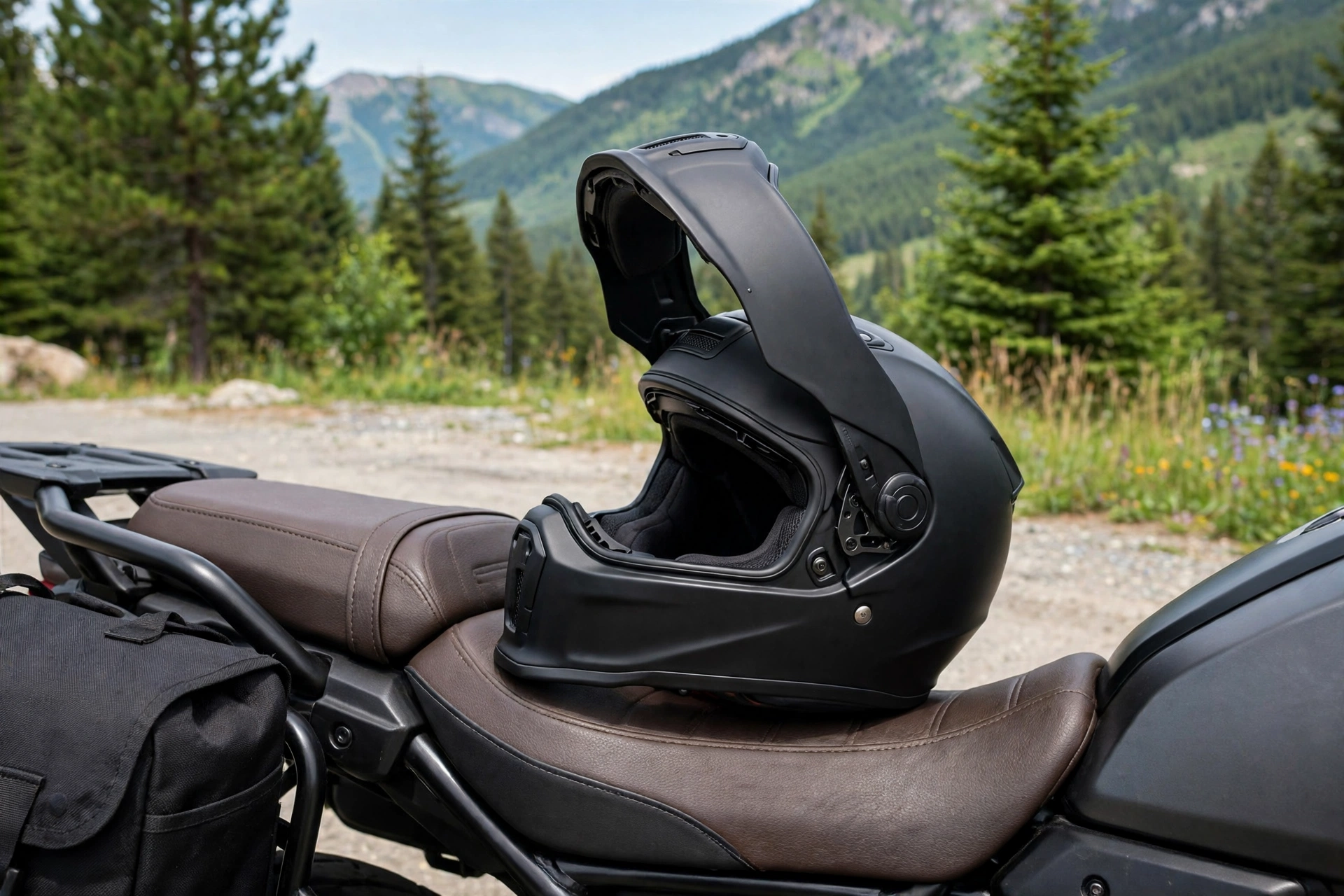
No single person can be credited with inventing the modular motorcycle helmet — in general terms, it developed over time as several makers and designers worked on the same idea: a full-face helmet whose chin bar could flip up so the rider could talk, drink, or get fresh air without taking the helmet off. The modular helmet, also called a flip-up helmet, grew out of the full-face helmet, and its history is a story of gradual improvement rather than a single moment of invention.
That matters, because the modular helmet is now one of the most popular helmet types among touring riders and commuters, and its appeal is easy to understand. It offers the protection of a full-face helmet on the road and the convenience of an open-face helmet at a stop. This guide explains how the design developed, why it took time to catch on, how it works, and what to look for if you are considering one.
What Is a Modular Motorcycle Helmet?
A modular helmet looks like a full-face helmet, with a chin bar that covers the jaw and a visor that covers the eyes. The difference is that the chin bar is hinged, so the whole front of the helmet can be lifted up and locked in place. With the chin bar raised, the rider’s face is open to the air, much like wearing an open-face helmet. With it lowered and locked, the helmet protects the face in the same way as a full-face helmet.
They have to be strong enough to hold the chin bar firmly in place at speed and in a crash, yet easy enough to operate with one gloved hand. Over time, makers improved the hinges, the seals, and the locks until the design felt solid and reliable.
In general terms, the modular helmet sits between two older designs. The open-face helmet came first and left the face exposed. The full-face helmet added the chin bar for better protection but made it harder to talk or eat at a stop. The modular helmet tries to offer both, and that compromise is the reason it exists.
How Did the Modular Design Develop Over Time?
The modular helmet developed gradually, rather than arriving all at once. Once the full-face helmet had become common, riders began asking for a way to open the front without removing the whole helmet, and makers began experimenting with hinged chin bars. Early attempts were often rough: the hinge might be stiff, the chin bar might not lock securely, or the helmet might be noticeably heavier than a standard full-face design.
In general terms, this pattern is common in helmet history. The full-face helmet, the flip-up visor, and the modular chin bar all appeared through gradual development, with makers learning from each other’s work and from rider feedback. That is why it is misleading to name one inventor of the modular helmet: the design is the result of shared progress across the helmet industry over a long period.
Why Did Riders Want a Flip-Up Helmet?
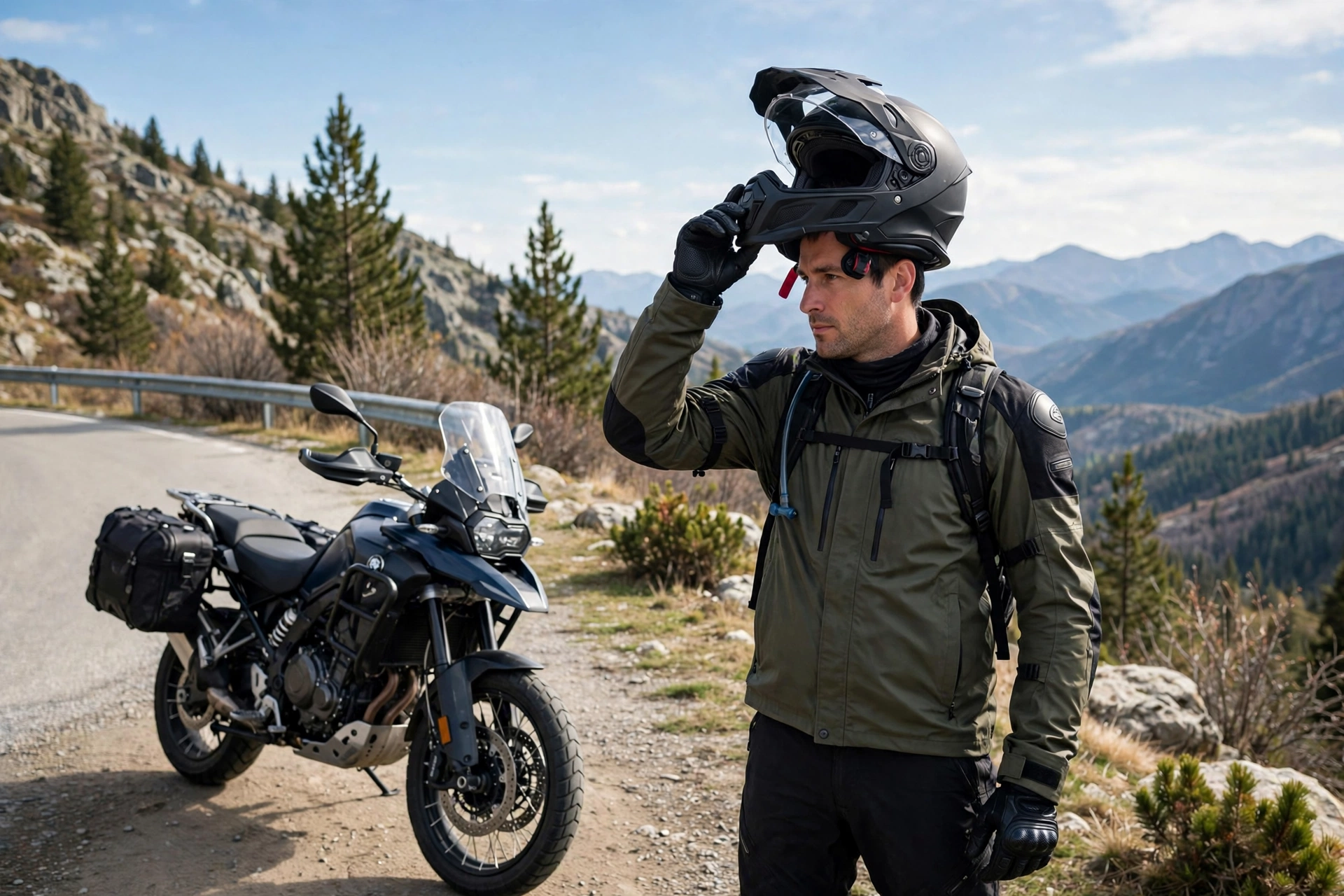
Riders wanted a flip-up helmet for practical reasons. On a long tour, a rider might stop many times a day — for fuel, for food, for directions, or just for a break — and taking a full-face helmet off and putting it back on each time is a nuisance. A modular helmet lets the rider lift the chin bar, talk to someone, have a drink, or cool down, all without removing the helmet. For commuters, the same convenience applies at traffic lights and in car parks.
The design also suits riders who wear glasses, because the open front makes it easier to put the helmet on and take it off without disturbing the frames. It suits riders who ride in hot weather too, since lifting the chin bar at a stop lets in a rush of fresh air. And for riders who use intercom systems or who need to be heard clearly, the open front makes conversation easier without shouting through a closed visor.
How Does the Chin Bar Mechanism Work?
The chin bar on a modular helmet is held by a hinge on each side, usually near the temples, and by a lock that holds it in the closed position. To open it, the rider releases the lock — often with a button or lever at the front — and lifts the chin bar up until it clicks into the open position. To close it, the rider pulls it down until the lock engages. A well-made helmet gives a clear click or feel when the lock is engaged, so the rider knows it is secure.
The mechanism has to deal with wind pressure at speed, so the lock and the hinge must be strong enough that the chin bar cannot be blown open by the slipstream. Makers test this by checking that the chin bar stays closed under force and that it does not move or rattle. The seals around the chin bar and visor also matter, because a gap lets in wind and noise, which can be tiring on a long ride.
What Should You Look for in a Modular Helmet?
When choosing a modular helmet, the first thing to check is the fit. A modular helmet should fit snugly all round the head, without pressure points, and it should not move when you shake your head gently. The chin bar adds weight at the front, so the balance of the helmet matters too: a helmet that feels nose-heavy on a long ride will be tiring, even if the fit is otherwise good.
The second thing to check is the quality of the mechanism. The chin bar should open and close smoothly with one hand, lock with a clear click, and stay firmly shut when you tug on it. The visor should seal well, and the helmet should not whistle or rattle at speed. These are signs that the maker has paid attention to the details that make a modular helmet work in daily use rather than just on a display stand.
It is also worth thinking about how the helmet handles the forces of a crash, because the hinge is an extra part that a standard full-face helmet does not have. Modern modular helmets are built and tested to recognised standards, and the best designs are made so that the chin bar stays in place when it matters most. If you want to understand how helmets manage different kinds of impact energy, reading about what MIPS is for helmets explains one of the technologies used in modern helmet design. In general terms, a good modular helmet is one where the moving parts feel as solid as the fixed parts.
Frequently Asked Questions
Q: Who invented the modular motorcycle helmet?
A: No single inventor can be credited with the modular helmet. It developed over time as several makers worked on hinged chin bars for full-face helmets, improving the hinge, lock, and seals in small steps until the design became reliable and popular.
Q: Is a modular helmet as safe as a full-face helmet?
A: In general terms, a well-made modular helmet worn with the chin bar down and locked offers protection close to a full-face helmet. The chin bar adds moving parts, so the quality of the hinge and lock matters, and the helmet should meet a recognised safety standard.
Q: Can you ride with the chin bar flipped up?
A: Some modular helmets are designed to be ridden with the chin bar open at low speed, but many are meant to be ridden closed. Check the maker’s guidance for your helmet, and in general terms ride with the chin bar down and locked at higher speeds.

Olivia
Writer at Helmet Today, covering helmet reviews, fit and riding safety.