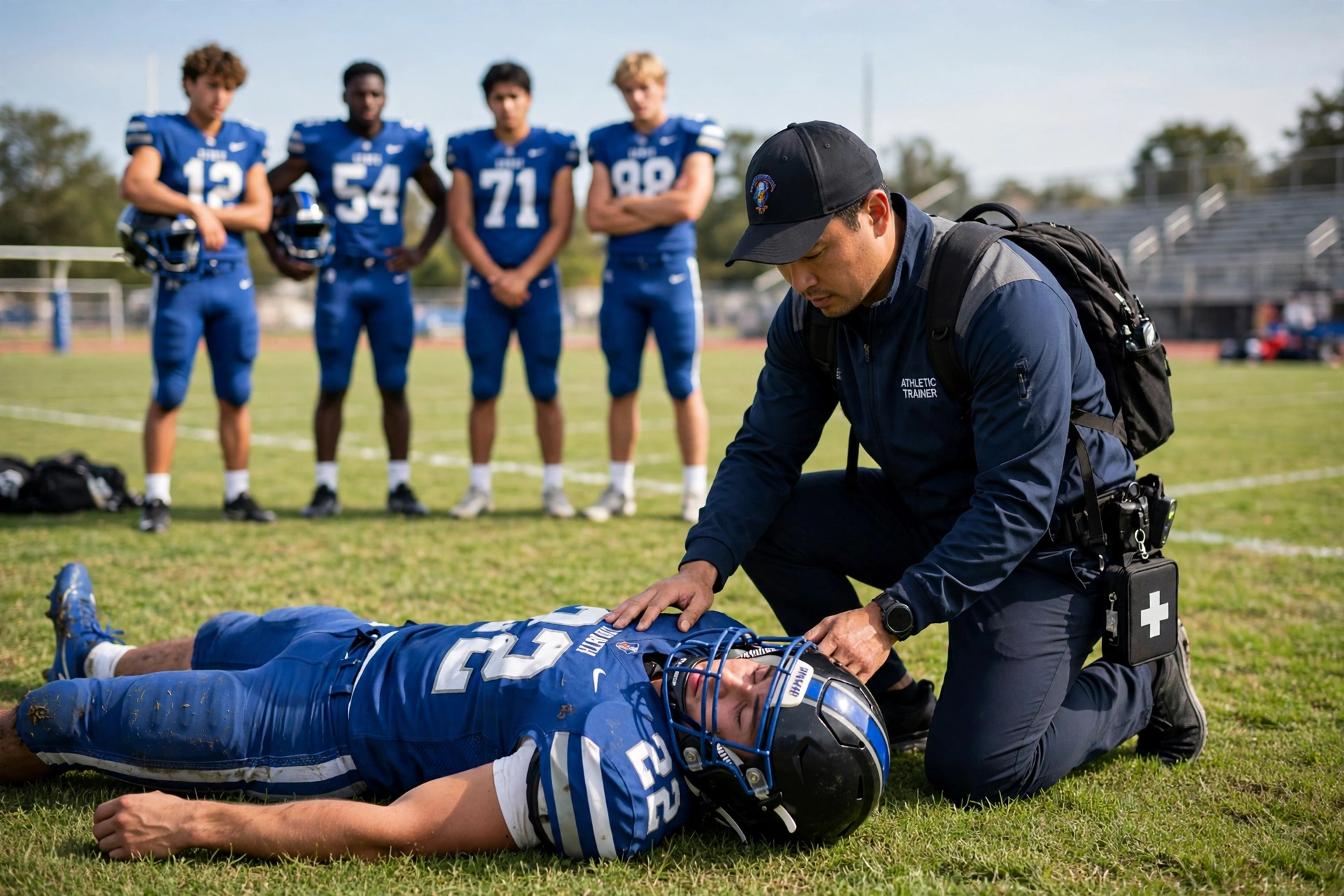
Do not remove an injured football player’s helmet yourself. Unless you are trained medical personnel working as part of a trained response team, removing the helmet can worsen a head or neck injury. Keep the player still, call emergency services, and let athletic trainers, paramedics, or team medical staff handle any helmet or facemask removal.
Why Helmet Removal Is Not a DIY Job
After a heavy collision, the injuries that matter most may be the ones you cannot see. A player may have a concussion, a skull or facial injury, or damage to the neck and spinal cord. A helmet fits closely around the head and works together with the shoulder pads to hold the head and neck in position. Pulling, twisting, or lifting that helmet off without training can move the neck in ways that turn a serious injury into a permanent one.
Trained responders remove helmets rarely, carefully, and for specific reasons, such as when the helmet prevents them from managing the player’s airway or performing resuscitation. Even then, it is a coordinated team procedure, with one person stabilizing the head and neck while others work, and the helmet and shoulder pads handled together so spinal alignment does not change. That is not something a teammate, parent, or spectator can safely improvise.
The urge to take the helmet off can feel like the caring thing to do. Resist it. Keeping the player still, getting trained help fast, and making room for the medical team are far more helpful.
What To Do Instead While Help Is Coming
If you are a teammate, coach, official, or spectator near an injured player, your role is support, not treatment. These steps help the trained responders who are on their way.
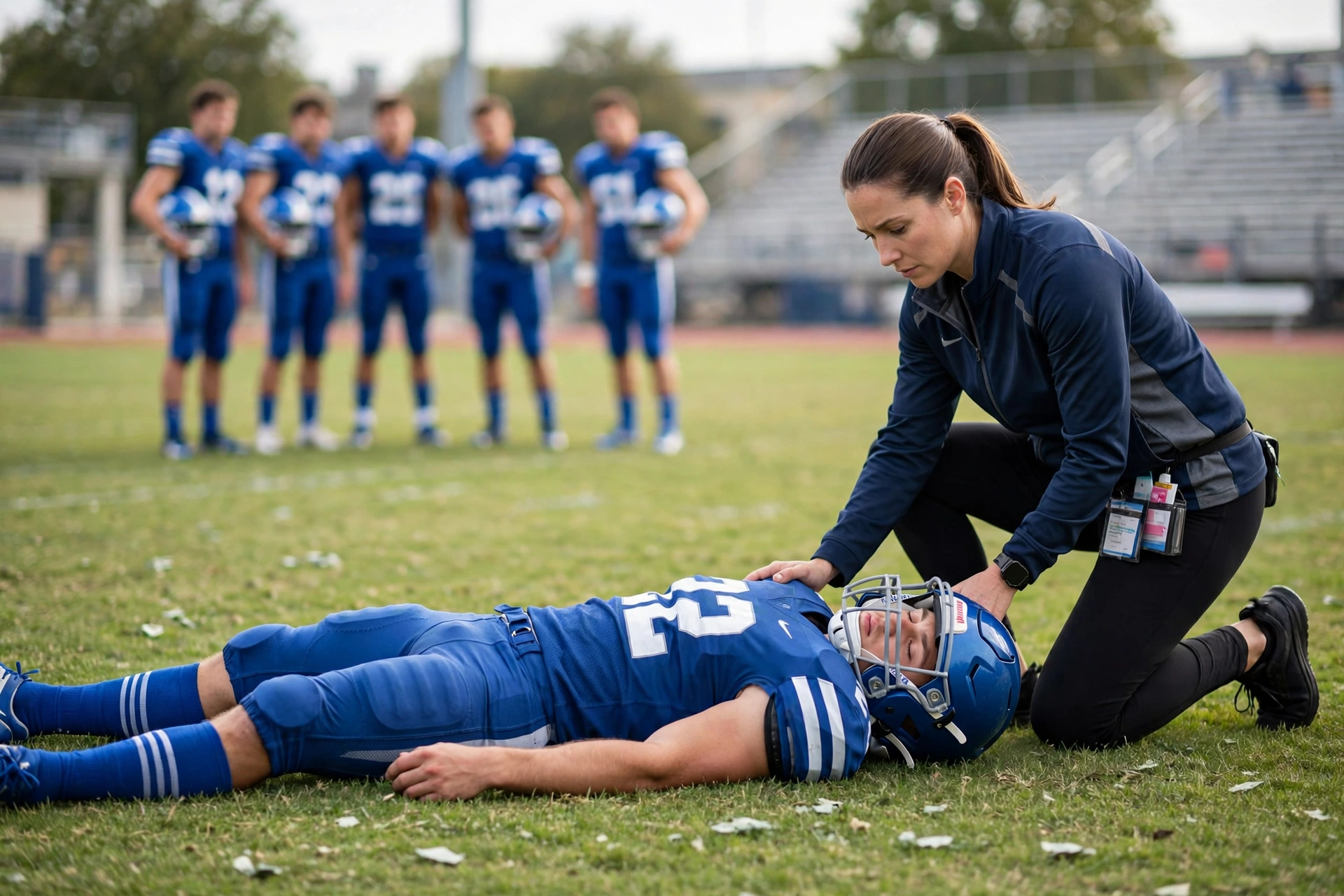
- Stop play and call for the medical team. Alert the athletic trainer and coaches immediately. If the player is unresponsive, not breathing normally, or a neck injury is possible, call emergency services or make sure someone specific has called.
- Keep the player still. Tell them not to try to sit up, stand, or take their own helmet off. Ask them to stay as still as possible until they are assessed.
- Do not move the player. Unless there is an immediate danger such as fire, leave them exactly where they are. Moving a player with a possible spine injury can cause further harm.
- Keep the helmet and pads on. Do not loosen straps, lift the helmet, or remove shoulder pads to make the player more comfortable. Comfort comes second to protecting the neck.
- Clear space around the player. Move teammates and spectators back so trainers and paramedics have room, and send someone to guide the ambulance crew to the right spot on the field.
- Share what you saw. When medical staff arrive, tell them clearly how the injury happened, whether the player lost consciousness, and any symptoms the player mentioned. That information genuinely helps their assessment.
If the player is not breathing, trained responders will begin resuscitation and direct anyone helping them. Follow their instructions exactly and do only what they ask.
How Trained Responders Handle the Facemask and Helmet
There is one part of the helmet that trained staff may remove on the field: the facemask. If responders need access to the player’s airway, a trained athletic trainer or paramedic can remove the facemask using a purpose-made cutting or unscrewing tool, while another responder holds the head and neck perfectly still. Removing the facemask gives access to the mouth and airway while the helmet itself stays in place, which is exactly why many programs practice this procedure and keep the tools on the sideline.
Full helmet removal follows strict protocols taught in sports medicine training. It involves multiple trained people, manual stabilization throughout, and removing the helmet and shoulder pads together, or cutting equipment away, so spinal alignment is preserved. Reading about this process is not training, and it should never be attempted by untrained people copying steps they saw online.
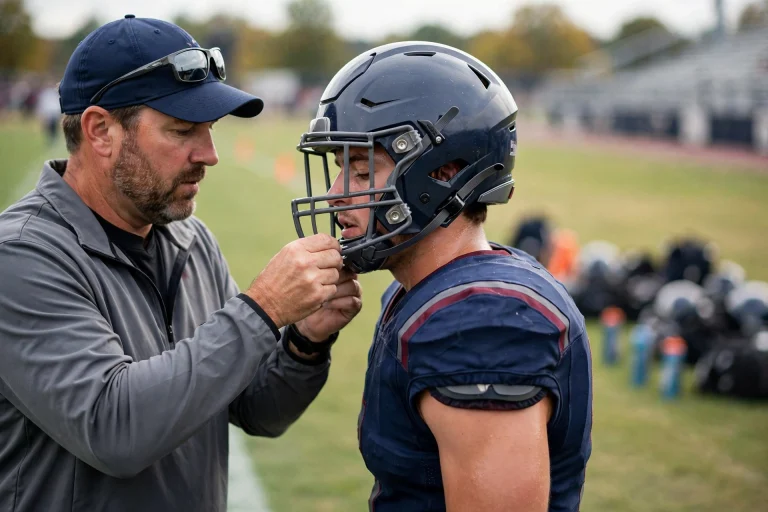
Well-fitted equipment matters long before any injury. A helmet with a strap secured as shown in guides on how to attach a chin strap to a football helmet supports the medical team’s work if they ever need to manage the equipment under pressure.
Warning Signs That Mean an Emergency
Some symptoms after a head impact should always be treated as an emergency, whether the player is still on the field or already on the sideline. Call emergency services and seek immediate medical assessment if a player shows any of the following.
- Loss of consciousness, even briefly, or being unresponsive.
- Trouble breathing, or a blocked airway.
- Neck pain, tenderness, or pain and weakness or numbness in the arms or legs.
- Seizure, repeated vomiting, or a headache that keeps getting worse.
- Confusion that is deepening, slurred speech, or behavior that seems very wrong to people who know the player.
- Clear fluid from the nose or ears, unequal pupils, or obvious deformity of the head or neck.
Do not let a player talk you out of calling for help because they want to return to the game. A player with a head or neck injury is not a reliable judge of their own condition, and returning to play is a medical decision, never a toughness test. When in doubt, sit them out and get them assessed. There will always be another game; spinal and brain injuries do not offer the same second chances.
What Coaches, Parents, and Teams Should Prepare
The time to think about helmet removal is before the season, not during a crisis. Schools and leagues should have a written emergency action plan for each venue, with roles assigned: who calls emergency services, who meets the ambulance, who brings the facemask removal tool and medical kit, and who manages the crowd. Trainers and coaches should rehearse this plan, including facemask removal practice, so the real event is not the first attempt.
Parents can ask at the start of the season: Is there an athletic trainer at games? Is there an emergency plan? Is there a defibrillator at the field, and do staff know where it is? This is the same preparation a good program puts into any part of player safety.
Players have a part, too. Report symptoms honestly, never hide a possible concussion to stay in a game, and learn now that beside an injured teammate, the right move is to keep them still and call for the trainer, not to touch their helmet.
Frequently Asked Questions
Should I ever remove an injured player’s helmet myself?
No, not if you are untrained. Helmet removal after a possible head or neck injury should be done only by trained medical personnel, working as a team, when there is a clinical reason. Keep the player still, keep the helmet on, and call for emergency help.
Can the facemask be removed instead of the helmet?
Yes, and that is the usual approach when airway access is needed. A trained responder can remove the facemask with a special tool while the helmet stays on and another responder stabilizes the head and neck. This, too, is a trained procedure, not a job for bystanders.
What if the player wants to take their own helmet off?
Ask them to stay still and leave it on until medical staff assess them. A player may feel hot, sick, or panicked and want the helmet off, but after a serious impact that decision belongs to the trainer or paramedics, who can judge whether it is safe.

Olivia
Writer at Helmet Today, covering helmet reviews, fit and riding safety.