


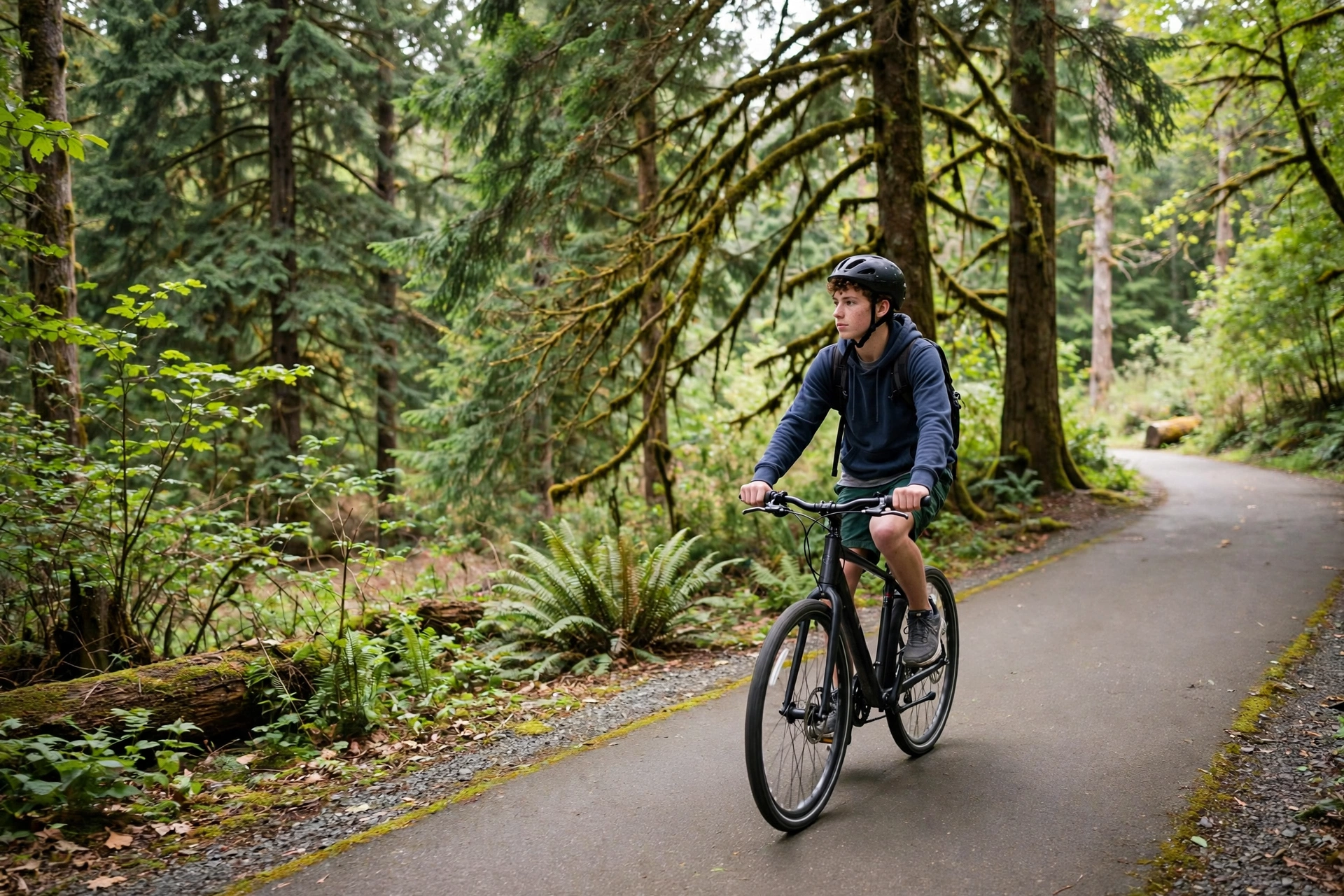
Oregon law requires every bicycle rider and passenger under the age of 16 to wear a helmet. The rule applies when riding on public roads and on premises that are open to the public, such as bike paths and public trails. Adults and riders age 16 and older are not required by Oregon law to wear a bicycle helmet.
Oregon’s under-16 cutoff is one of the higher age limits in the country, so teenagers who would be exempt in other states still need a helmet here. Here is how the requirement works in practice.
What is the bicycle helmet age requirement in Oregon?
Anyone under 16 must wear a helmet while operating a bicycle or riding as a passenger on one, as long as they are on a public roadway or on premises open to the public. That covers streets, highways, shared-use paths, and most public riding areas in Oregon cities and towns.
The law does not apply on private property. A child riding only in your own driveway or yard is not covered by the state requirement, though most safety experts would still insist on a helmet for every ride, since many falls happen close to home at low speed.
Oregon’s age limit also matters for visiting families. A 14- or 15-year-old who rides legally bare-headed at home may be required to wear a helmet the moment they ride in Oregon, because the law follows the rider’s age and the place, not the rider’s home state. If your family travels to Oregon with bikes — for the coast, the Gorge, or a city break in Portland — pack helmets for everyone under 16. The same logic applies to rental bikes: Oregon shops will expect young riders to be helmeted, and many include a helmet with youth rentals for exactly this reason.
Does the law cover passengers and younger children?
Yes. The under-16 rule includes children riding as passengers, whether they are in a mounted child seat or another passenger arrangement. If the passenger is under 16, a helmet is required on public roads and public premises, just as it is for the person pedaling.
Parents should make sure a child’s helmet genuinely fits before relying on it. The helmet should meet the U.S. CPSC safety standard, sit level on the head, and stay in place when the child shakes their head with the strap fastened. A loose helmet can shift or come off in a fall, which defeats the purpose of wearing one.
Are there any exceptions to Oregon’s helmet rule?
Oregon’s law includes a narrow exemption for a person whose religious beliefs or practices make wearing a helmet impractical, and the general private-property limitation described above. Beyond that, the rule is broad: if your under-16 child is riding on public roads or public-use land anywhere in Oregon, plan on a helmet.
It is also worth remembering that Oregon’s bicycle helmet rule is separate from its rules for other devices. E-bikes, mopeds, and motor-assisted scooters can fall under different helmet requirements in Oregon, so check the specific rule if your teenager rides something with a motor. For a wider view of how states differ, see our overview of what states have helmet laws.
What is the penalty for breaking Oregon’s bicycle helmet law?
Violating Oregon’s bicycle helmet requirement is a traffic violation that carries a small fine — it is treated as a minor, Class D level offense, and the exact amount can vary. In practice, enforcement tends to emphasize safety education, especially for younger riders, but the citation is real and parents can be the ones dealing with it.
More importantly, the cost of skipping a helmet is measured in injury risk, not dollars. A properly fitted helmet greatly reduces the chance of a serious head injury in a crash, which is reason enough to follow the rule every time. Parents should also know that Oregon’s rule follows the child onto school grounds, park programs, and organized rides, where staff will typically require helmets for anyone under 16 as a matter of policy on top of the law itself.
How should parents handle the age-16 cutoff?
When an Oregon teen turns 16, the legal requirement ends, but the risk does not. Riders in their late teens often travel faster, ride farther, and mix with traffic more than younger children. Parents can keep helmets normal by setting a family rule that outlasts the legal one: anyone riding from the house wears a helmet, whatever their age.
Letting an older teen choose their own well-fitting, good-looking helmet also helps. A helmet they picked themselves is far more likely to be worn than one imposed on them.
Getting the fit right matters just as much as wearing the helmet at all. An Oregon-compliant helmet should sit level on the head with the front edge about an inch above the eyebrows. The dial or fit system at the back should be snug, the side straps should meet just below the earlobes, and the chin strap should allow only one or two fingers of space. If the helmet rocks forward, backward, or side to side, it is the wrong size or the straps need adjusting.
Helmets also have a working life. The foam inside gradually degrades, and most manufacturers suggest replacing a helmet every five years or so, sooner if it has been dropped hard or involved in a crash. A helmet that has absorbed one serious impact has done its job and should be retired, even if there is no visible crack — the damage is usually inside the foam where you cannot see it.
Finally, remember that Oregon’s wet climate adds its own argument for a helmet routine: rain-slick roads, wet leaves, and painted crosswalks all increase the chance of a low-speed slide. Those everyday falls, not just collisions with cars, are where bicycle helmets prevent the most injuries.
Frequently Asked Questions
Do adults have to wear a bicycle helmet in Oregon?
No. Oregon’s bicycle helmet law only applies to riders and passengers under 16 on public roads and premises open to the public. Adults are exempt, though helmets are recommended for everyone.
Does Oregon’s helmet law apply on private property?
No. The requirement covers public roadways and premises open to the public. It does not apply to riding on your own private property, but wearing a helmet there is still the safer choice.
What age can a child stop wearing a bike helmet in Oregon?
Legally, at 16. Until then, every rider and passenger under 16 must wear a helmet when riding in public spaces in Oregon.

Olivia
Writer at Helmet Today, covering helmet reviews, fit and riding safety.


