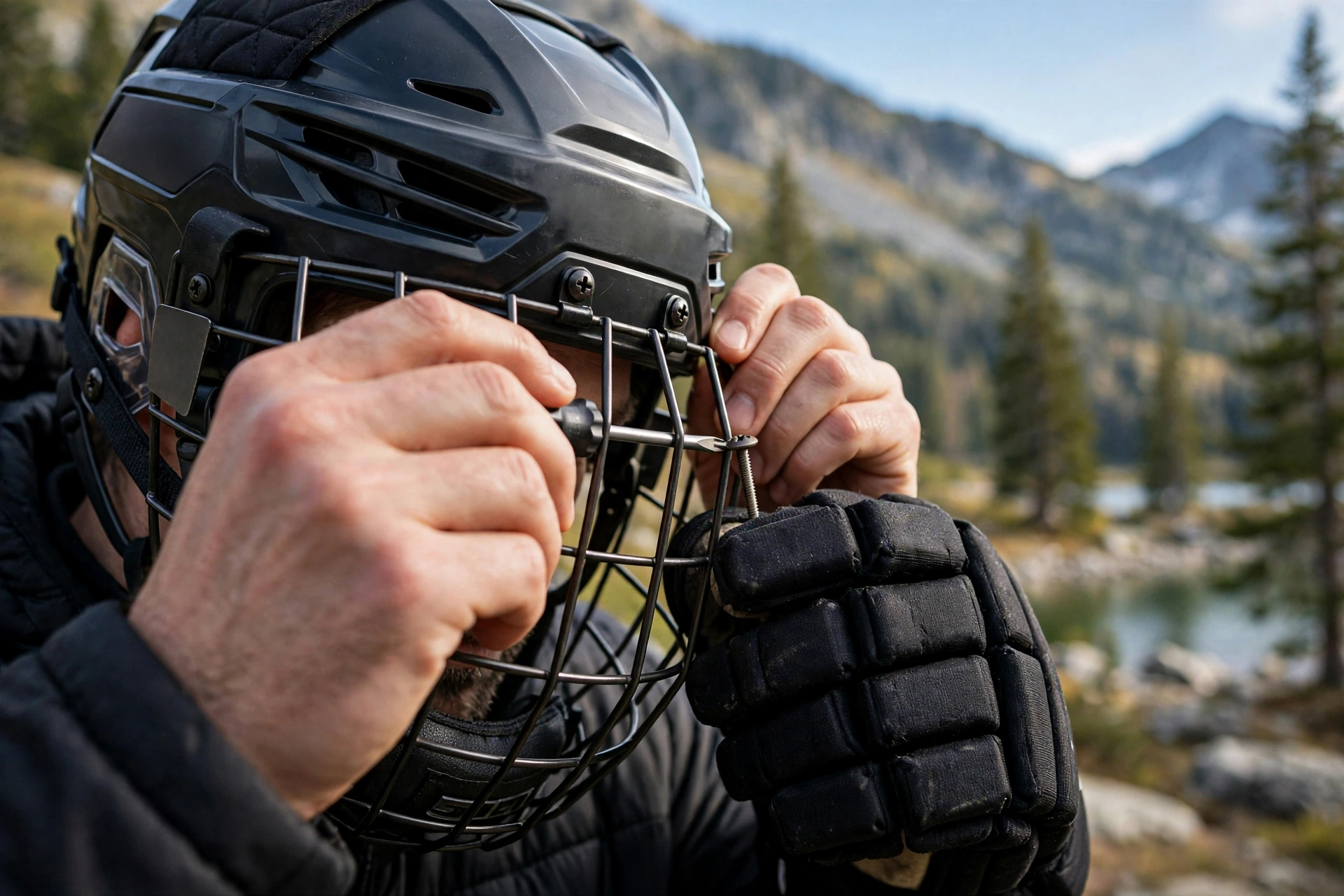
To adjust a hockey helmet cage, loosen the front mounting screws slightly, slide the cage until the chin cup rests centered under your chin, then tighten everything evenly and check your sight lines. A cage that sits too high leaves your chin and jaw exposed, and one that hangs too low blocks your vision and rattles. Ten minutes of careful adjustment fixes both problems.
Where should a cage sit on your face?
The chin cup is your reference point. With the helmet on and the chin strap done up, the cup should cradle your chin — not press into your jaw, not float below it, and not push up into your lower lip. The cage frame should sit close to your cheeks without touching them, and the top bar should be high enough that you are not looking through it at eye level.
Vertical position matters most. If the cage rides too high, your chin and jaw hang below the protection. Too low, and the bottom bar crosses your vision every time you glance down at the puck. Your eyes should sit roughly in the upper third of the cage opening, giving you a clear downward view through open space rather than through a row of bars.
Do this check wearing the helmet exactly as you play in it, including any mouthguard. A mouthguard changes your jaw position slightly, and a cage set without one can end up pressing once the guard is in. Skate a few easy strides or at least move your head through game motions — a cage that feels fine standing perfectly still can reveal a pressure point the moment you start looking up and down the ice.
How do you loosen and reposition the cage mounts?
Most cages attach with two screws at the front of the helmet plus straps or J-clips at the sides near the ears. With a screwdriver, loosen the front screws just enough that the cage can slide — half a turn usually does it. Do not remove them completely; a loose cage that stays captured is far easier to position than one you are holding in your hands.
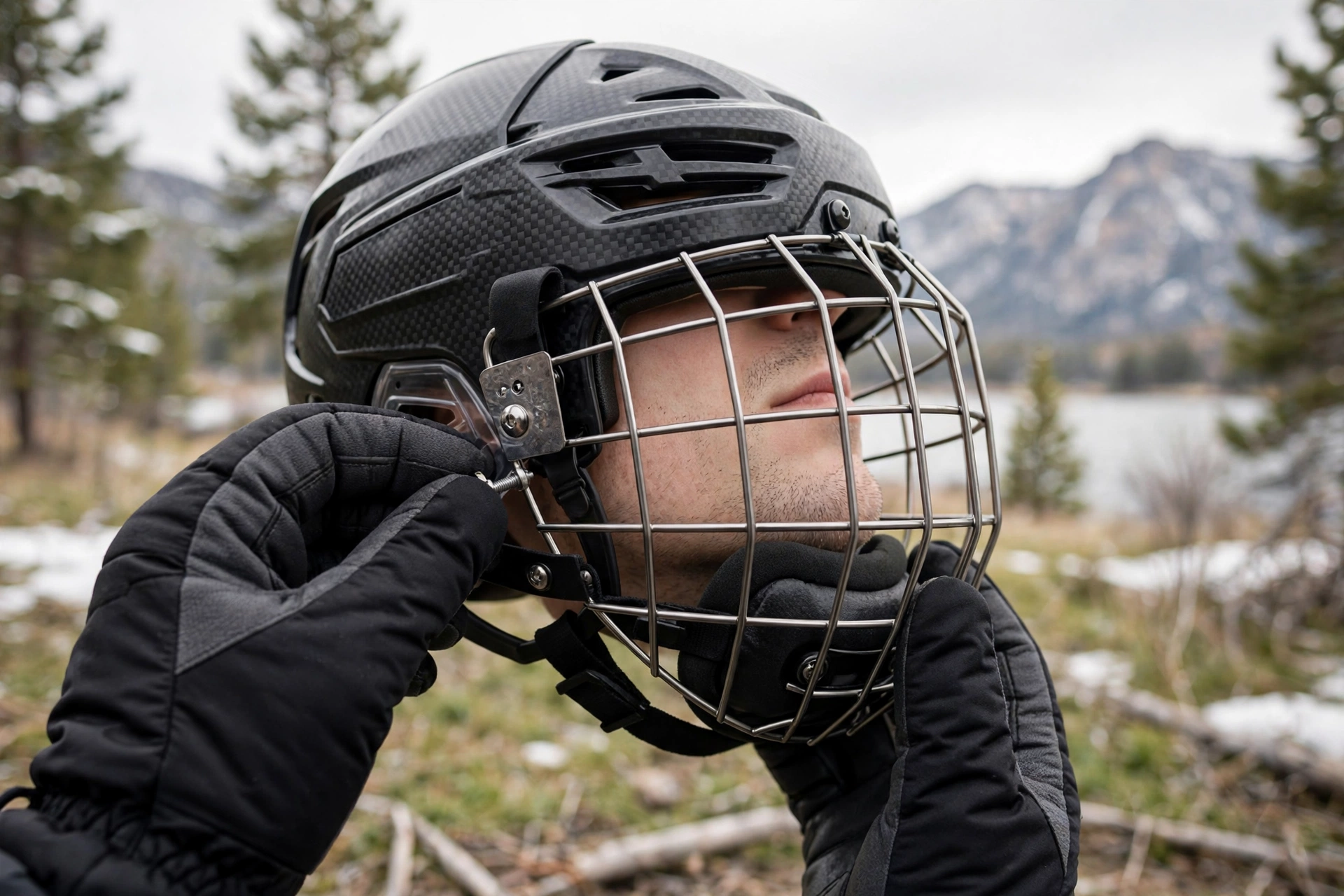
Slide the cage up or down until the chin cup lands in the right spot, keeping both sides level. Tilt matters as well: the cage should follow the angle of your face, not tip forward at the bottom. Once positioned, tighten the front screws alternately — a little on the left, a little on the right — so the cage does not twist as it clamps down. Then secure the side straps or J-clips, which stop the cage from flipping up or shifting sideways during play.
How do the chin cup and straps affect cage fit?
The cage and chin strap work as one system. If the strap is loose, the cage bounces and the cup drifts off your chin no matter how well the mounts are set. So adjust the cage position first with the strap undone, then do the strap up and fine-tune: the cup should stay centered when you open and close your mouth.
Some cages have a floating chin cup that slides along the bottom bar, while others are fixed in place. If your cup is adjustable, center it once the cage height is set. If the cup consistently sits to one side, check that the cage itself is not mounted crooked before blaming the cup — a twisted cage will pull even a perfectly centered cup off line.
How do you check vision lines and look for dangerous gaps?
With everything tightened, look straight ahead, then down, then side to side. You should be able to see the puck at your feet through the cage opening without a bar crossing the middle of your view. Turn your head sharply both ways — the cage should move with the helmet as a single unit, with no lag, wobble, or rattling.
Now check the gaps. There should be no wide opening between the bottom of the cage and your chest, and no gap at the sides between the cage and the helmet shell. Also run a hand around the frame to feel for loose screws or a strap that missed its clip. Have a teammate look at you from the front and sides; a second set of eyes spots an off-center cage far faster than a mirror does.
Also check how the cage behaves in a crouch and when you look up for a pass. In a low stance the bottom of the cage should still clear your chest protector comfortably, and looking up should not bring the top bar down across your eyes. Players who wear a throat guard or dangler should confirm the attachment still hangs freely and does not catch on the bottom bar when the head turns.
What are the signs your cage is the wrong size?
If you have run out of adjustment — screws at the end of their slots, straps on their last hole — and the cup still will not sit on your chin, the cage size does not match the helmet. Cages are sized to helmet shells, and a cage meant for a smaller shell will always ride wrong on a bigger one. Other signs include the cage pressing your cheeks, the frame hitting the helmet’s ear loops, or chronic rattling you cannot tune out.
Fit problems like these are worth solving properly rather than skating around, because protection only works when it stays in position — the same reason modern helmet fit and technology, explained in our guide to what MIPS is in helmets, depend on the helmet sitting exactly where it should. If the cage is right but the helmet itself feels wrong, get the helmet fitted first, then set the cage again.
Frequently Asked Questions
Should the chin cup touch your chin all the time?
Yes, lightly. The cup should rest against your chin with the strap snug, so the cage and helmet move with your head. A visible gap usually means the cage is sitting too low or the strap is too loose.
Can you bend a cage slightly to make it fit?
No. Bending weakens welds and changes the shape the cage was designed and tested in. Adjust through the mounts and straps only, and replace a cage that has already been bent in a collision.
Why does my cage rattle after I adjusted it?
Usually one mount ends up tighter than the other, or a side strap is loose. Re-loosen both front screws, seat the cage evenly, alternate tightening from side to side, and snug the side straps last.

Olivia
Writer at Helmet Today, covering helmet reviews, fit and riding safety.